
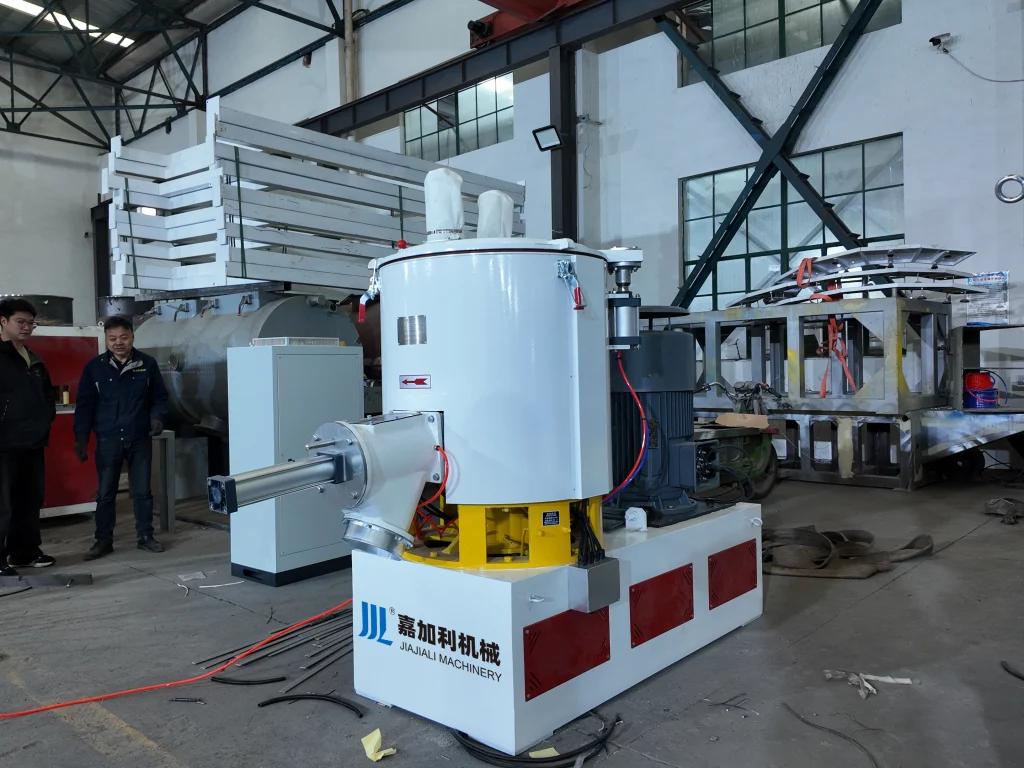
Ask any PVC pipe or profile manufacturer what the first machine on their compounding line is, and most will give the same answer: a high speed mixer.
Before powder becomes pellets, and before pellets become pipes, every ingredient — resin, stabilizer, filler, lubricant — has to be blended into a uniform, fluxed mix. That’s the job of the SHR high speed mixer, and it’s why this machine shows up at the start of almost every dry-blend line in the industry.
This guide covers how SHR mixers work, the full model range with real specs, what they’re actually used for, and the questions you should ask before buying one.
What Is an SHR High Speed Mixer?
An SHR high speed mixer (also called a high-speed hot mixer or PVC dry-blend mixer) is a batch mixing machine that blends plastic resin with additives at high rotor speeds. The friction between materials — plus optional electrical heating — raises the mix temperature quickly, producing a hot, homogeneous dry blend that’s ready for cooling and further processing.
“SHR” is the model prefix used by JIAJIALI for this series. Sizes range from a lab-friendly 10 liters to 1000 liters and above, so the same basic machine scales from R&D work to full production lines.
What makes it different from a simple agitator is the rotor speed and the result: a properly run high speed mixer produces a fluxed, uniform compound — not just a stirred pile of powder.
How a High Speed Mixer Works
The principle is called turbulent high-frequency stirring, and it’s simpler than it sounds:
1. **Loading** — Resin (PVC, PE, or PP), stabilizers, fillers, pigments, and other additives are loaded into the sealed mixing chamber.
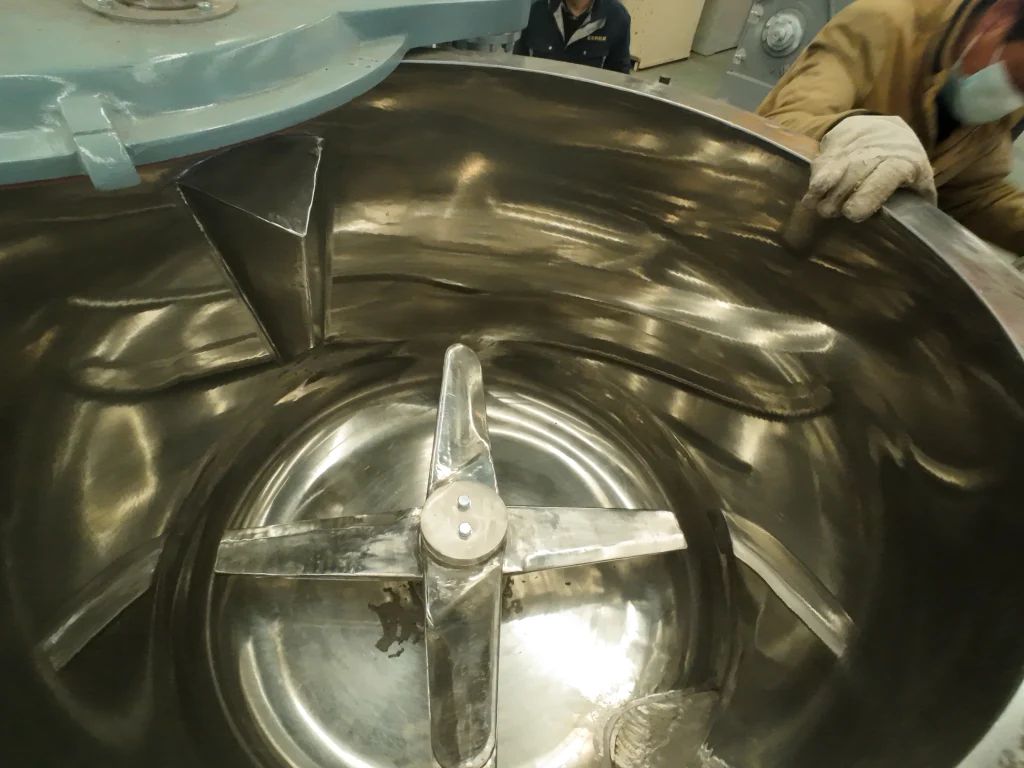
2. **High-speed agitation** — The rotor spins at up to 2000 rpm (depending on model), creating a turbulent vortex that lifts and folds the entire batch. There are no dead angles in the chamber, so every particle gets mixed, not just the ones near the blade.
3. **Friction heating** — At high speeds, particle-to-particle friction generates heat. For most formulations this self-friction heating is enough; for others, electrical heating provides additional temperature control.
4. **Uniform dispersion** — The turbulent flow breaks up agglomerates and disperses additives evenly through the resin, so the final dry blend has consistent composition batch after batch.
5. **Discharge** — Once the target temperature is reached, the batch is discharged (manually or pneumatically, depending on model) — usually into a [cooling mixer or an SRL-Z hot/cold mixing unit to bring the temperature down before storage or pelletizing.
Because the chamber is fully sealed and the barrel is made of wear-resistant alloy, contamination stays out and the machine keeps working cleanly for years — even with abrasive fillers like calcium carbonate in every batch.
SHR Series: Models & Technical Specs
The SHR series covers everything from small batch development to high-volume production. Here are the standard models:
| Model | Total capacity (L) | Effective capacity (L) | Motor power (kW) | Rotor speed (rpm) | Discharge |
| SHR‑10 | 10 | 7 | 3 | 0–2000 | Manual / Pneumatic |
| SHR‑25 | 25 | 18 | 5.5 | 0–1750 | |
| SHR‑50 | 50 | 35 | 11 | 0–1500 | |
| SHR‑100 | 100 | 70 | 22 | 0–1300 | Pneumatic |
| SHR‑200 | 200 | 140 | 45 | 0–1100 | |
| SHR‑300 | 300 | 210 | 55 | 0–950 | |
| SHR‑500 | 500 | 350 | 75 | 0–860 | |
| SHR‑800 | 800 | 560 | 110 | 0–740 | |
| SHR‑1000 | 1000 | 700 | 132 | 0–640 |
A few notes on reading this table:
– **Effective capacity is what matters.** The total capacity is the chamber volume; the effective capacity is the batch size you can actually run. Don’t let a supplier quote you on total capacity — spec your line on effective capacity.
– **Bigger machines turn slower.** Rotor speed drops as capacity grows. That’s normal — larger batches need more torque, not more rpm. What you want is the turbulent vortex at any size, not a specific rpm number.
– **SHR-10 to SHR-50 are the entry range** — popular for small workshops, color masterbatch development, and lab testing.
– **SHR-200 to SHR-500 are the workhorses** of PVC pipe and profile lines.
– **SHR-800 and SHR-1000** are for high-volume compounding plants that run around the clock.
All models are CE and ISO9001 certified, with anti-wear barrel design as standard. Custom sizes from 50L to 2000L are available — if your line needs something between or beyond the standard range, the JIAJIALI team can configure it.
hat Is an SHR Mixer Used For?
The SHR high speed mixer is first and foremost a **pre-mixing machine** for compounding lines. Typical applications:
– **PVC pipe & profile compounding** — dry-blending PVC resin with stabilizers, fillers, and lubricants before extrusion. This is the classic application.
– **PVC pelletizing** — producing fluxed dry blend as feedstock for a [PVC granulation unit](https://jiajialimachinery.com/products/pvc-granulation-unit/).
– **PE/PP compounding** — blending polyolefins with additives, masterbatch, or fillers before extrusion or injection.
– **Masterbatch & color mixing** — uniform pigment dispersion without agglomeration, critical for consistent color.
– **WPC compounding** — mixing wood fiber and plastic with coupling agents for WPC profile production.
– **Recycling lines** — homogenizing regrind with virgin material and additives.
In short: anywhere you need powder or granules blended fast, uniformly, and with controlled heat, an SHR mixer fits.
SHR vs. Other Mixers: Which One Do You Actually Need?
Buyers often confuse the different mixer types. Here’s the short version:
– **SHR high speed mixer (this machine)** — hot mixing, friction heating, fast cycle, for fluxing dry blends. Usually the first stage of a compounding line.
– **SRL-Z hot/cold mixing unit** — pairs a high speed hot mixer with a cooling mixer, so you get a complete hot-cold cycle without material sitting hot. If you’re building a full compounding line, this is the typical setup. See the SRL-Z unit.
– **SH vertical mixer** — a large-capacity vertical blender for gentle, low-temperature mixing of dry materials. Good for blending finished compounds or multiple ingredients without heating. [More on the SH vertical mixer](https://jiajialimachinery.com/products/sh-vertical-mixer/).
– **Horizontal ribbon mixer** — gentle mixing for powders and granules that shouldn’t be heated or sheared aggressively.
Rule of thumb: if you need heat and fluxing (PVC compounding), go SHR or SRL-Z. If you need gentle cold blending at volume, an SH vertical or ribbon mixer is the better fit. A lot of plants end up with both — an SHR for compounding and a vertical mixer for blending.
Buying Guide: 8 Questions to Ask a High Speed Mixer Supplier
High speed mixers look similar from the outside. The differences are inside — and they show up in your batch consistency and your maintenance costs. Ask these before you commit:
1. What’s the effective capacity, not the total?
Make sure the quoted batch size matches your production target. A 500L total machine is a 350L batch machine.
2. Is the barrel wear-resistant?
Fillers like calcium carbonate are abrasive. A standard steel barrel will wear, contaminate your mix, and need replacement. Insist on anti-wear alloy construction.
3. Can I control the temperature?
Self-friction heating is standard, but temperature control matters for heat-sensitive formulations. Does the machine have electrical heating and accurate temperature monitoring?
4. How is the batch discharged?
Pneumatic discharge is faster and safer for large machines; manual discharge is fine for lab sizes. Don’t find out after installation.
5. Is the seal system dust-tight?
A sealed chamber keeps powder in the mix and out of the air. Poor sealing means dust, contamination, and a messy workshop.
6. What’s the control system?
Timer, temperature display, and automatic discharge control should be standard on production-size machines. Full PLC control is worth asking about for repeatable recipes.
7. What happens when the rotor wears?
Are blades and liners replaceable parts you can buy later? What’s the typical wear life with your materials?
8. Who installs and trains?
Insist on on-site commissioning and operator training. A high speed mixer is simple to run, but setup and safety briefings matter.
FAQ
Q: What is the difference between a high speed mixer and a low speed mixer?
A: Speed and purpose. High speed mixers run at hundreds to thousands of rpm to create turbulent mixing and friction heat — used for fluxing and compounding dry blends. Low speed mixers (vertical, ribbon, drum) blend gently at low temperatures and are used when you don’t want to heat or shear the material.
Q: What temperature does an SHR high speed mixer reach?
A: Depends on the formulation and cycle time. In PVC dry-blend applications, batches commonly reach 100–130°C from self-friction alone, at which point the mix fluxes and is discharged into a cooling mixer. Electrical heating is available where more control is needed.
Q: How long is a mixing cycle?
A: Typically 6–12 minutes per batch for standard PVC formulations, depending on batch size, target temperature, and recipe. That’s why one high speed mixer can feed a surprisingly large extrusion line.
Q: Can an SHR mixer handle calcium carbonate filler?
A: Yes — with the right barrel. High filler loads are standard in PVC compounding, and the anti-wear alloy barrel is designed exactly for this. Make sure your supplier knows your filler percentage before quoting.
Q: Do I need a cooling mixer with it?
A: For PVC and other heat-sensitive materials, yes. Hot blend straight out of the mixer will degrade if it sits. An SRL-Z hot/cold unit combines both stages so the material is cooled to storage temperature before it reaches the extruder or pelletizer.
Q: What’s the price range for an SHR high speed mixer?
A: It varies widely with capacity, configuration, and control level — from a few thousand USD for small models to tens of thousands for large production units. Get a quote based on your effective capacity requirement and ask what’s included (control, heating, discharge, installation).
Ready to Build Your Compounding Line?
The SHR high speed mixer is the starting point of almost every plastic compounding line — and the difference between a uniform, consistent dry blend and a batch that fights you at the extruder.
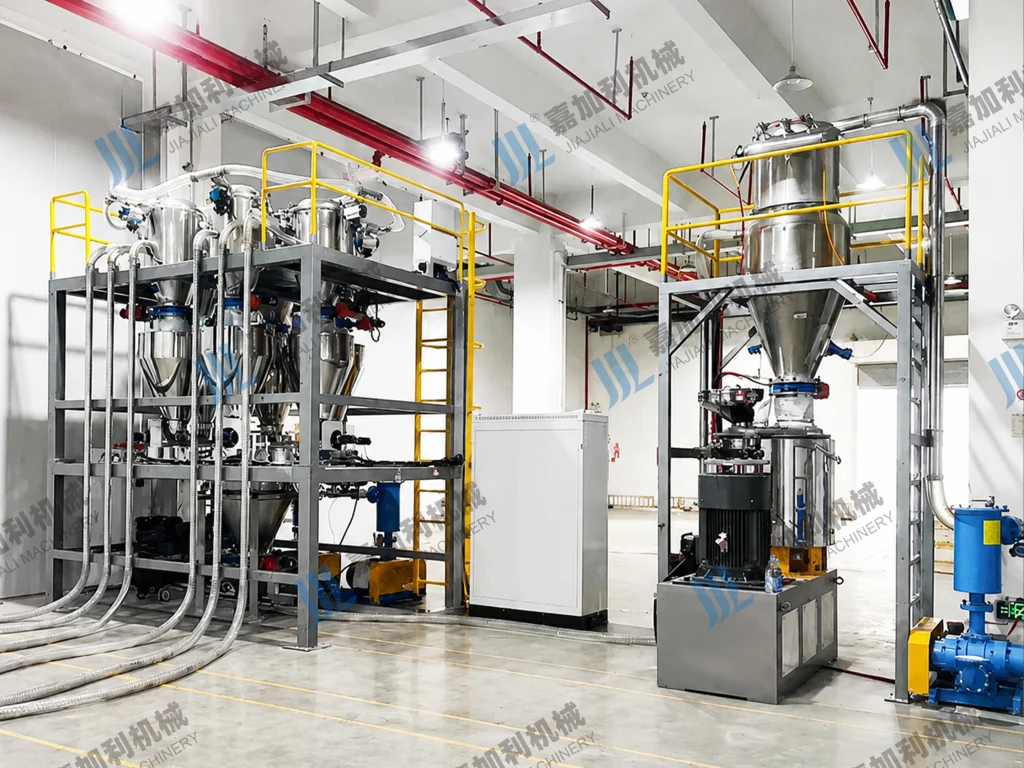
JIAJIALI has been building mixing and conveying equipment for more than 20 years. Every SHR mixer is CE and ISO9001 certified, with anti-wear barrels, sealed chambers, and capacities from 10L to 1000L+ — plus complete [automatic compounding systems](https://jiajialimachinery.com/products/automatic-compounding-system/) if you want the whole line handled by one supplier.
Send us your formulation and target capacity— we’ll recommend the right model, with specs and pricing within 24 hours.