
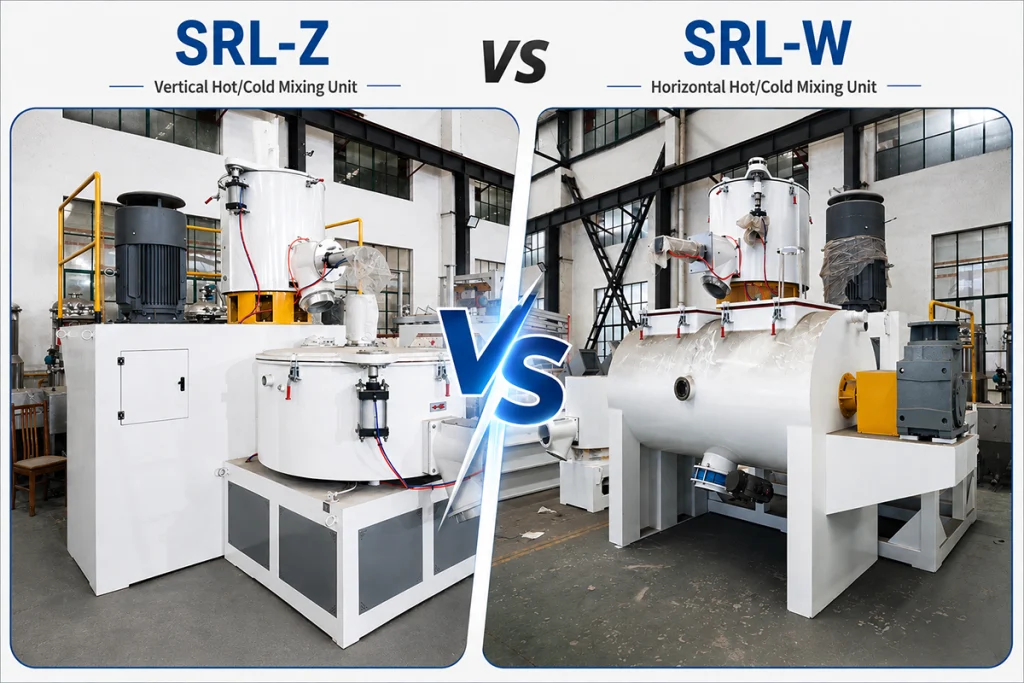
If you’ve already chosen a high speed mixer, your next decision is how to cool the batch down — because a hot PVC dry blend can’t go straight into storage or extrusion. It has to be cooled to below 40–50 °C, or the powder will cake, degrade, and ruin your pellet quality.
That’s the job of the hot/cold mixing unit: a hot mixer to flux the blend, plus a cooling mixer that brings the temperature down fast before the next step. The two most common configurations are the SRL-Z (vertical) hot cold mixing unit and the SRL-W (horizontal) hot cold mixing unit for PVC compounding.
Both do the same fundamental job. The difference is in layout, footprint, and how they fit your plant — and picking the wrong one usually means wasted floor space or a ceiling that’s too low.
This guide explains exactly what each configuration is, compares them side by side, and gives you a checklist to choose the right one.
What Is an SRL-Z Hot/Cold Mixing Unit?
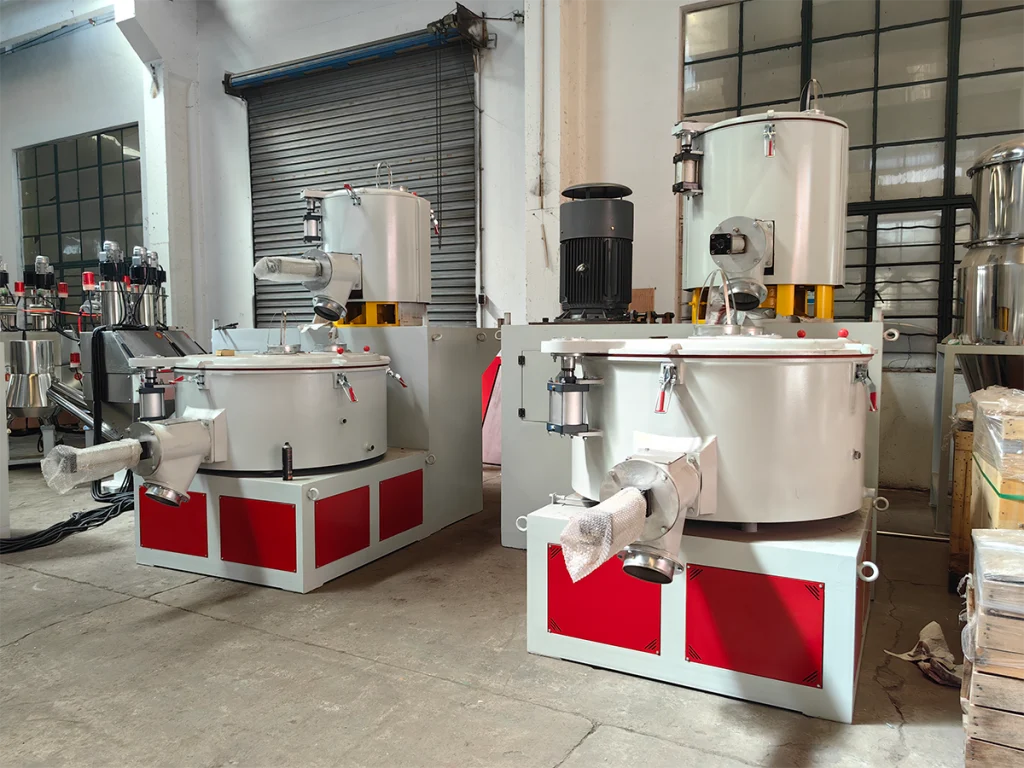
The SRL-Z is the classic vertical hot/cold mixing unit. It combines two mixers in one system:
Hot mixing stage (top) — an SHR-style high speed mixer that blends resin, stabilizer, filler, and lubricant under turbulent agitation. Friction heats the batch to the fluxing temperature (typically 100–130 °C depending on formulation).
Cold mixing stage (bottom) — a large vertical cooling mixer with a water-jacketed vessel and a slowly rotating agitator. The hot batch drops straight down into it, gets stirred against the cooled wall, and is discharged once it drops below ~40–50 °C.
The whole cycle is controlled by a PLC with automatic temperature control: load → mix to set temperature → discharge to cooling mixer → cool to set temperature → discharge to storage or the next machine.
“Z” refers to the vertical layout — the hot mixer sits directly above the cooling mixer, so the material moves by gravity with no transfer screws between stages.
What Is an SRL-W Horizontal Mixing Unit?
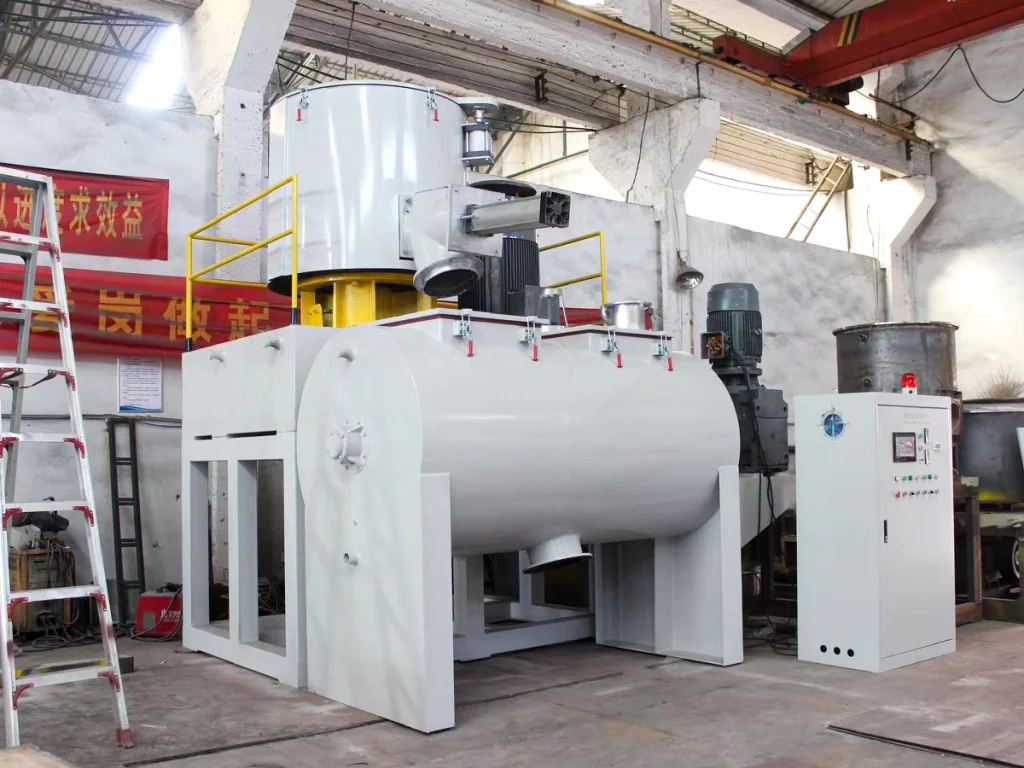
The SRL-W is the horizontal version of the same idea. Instead of stacking the hot mixer on top of the cooling mixer, both vessels are mounted horizontally, side by side, with material transferred between them by a screw or pneumatic system.
The horizontal design changes three things in practice:
Total height drops dramatically — the SRL-Z’s stacked design needs ~5–6 m of headroom; the SRL-W usually fits in a single-story building.
The plant layout is wider instead of taller — you trade vertical space for floor space.
Transfer between stages is active (screw/auger) rather than gravity-fed, which adds one moving part but gives you more control over when and how the batch moves.
For the same batch size, an SRL-W and an SRL-Z produce the same quality dry blend. The real difference is where the machine is going to live.
SRL-Z vs SRL-W: Side-by-Side Comparison
| Factor | SRL-Z (Vertical) | SRL-W (Horizontal) |
|---|---|---|
| Layout | Hot mixer stacked above cooling mixer | Hot + cold mixers arranged horizontally |
| Height | Taller | Lower overall height |
| Footprint | More compact floor footprint | Wider floor footprint |
| Material transfer | Gravity transfer | Mechanical transfer |
| Typical capacity | Depends on model | Depends on model |
| Best for | Plants with sufficient ceiling height | Low-ceiling plants and retrofit projects |
| Maintenance access | Hot mixer may require platform access | More equipment can be accessed at floor level |
| Layout flexibility | Compact | More flexible for low buildings |
SRL-Z Series: Typical Specs
Standard SRL-Z units pair a hot mixer with a cooling mixer roughly 4–5× its volume:
| Model | Hot Mixer Capacity | Cooling Mixer Capacity | Hot Mixer Motor | Cooling Mixer Motor | Approx. Batch |
|---|---|---|---|---|---|
| SRL-Z 200/1000 | 200 L | 1000 L | 45 kW | 15 kW | 120–140 kg |
| SRL-Z 300/1200 | 300 L | 1200 L | 55 kW | 18.5 kW | ~200 kg |
| SRL-Z 500/2000 | 500 L | 2000 L | 75 kW | 22 kW | ~300 kg |
| SRL-Z 800/2500 | 800 L | 2500 L | 110 kW | 30 kW | ~450 kg |
*Typical industry values — confirm exact figures with the supplier for your line.*
SRL-W Series: Typical Specs
SRL-W units follow the same hot/cold volume ratio but in horizontal vessels:
| Model | Hot Mixer Capacity | Cooling Mixer Capacity | Hot Mixer Motor | Cooling Mixer Motor |
|---|---|---|---|---|
| SRL-W 300/1500 | 300 L | 1500 L | 55 kW | 22 kW |
| SRL-W 500/2500 | 500 L | 2500 L | 75 kW | 30 kW |
| SRL-W 800/3000 | 800 L | 3000 L | 110 kW | 37 kW |
*Typical industry values — confirm exact figures with the supplier.*
Which One Should You Choose?
Choose the SRL-Z (vertical) when:
- Your building has normal industrial ceiling height (5 m+).
- You want the most compact footprint for the batch size.
- You’re running a classic PVC pipe, profile, or pelletizing line — this is the industry default.
- You want gravity transfer (fewer moving parts, less to maintain).
Choose the SRL-W (horizontal) when:
- Your ceiling is low — a single-story workshop, a mezzanine, or a retrofit into an existing building.
- You’re planning a high-capacity line where vertical stacking would get awkward.
- You want both vessels accessible from the floor for cleaning and maintenance.
A common rule of thumb: if the plant was designed around extrusion, go SRL-Z. If you’re squeezing the compounding section into a building that wasn’t designed for it, go SRL-W.
The Buying Checklist
1. Measure your ceiling height first. It decides the question before price does.
2. Confirm effective capacity, not total capacity. A “300 L hot mixer” usually runs 200–220 kg batches — know the real number.
3. Ask about the cooling rate. How many minutes to cool a full batch from 120 °C to below 45 °C? That number sets your line’s cycle time.
4. Check the transfer system. On SRL-W units, ask about screw wear and whether the auger is easy to service.
5. Verify automation. PLC control with automatic temperature cut-over is standard — confirm it’s included, not an extra.
6. Ask about the matching SHR hot mixer. The hot stage of both units is effectively an SHR high speed mixer — make sure the pair is sized and tuned as one system, not two random machines bolted together.
FAQ
Q: Can an SRL-Z be installed outdoors or in a low shed?
A: The SRL-Z needs ~5–6 m of vertical clearance for the hot mixer and ducting. If your shed is lower, the horizontal SRL-W is the safer choice.
Q: Is the dry blend from an SRL-Z ready for extrusion directly?
A: Yes — after cooling below ~40–50 °C the blend is stable for storage or direct feeding to an extruder or pelletizing line. Add a central feeding system if you want automatic dosing from storage to multiple machines.
Q: What’s the typical cycle time for one batch?
A: Roughly 8–15 minutes total (hot mix ~6–10 min, cool ~5–8 min), depending on formulation and model. The cooling stage is usually the bottleneck, which is why cooling mixer volume is 4–5× the hot mixer.
Q: Can the SRL-W handle the same formulations as the SRL-Z?
A: Yes. Hot/cold mixing is the same process in both — the configuration only changes the plant layout.
Q: What maintenance do these units need?
A: Regular checks on the hot mixer rotor blades (wear from fillers like calcium carbonate), cooling jacket water flow, seals on both vessels, and the transfer screw on SRL-W units. With proper maintenance, these machines run 15+ years.
Still deciding?The JIAJIALI team builds both SRL-Z and SRL-W units and can recommend a configuration from your plant drawings — send us your ceiling height, batch size, and line speed, and you’ll get a concrete layout proposal.