
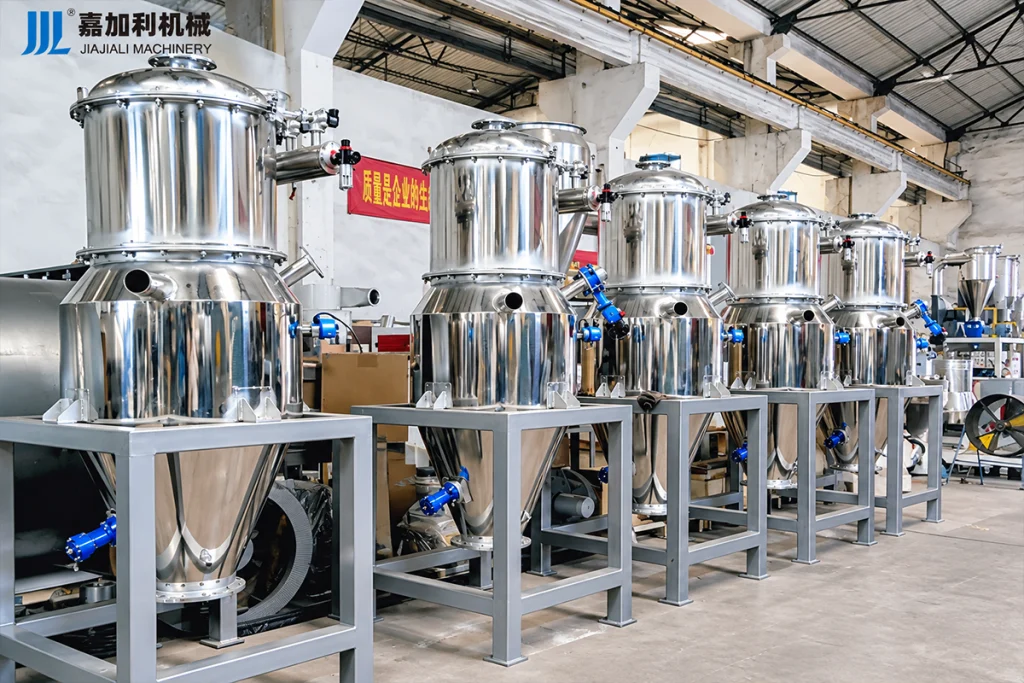
Every injection molding machine, extruder, and mixer has the same quiet problem: how does the material get from the bag or drum into the machine hopper?
Manual loading means an operator hauling 25 kg bags up a ladder, hour after hour. Open dumping means dust, spilled pellets, and contamination. And in a modern shop running multiple machines, manual loading stops being a chore and starts being the bottleneck — machines waiting on material are machines not making money.
A vacuum automatic feeder (also called a vacuum loader) removes the human from that loop entirely. This guide explains how these units actually work, the two main types, and how to know when you need one — or when you need several working as one central feeding system.
What Is a Vacuum Automatic Feeder?
A vacuum automatic feeder is a device that uses suction to convey plastic material — pellets, granules, regrind, or free-flowing powder — from a source point to a destination hopper. It’s the workhorse of “machine-side” material loading: sit one on top of an injection molding machine and it keeps the machine hopper full automatically, on demand.
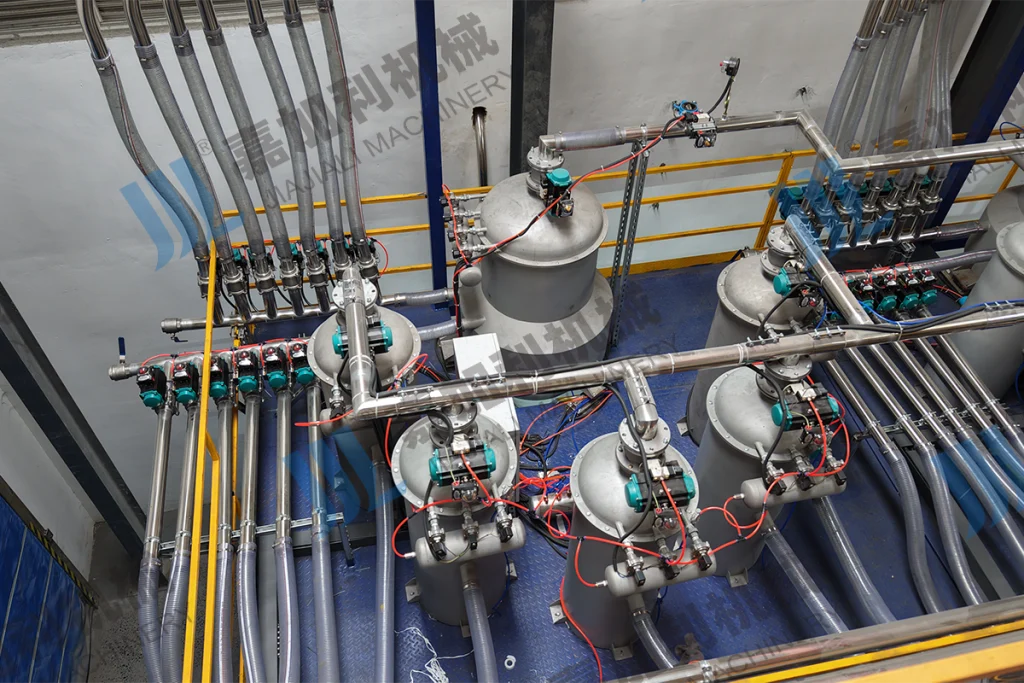
The basic parts are simple:
1. Vacuum source — creates the negative pressure that pulls material through the line.
2. Receiving hopper with filter — where the conveyed material lands and the air is separated from the material.
3. Level control — tells the feeder when the machine hopper is full (or the receiving chamber is loaded) so the cycle can stop.
4. Discharge valve — releases the collected material into the machine hopper.
5. Pickup assembly — a lance or probe with a flow-control valve at the source end (bag, drum, gaylord, or silo).
How the Conveying Cycle Works
A vacuum feeder runs in short, repeated cycles. Here’s one cycle:
1. Suction phase
The vacuum source turns on. Air is drawn through the filter, creating negative pressure in the receiving hopper and the conveying line.
2. Loading
Atmospheric pressure at the pickup point pushes material into the line, and the airstream carries it to the receiving hopper. In dilute-phase conveying, the material travels suspended in the air at high velocity.
3. Separation
The material drops out of the airstream and collects in the hopper; the air passes through the filter and out through the vacuum source.
4. Filter cleaning
A reverse pulse of air (or a mechanical shaker) cleans the filter so it doesn’t clog — critical when conveying powders.
5. Discharge
When the level sensor says the chamber is loaded (or the machine hopper is low), the vacuum stops and the discharge flap opens, dropping the material into the machine hopper below.
6. Repeat
The cycle restarts whenever the destination needs more material.
The beauty of this design is that it’s on-demand : the feeder only runs when the machine actually needs material, so a single unit can keep up with the intermittent consumption of a molding machine without overfilling.
Venturi or Blower: Which Vacuum Source?
The vacuum source is the biggest decision, and it splits feeders into two camps:
| Feature | Venturi (compressed air) | Electric blower (regenerative/roots) |
|---|---|---|
| How it works | Compressed air through a venturi nozzle creates vacuum | Electric blower generates continuous suction |
| Capacity | Low – medium (up to ~300–500 kg/h typical) | Medium – high (hundreds to several t/h) |
| Conveying distance | Short (a few meters) | Longer (tens of meters, with more bends) |
| Energy cost | High air consumption; expensive if compressed air is scarce | Lower running cost at scale; uses electricity |
| Best for | Single machines, occasional loading, retrofit | Continuous or multi-point conveying, central systems |
| Maintenance | No moving parts in the head | Blower needs periodic servicing |
The rule of thumb: for one or two machines close to the material source, a compressed-air venturi feeder is cheap and reliable. Once you’re conveying further, running many loaders, or moving high volumes, electric blowers (usually one shared vacuum pump in a [central system](https://jiajialimachinery.com/products/central-feeding-system/)) win on operating cost.
JIAJIALI ZKF Series Vacuum Feeder
JIAJIALI’s standalone ZKF series feeders sit in the electric camp: the vacuum is generated by the unit’s own integrated electric motor, not by plant compressed air. That makes them a good fit for shops without a large air supply, and they’re designed to mount directly on injection molding machines and extruders of various sizes.
Pellets vs Powders: What Changes
Pellets and granules
Pellets and granules are forgiving: they flow freely, don’t pack, and don’t clog filters badly. A simple screen or sieve at the receiving point catches stray fines, and even a basic feeder handles them well.
Powders
Powders change the design requirements:
- The filter area must be larger and cleaned aggressively (reverse-pulse air jet), because powder cakes on filter media.
- Conveying velocity and air-to-material ratio must be tuned — too slow and powder drops out and blocks the line; too fast and it heats up or degrades.
- Bridges and blockages are a real risk at the pickup point and in the hopper cone; flow aids may be needed.
If you handle both pellets and powders — common in compounding shops — make sure the feeder (and its filter) is specified for the powder case, because that’s the harder one.
When Do You Need One Feeder — or a Whole System?
Ask three questions:
1. How many machines need loading?
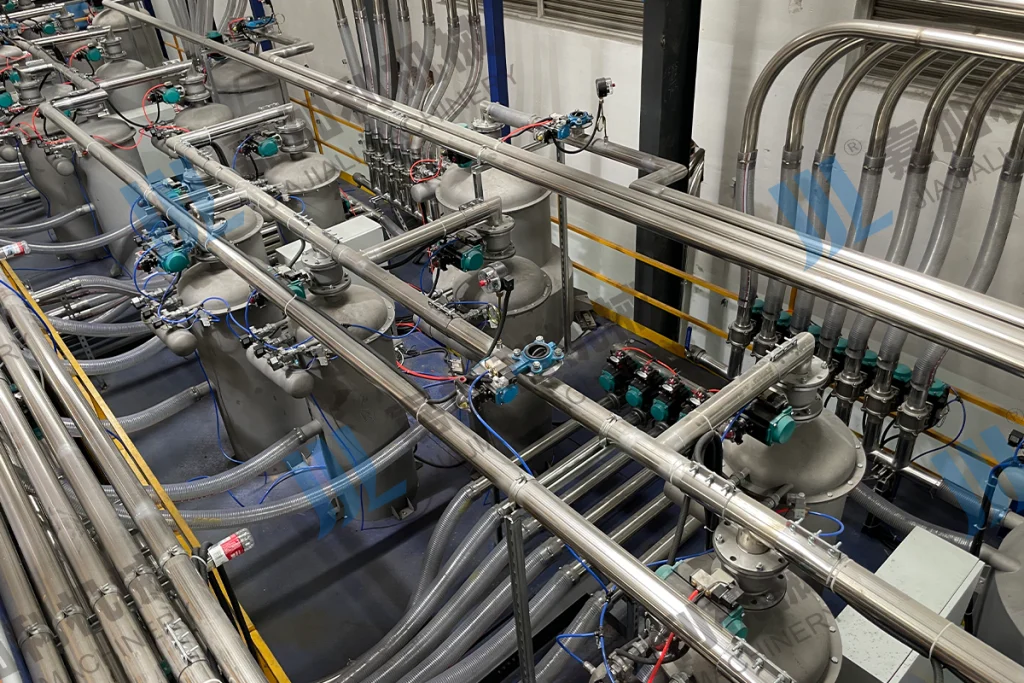
One or two machines → individual machine-side feeders. Five, ten, or twenty machines → a [centralized feeding system](https://jiajialimachinery.com/products/central-feeding-system/), where one vacuum pump and control system feed multiple stations, each dropping material into its machine hopper on demand.
2. Where does the material start?
Bags or drums next to the machine → simple feeders with pickup lances. Bags on a [ton bag discharging station](https://jiajialimachinery.com/products/ton-bag-discharging-station/), or silos and dryers in a material room → longer conveying runs that need proper pipe sizing and a stronger vacuum source.
3. Is drying involved?
Many molding plants convey into drying hoppers, then from the dryer to the machine. The feeder layout (loader on the dryer, dryer discharging to the machine) affects the whole arrangement.
For a compounding or mixing line, vacuum feeders also load the mixers themselves — delivering weighed or measured ingredients to the SHR high speed mixer hopper automatically, instead of an operator tipping bags.
Typical Specifications: JIAJIALI ZKF Series
Feeding capacity is not one number — it depends on how far the material has to travel. JIAJIALI’s ZKF series of vacuum automatic feeders shows the pattern clearly:
| Model | ZKF-300 | ZKF-500 | ZKF-800 | ZKF-1000 |
|---|---|---|---|---|
| Motor power (kW) | 2.2 | 5.5 | 7.5 | 11 |
| Capacity at 5 m (kg/h) | 300 | 500 | 800 | 1,000 |
| Capacity at 10 m (kg/h) | 150 | 300 | 450 | 700 |
| Capacity at 15 m (kg/h) | — | — | 360 | 500 |
| Conveying hose ID (mm) | 31 | 51 | 63 | 63 |
| Suction air hose ID (mm) | 51 | 63 | 76 | 76 |
Two things in that table are worth remembering. First, capacity falls as distance grows — the ZKF-800 delivers 800 kg/h at 5 m but only 360 kg/h at 15 m. That’s why a good supplier asks about your exact layout, not just your machine’s consumption. Second, these are self-contained, motor-driven units (2.2–11 kW) with no compressed-air hookup required — one power cable and a hose, and they’re ready to feed.
Buying Checklist
1. Define the conveying rate honestly.
“Machine consumes 50 kg/h” is not the spec — the feeder must deliver in short bursts fast enough to keep the hopper full during peak consumption. Work out the peak demand, then add margin.
2. Measure distance and bends, not just meters.
Every bend adds resistance. The real spec is distance + number of bends + vertical lift, and suppliers need all three to size the vacuum source and line.
3.Name your material precisely.
Bulk density, particle shape, and moisture content change everything — a feeder sized for pellets may be useless for the same weight of powder.
4. Ask about filter cleaning and access.
The filter is the maintenance item. Reverse-pulse cleaning and a filter you can change in minutes matter more than brand name.
5. Think about tomorrow.
If you’ll add machines later, a centralized vacuum system is easier to extend than a pile of standalone feeders. Design the material flow now and the feeder follows.
FAQ
Q: How is a vacuum automatic feeder different from a conveyor belt or screw conveyor?
A: A vacuum feeder uses air to pull material through a closed pipe — no moving parts in contact with the material, no dust escape, and it can lift material vertically and snake around obstacles. Belts and screws are mechanical and open; they suit different layouts.
Q: Can it handle powder as well as pellets?
A: Yes, but the unit must be specified for powder: more filter area, reverse-pulse cleaning, and tuned air settings. Don’t assume a pellet-rated feeder will handle powder.
Q: What’s the maximum conveying distance?
A: A single machine-side venturi feeder is practical over a few meters. Blower-driven systems (and central systems) routinely convey 30–100+ meters with proper line sizing — but distance always trades against rate.
Q: Does the feeder damage the material?
A: For pellets, no — dilute-phase conveying is gentle at correct settings. Fragile materials (coated pellets, regrind flakes) need velocity control and possibly vacuum conveying at lower speeds; tell the supplier if material degradation is a concern.
Q: Can one vacuum feeder serve two machines?
A: Technically yes with a diverting valve, but it’s usually a bad idea — a feeder can only load one destination at a time, and two machines rarely need material on the same schedule. For multiple machines, individual feeders or a proper central system are the reliable answers.
Q: How do I know which size I need?
A: Send the supplier three numbers: peak consumption rate (kg/h), conveying distance with number of bends, and material type with bulk density. That’s enough for a first sizing — and a good supplier will ask for exactly those three things.
Want the full picture? A vacuum feeder is the building block of larger automation. See how multiple feeders and stations combine into a centralized feeding system for injection molding, or how feeding ties into weighing in an automatic dosing and batching system. Send your machine list and layout to the JIAJIALI team for a feeder and line configuration.