
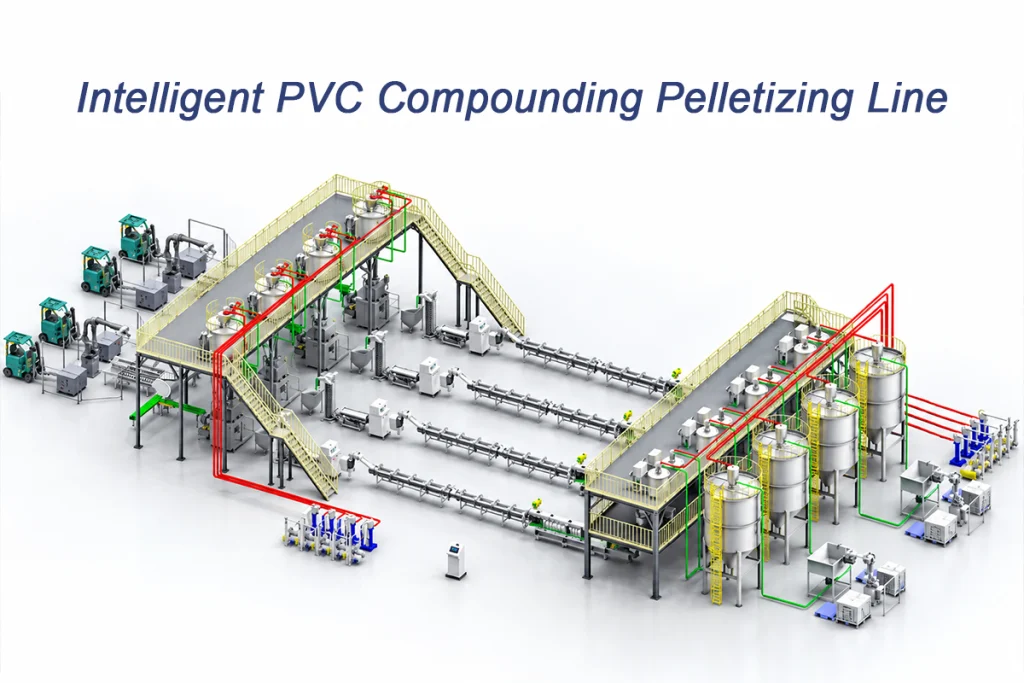
A PVC pelletizing line looks simple from the outside: feed compound in, get pellets out. In practice, the difference between a line that runs for years and one that fights you every shift comes down to a handful of specification decisions made before the order — screw design, cutting method, cooling, and how the line is matched to the material you actually run.
This checklist walks through those decisions in the order a buyer should think about them.
First, Define What the Line Has to Do
Before comparing suppliers, write down four things:
- Material source. Virgin PVC compound, recycled PVC, or both? Rigid or plasticized? Pipe grade, cable compound, profile compound?
- Output. Kilograms per hour at your realistic formulation — not the supplier’s best-case number on easy material.
- Product form. Pellets for sale, for your own extrusion lines, or for compounding/blending?
- Operating pattern. One product continuously, or frequent changeovers between formulations and colours?
Most disappointing installations trace back to one of these being vague at the quotation stage. “PVC pelletizing line, 500 kg/h” is not a specification; it is the start of a conversation.
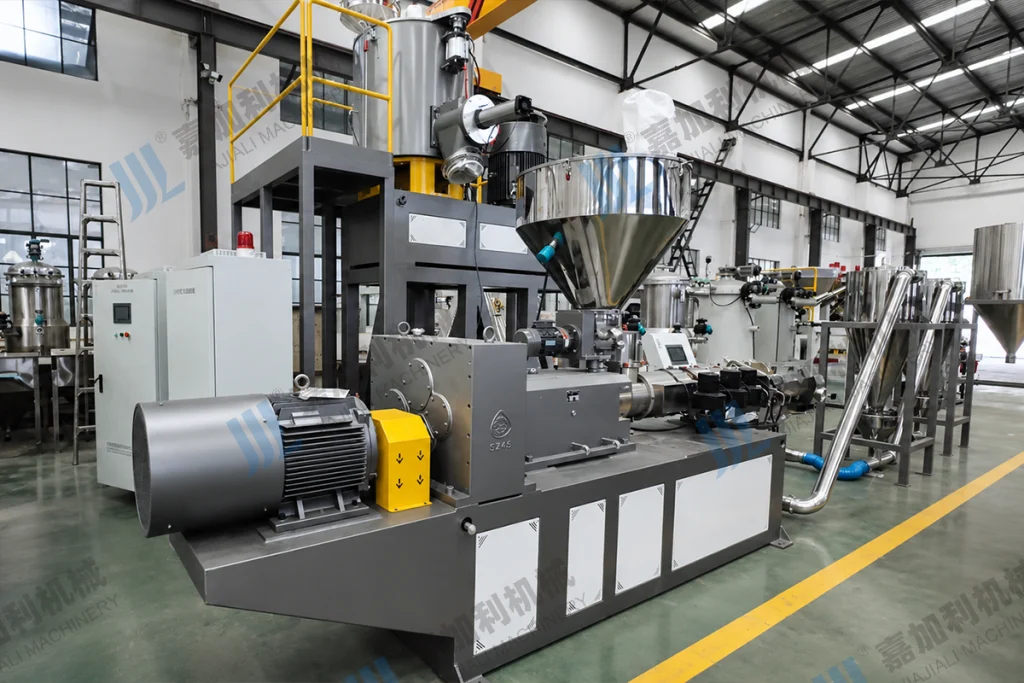
Check 1: Screw Design Matched to PVC
PVC is thermally sensitive. It degrades if it sits too long, gets too hot, or sees too much shear. That is why a PVC pelletizing line cannot simply use a general-purpose screw.
Look for:
- A screw geometry designed for PVC, with compression and mixing sections that plasticize fully without overheating.
- Low-temperature extrusion capability, so the melt leaves the die in a stable state rather than on the edge of decomposition.
- Barrel heating and cooling that can hold tight zone temperatures, not just heat up.
- Wear protection if you run filled or recycled material.
Ask the supplier what screw they would recommend for your specific formulation and why. A supplier who answers with a model number instead of a reasoning about your material is not really specifying.
Check 2: Pelletizing Method — Strand or Hot-Cut
This is the biggest process choice on the line.
| Strand pelletizing | Hot-face / water-ring pelletizing | |
| How it works | Polymer strands cool in a water bath, then are cut by a strand pelletizer | Pellets are cut at the die face, often under water |
| Pellet shape | Cylindrical, uniform | Round, smooth |
| Floor space | Larger (water bath, dryers) | Compact |
| Changeover | Slower | Faster |
| Best for | Rigid PVC, engineering compounds, consistent cylindrical pellets | High output, round pellets, recycling, formulations that string badly |
| Watch out for | Strand breakage, water carry-over | Die freeze-off, cutter wear, water temperature control |
For rigid PVC pipe and profile compound, strand pelletizing is the traditional and often the more forgiving choice. For recycled PVC and higher outputs, hot-cut systems are compact and produce a nicer round pellet — but they demand better temperature control at the die and a well-designed water circuit.
Ask for sample pellets from a line running material similar to yours, and check size distribution, dust and surface quality — not just the shape in a brochure photo.
Check 3: Output at Your Formulation, Not on Paper
Supplier capacity figures are usually quoted at a favourable formulation. Your material may be filled, recycled, or higher viscosity, and the achievable output can drop.
Ask:
- What output is guaranteed at my formulation, with a written acceptance test?
- What is the output derating for recycled or heavily filled material?
- Is the quoted output limited by the extruder, the die, the cutter, or the cooling section?
That last question matters. If the cutter or cooling is the bottleneck, buying a bigger extruder does not help.
Check 4: Cooling and Water Circuit
Pellet quality is largely a cooling story. If pellets are cut too hot or cooled unevenly, you get deformation, agglomeration and dust.
Check:
- Cooling capacity sized for your output and ambient temperature. In hot climates, this needs explicit attention.
- Water temperature control, not just a tank and a pump.
- Dryer and dewatering adequate for the pellet size and output.
- Filtration on the water circuit — fines accumulate and eventually clog nozzles and heat exchangers.
A line that runs well in winter can struggle in a 40 °C plant if the cooling section was sized on a mild-climate assumption.
Check 5: Pellet Quality Criteria
Write down what “good pellet” means for your product, and put it in the acceptance criteria:
- Size distribution — narrow, with minimal oversize and fines.
- Surface — smooth, without bubbles, cracks or discoloration.
- Dust and fines — low, because they cause feeding problems downstream.
- Bulk density — consistent, especially if you sell compound.
- Moisture — controlled after cooling and drying.
Ask for a sieve analysis and a photo of pellets from a reference installation. Then verify at commissioning with your own material.
Check 6: Upstream — Feeding and Compounding
A pelletizing line is only as steady as its feed. If you are compounding in-house, the line should be fed by a properly designed automatic dosing and batching system with loss-in-weight feeders , not by manual weighing.
If the compound needs hot mixing before pelletizing, the SRL-Z hot/cold mixing unit is the standard pairing. The PVC compounding guide covers that sequence from powder to pellets.
Inconsistent feed shows up as inconsistent pellet quality, and operators often blame the pelletizer for a problem that starts at the feeder.
Check 7: Energy and Operating Cost
Compare specific energy consumption — kWh per tonne of pellets — rather than motor nameplate. Ask for:
- Measured specific energy at a reference site, at a stated output and formulation.
- Heating method and insulation on the barrel.
- Whether the drive is direct or belt-driven, and its efficiency.
- Water and compressed air consumption.
Over a five-year life, energy usually costs more than the price difference between a cheap line and a well-specified one.
Check 8: Changeover and Cleaning
If you run multiple formulations or colours, changeover time is production time. Ask:
- How long does a material change take, and what must be dismantled?
- Are the die, cutter and water circuit accessible without major disassembly?
- Is there a purge procedure, and what purge material does the supplier recommend?
- Can recipes and temperature profiles be stored and recalled?
A line that takes four hours to change over is expensive even if its purchase price is low.
Check 9: Controls and Traceability
Modern lines should log the parameters that matter: zone temperatures, screw speed, melt pressure, feeder rates, cutter speed and alarm history. If you supply automotive, medical or branded construction products, traceability may be a customer requirement, not a nice-to-have.
At minimum, confirm:
- PLC control with recipe storage.
- Melt pressure and temperature alarms that stop the line before damage.
- Data export or logging.
- Remote support capability.
Check 10: Service, Spares and Commissioning
The final check is the least technical and the most expensive to get wrong:
- Commissioning scope in writing, with acceptance tests and performance criteria.
- Spare parts list with lead times for wear items — screens, cutter blades, heater bands, seals.
- Operator training included, not sold separately.
- Response time for service, and whether remote diagnostics are available.
- Reference installations you can contact, ideally running similar material.
A Simple Decision Sequence
If you want a practical order of work:
- Define material, output and product form in writing.
- Choose pelletizing method (strand vs hot-cut) based on material and output.
- Size the extruder and die for your formulation, with a guaranteed output.
- Size cooling and water circuit for your ambient conditions.
- Specify upstream feeding and mixing as part of the same line.
- Agree pellet quality acceptance criteria.
- Compare specific energy, not just purchase price.
- Lock down commissioning, training and spares.
FAQ
Q: What is the difference between a PVC pelletizing line and a PVC granulation line?
A: In common usage they mean the same thing: a line that melts PVC compound and forms pellets. “Granulation” is often used for recycling and size-reduction contexts, “pelletizing” for compounding and virgin material, but the equipment overlap is large. Specify by material and output, not by the label.
Q: Can one line handle both virgin and recycled PVC?
A: Often yes, but not identically. Recycled material varies in bulk density, contamination and thermal history, so the line needs appropriate filtration, wear protection and a wider processing window. State both materials at the quotation stage.
Q: Strand or water-ring pelletizing for rigid PVC?
A: Strand pelletizing is the traditional choice for rigid PVC compound and gives uniform cylindrical pellets. Water-ring or hot-face systems are compact and suit higher outputs and recycling, but need tight die temperature control. The right answer depends on your formulation and product.
Q: How much output can I expect?
A: It depends on screw diameter, die, formulation and cooling capacity. Do not accept a single headline figure — ask for guaranteed output at your material, and for the basis of the guarantee.
Q: How long does installation and commissioning take?
A: Typically a few weeks for installation and commissioning, depending on line size, site readiness and utilities. Ask for a schedule with milestones and acceptance criteria before placing the order.
Q: What maintenance does a PVC pelletizing line need?
A: Regular checks on cutter blades, screens, heater bands, water filtration and lubrication. Wear items should be in your spares stock from day one — waiting for a blade shipment is an expensive way to learn this.
Specifying a PVC pelletizing line? Send JIAJIALI your material, target output and product form, and the team will propose the extruder, die, cutting method and upstream batching as one system. See the PVC granulation unit , the PVC pelletizing line range , or contact us with your requirements.