
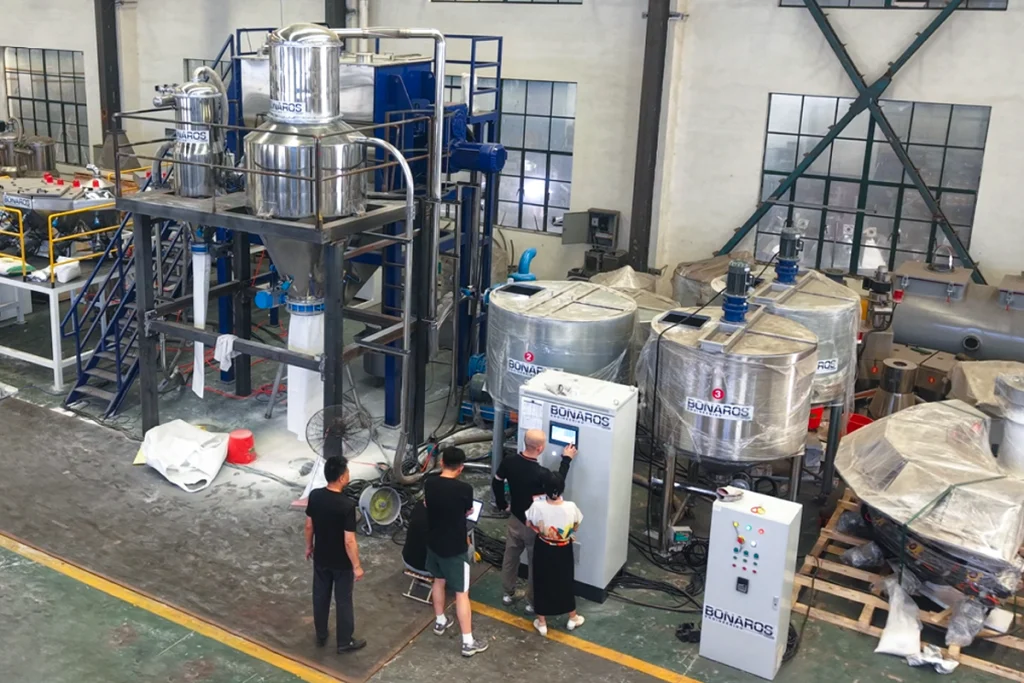
Most plastic machinery is bought twice. The first purchase is the machine the supplier had on the shelf. The second purchase — usually two years later, after the line has been nursed through a product change — is the machine that actually fits the plant.
OEM and ODM sourcing exists to skip that second purchase. But the words are used loosely in this industry, and the difference between a good custom project and an expensive lesson usually comes down to what was agreed before the first drawing was issued.
This guide covers what OEM and ODM actually mean for plastic mixing, dosing and conveying equipment, what you should prepare before asking for a quote, and the contractual details that decide who owns what when the project ends.
OEM vs ODM Plastic Machinery: The Difference That Matters
In plastics equipment, the two terms describe who controls the design:
OEM (original equipment manufacturer) — you bring the design. You own the specification, the drawings, the brand and the performance targets. The factory builds to your documentation, or to a joint design you approve line by line. Your name goes on the machine.
ODM (original design manufacturer) — the factory brings the design. You select from an existing platform, then modify it: capacity, material contact parts, control philosophy, voltage, paint colour, branding. The core engineering stays with the manufacturer, and you license or buy the finished product under your own label.
In practice, most projects sit between the two. A buyer needs a 500 kg/h PVC compounding line with a specific layout, a preferred PLC brand and a local voltage, but has no interest in designing a mixer from scratch. That is a modified ODM platform with OEM elements — and it is the most common shape of a real order.
The practical question is not “which label do we use?” but “which parts of this machine are fixed by the platform, and which parts are being designed for us?” Get that answer in writing early.
Why Buyers Customize at All
Standard equipment is cheaper and faster. Buyers still pay for customization when one of four conditions applies:
- The material is unusual. Glass-filled compounds, 200-mesh powder, regrind-heavy PVC dry blend, WPC with high wood flour loading — each behaves differently in a hopper, a screw and a conveying line. A standard screw geometry may bridge, segregate or wear out in months.
- The building constrains the layout. Low headroom, a fixed mezzanine, a column in the wrong place, or a silo farm on the roof can make a catalogue layout physically impossible.
- The line must integrate. A new feeding system has to talk to an existing extruder, a batching controller and a plant MES. Protocol and signal compatibility are design inputs, not accessories.
- The brand needs its own machine. Distributors and plant builders who resell under their own name need consistent livery, documentation and spare-parts identity.
If none of these apply, buy standard. Customization has a real cost in engineering hours, lead time and validation — it should be buying you something specific.
What to Prepare Before the First RFQ
The quality of the quote is set by the quality of the inquiry. Suppliers who receive a one-line request (“need a mixer, please quote”) will quote a generic machine, and both sides will discover the mismatch later.
Prepare a package with these eight items:
- Process description — what goes in, what comes out, and at what rate. Include the formulation or component list with percentages, and note which components are hazardous, sticky, abrasive or heat-sensitive.
- Bulk material data — bulk density (loose and tapped), particle size, moisture content, angle of repose, flowability notes. For regrind, state the percentage and source.
- Capacity and duty — normal rate, peak rate, hours per day, shifts per week. State whether the number is a batch size or a continuous throughput; they are not interchangeable.
- Utilities and environment — voltage, frequency, phase, compressed-air pressure and quality, ambient temperature, washdown regime, dust classification, humidity.
- Layout constraints — a sketch with dimensions, available headroom, floor loading limits, access routes for delivery, and the position of adjacent equipment.
- Interface requirements — which controller runs the line, which protocol (Modbus TCP, Profinet, EtherNet/IP, analogue), what data must be logged, and who integrates.
- Standards and documentation — CE, UL, local electrical code, language of manuals, required drawings (GA, electrical, P&ID), spare-parts list format.
- Commercial frame — target budget range, required delivery window, Incoterm, destination port, and whether installation and commissioning support are needed.
A supplier who asks follow-up questions on items 1, 2 and 6 is engaged. A supplier who quotes in 24 hours without asking anything is quoting a catalogue page.
The Specification Document Is the Contract
For custom equipment, the technical specification should be an annex to the purchase contract, not an email thread. It should state, at minimum:
- Every material contact surface and its grade (304, 316L, and the surface finish)
- Motor brands, reducer brands, PLC and HMI brands, with model numbers where agreed
- Achievable accuracy and throughput, with the test method and the material used for the guarantee
- Noise level, dust emission and guarding standard
- Documentation deliverables and language
- Acceptance criteria and the test procedure at the factory
Vague performance language is where disputes live. “High accuracy” means nothing; “±0.5% of set rate at 300 kg/h on this material, verified over three 30-minute runs” is something both sides can test.
Who Owns the Drawings?
This is the most commonly skipped question in OEM/ODM projects and the most expensive one to fix later.
Three things need to be settled before work starts:
- Background IP. The factory’s existing platform design stays with the factory. Your modifications should be defined, and the ownership of those modifications should be stated. A common fair arrangement: the factory retains the platform, you own the project-specific drawings and any tooling you paid for.
- Tooling and moulds. If custom parts require a mould or a fixture, state who pays, who stores it, and what happens to it if the relationship ends. “Tooling remains the property of the customer, stored at the supplier’s premises, returnable on request” is a standard, workable clause.
- Confidentiality and exclusivity. If you are building a branded line, you need to know whether the factory can sell the same configuration to your competitor, and under what terms. Exclusivity costs money; it should be priced openly, not assumed.
Get these in the contract, not in a WeChat message.
Factory Acceptance: Test the Duty Point, Not the Brochure
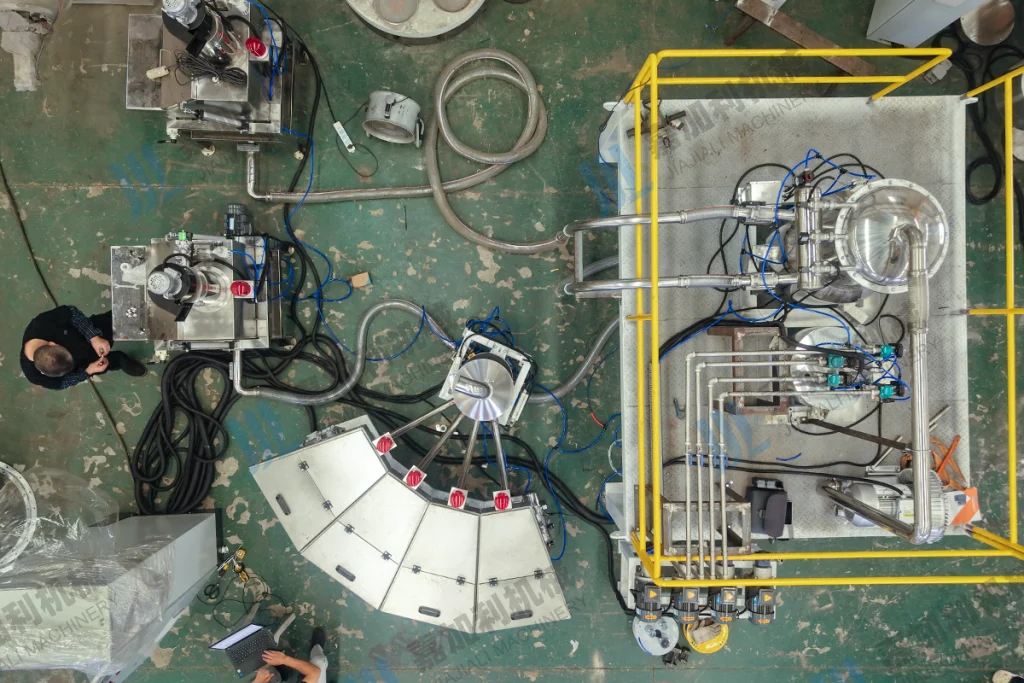
The machine will be tested once, at the factory, before it ships. Make that test count.
A useful FAT for mixing, dosing and conveying equipment includes:
- Run at the normal duty point, not at maximum capacity. Accuracy and mixing uniformity are usually specified at the normal rate.
- Run at the material you will actually use, or the closest available equivalent, and record the difference.
- Verify the control logic: alarm handling, refill sequence, recipe change, power-loss recovery, emergency stop.
- Check documentation against the annex: drawings, manual language, spare-parts list, calibration records.
- Photograph and video the run, with the instrument readings visible, so there is a shared record if performance is questioned after installation.
If the material cannot be shipped to the factory, ask for a video FAT with live readings, and make the acceptance criteria explicit before the run. A recording of a machine running empty proves very little.
Five Mistakes That Repeat Across Projects
- Specifying capacity instead of duty point. A machine rated at 1,000 kg/h may hold accuracy only between 400 and 800 kg/h. Buy for where you actually run.
- Leaving the interface to the end. Controls integration is routinely discovered late, when the PLC has no spare card and the protocol is not supported.
- No material sample. Suppliers cannot guarantee performance on a material they have never seen. Send 20–50 kg if the material is unusual; it is the cheapest insurance in the project.
- Skipping the drawing review. A GA drawing review takes an hour and catches layout collisions, access problems and service-clearance issues that cost days on site.
- Paying the balance before documentation. Hold the final payment until manuals, drawings, calibration records and the spare-parts list are delivered in the agreed language.
How to Vet a Custom Machinery Supplier
Beyond price, check four things:
- Engineering capacity. Ask who will do the drawings and whether you can speak to that person. A trading company with no engineering team will subcontract the design, and the accountability becomes diffuse.
- Reference installations on similar material. Not a customer list — a specific line, a specific material, and ideally a contact who will answer two questions.
- Warranty behaviour on the last project. Ask what the last three warranty claims were and how they were resolved. The answer tells you more than the warranty clause.
- Communication during the quote. Response quality before the order is the best predictor of response quality after it.
FAQ
Q: Is OEM cheaper than ODM?
A: Usually not. OEM means the factory builds to your drawings, so engineering effort is charged to you. ODM leverages an existing platform and is normally cheaper and faster. OEM becomes worthwhile when the design itself is your competitive advantage or when no platform fits your process.
Q: Can we put our brand on the machine?
A: Yes. Branding — nameplate, paint colour, manual cover, HMI splash screen — is routine in both OEM and ODM arrangements. Confirm in writing that the nameplate and documentation will carry your brand, and check that the factory will not use your brand in its own marketing.
Q: What is a realistic lead time for custom plastic machinery?
A: Simple modifications to an existing platform typically run 45–75 days including testing. Fully custom lines with new tooling and multi-stage FAT commonly run 90–150 days. Add shipping and installation. Treat any quote promising a custom line in three weeks as either a standard machine in disguise or a schedule that will slip.
Q: How do we protect our design if we send drawings to a Chinese factory?
A: Use an NDA that names the legal entity, mark drawings as confidential, send only what the factory needs for the quote, and keep the critical process parameters in your own specification rather than in the drawing set. Ownership of project-specific drawings should be stated in the supply contract.
Q: Do we need to visit the factory?
A: For a first custom order above a modest value, yes — visit before the order or at FAT. You are assessing assembly discipline, material handling, QC records and whether the engineering team actually exists. Video calls are a weak substitute.
Q: Can one supplier handle mixing, dosing and conveying together?
A: That is the advantage of a system supplier: one control philosophy, one interface responsibility, one warranty contact. The risk is over-integration with a supplier who is strong in one area and subcontracts the rest. Ask which modules are built in-house.
Q: What should the payment schedule look like?
A: A common structure is 30% with the order, 60–70% before shipment after FAT, and 10% after installation or documentation delivery. Paying 100% before FAT removes your only real leverage.
Planning a custom line and want the specification reviewed before you send it out? JIAJIALI builds mixing, dosing and conveying equipment to OEM and ODM requirements, with in-house engineering and factory acceptance testing. Send your material data, duty point and layout sketch through contact us, or start from the mixing equipment, centralized feeding and conveying and automatic dosing and batching ranges.