
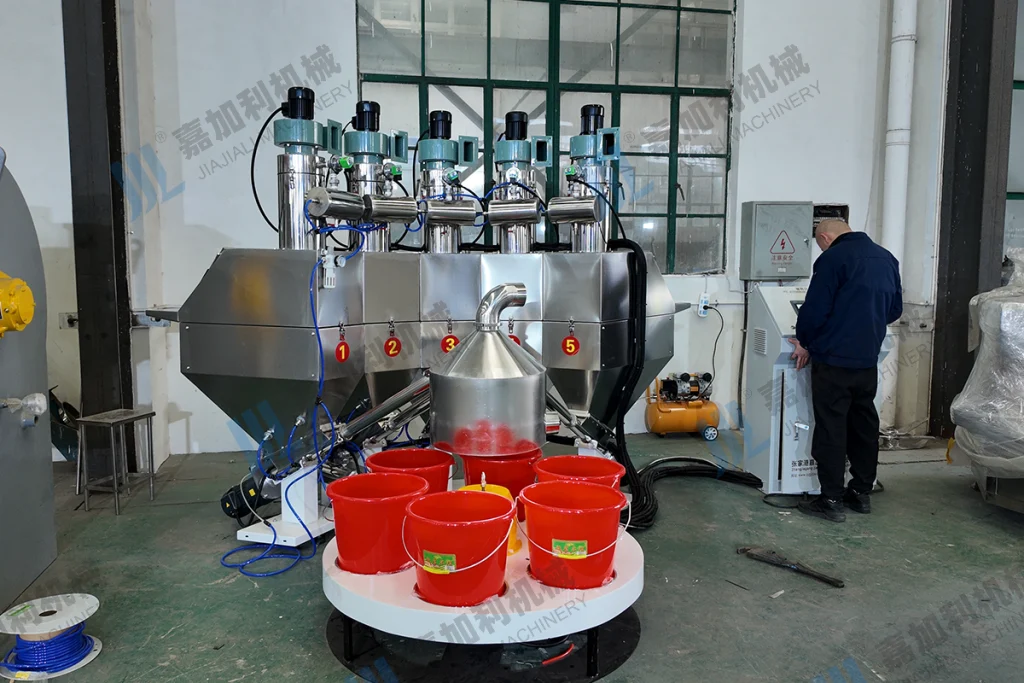
Most plastic compounders don’t set out to lose money on batching. An Automatic Dosing & Batching System can help prevent these hidden losses, but without automation, they happen quietly: an operator scoops 2% too much filler by eye, a colour batch comes out slightly off and gets scrapped, a shift spends forty minutes hand-weighing additives that a machine could have measured in seconds.
None of that shows up as a single line on the P&L. It shows up as a margin that’s a little thinner than it should be, quarter after quarter.
An automatic dosing and batching system — also called an automatic formula machine or PLC batching system — attacks those losses directly. This guide shows you how to work out whether one will pay for itself in your plant, with a formula you can fill in yourself.
What an Automatic Dosing & Batching System Actually Does
A batching system replaces manual weighing with a controller. You enter the recipe once; the system weighs each ingredient, dispenses the right amount in the right sequence, and records what it did.
JIAJIALI’s automatic formula machine is a representative example of how these units are built:
- High-sensitivity load cells with metering error controlled within 0.1%.
- PLC control with mass formula storage and one-click recipe switching.
- Fully automatic batching — no operator judgement in the loop, so no manual weighing error.
- Multi-industry compatibility— plastic compounding, food, feed, chemical, and new-material recipes.
The important point for ROI is not the hardware. It’s that every one of the five cost buckets below is driven by the number the load cell produces, and a machine hits that number far more consistently than a person with a scoop.
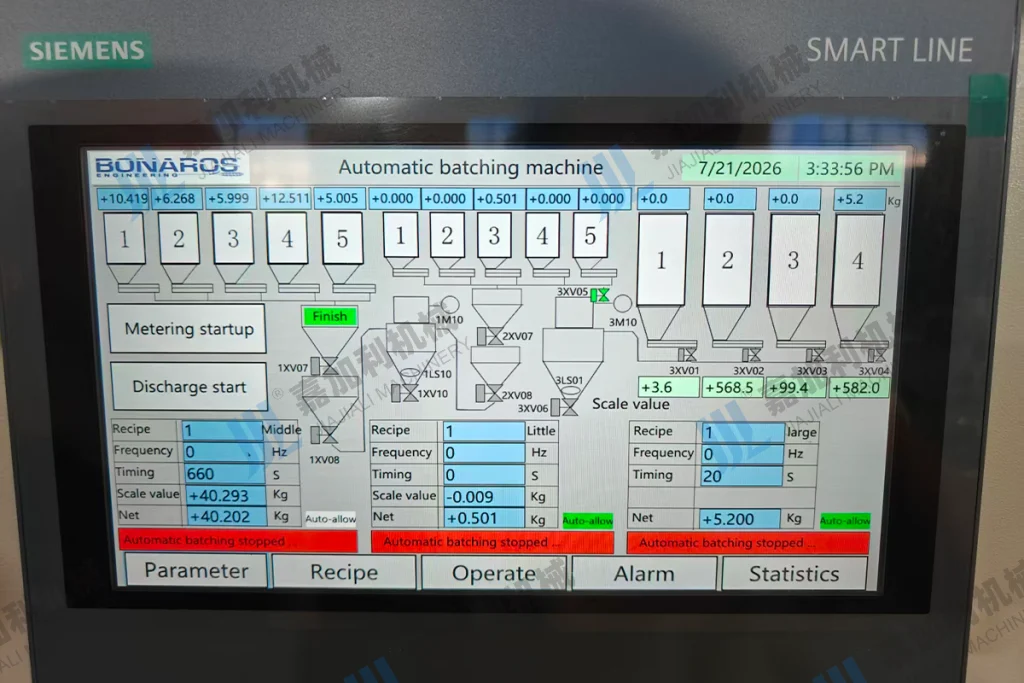
Where the Money Actually Goes
Before you can calculate ROI, separate the losses into buckets. Five matter for plastics:
Labour
people whose main job is weighing, scooping, carrying bags, and writing batch records.
Material giveaway
the extra you add “to be safe.” Manual batching tends to over-dose, and on expensive additives that over-dose is pure lost margin.
Off-spec scrap and rework
batches that miss the tolerance window get re-mixed or dumped. The cost is the *whole* compound, not just the additive.
Downtime and changeover
time spent finding the recipe sheet, cleaning scoops, and re-weighing after a mistake.
Energy and waste
less obviously, manual lines often run mixers longer because nobody trusts the batch is right the first time.
A batching system touches all five. The trick is putting a number on each one.
The ROI Formula (Fill-In-Yourself Version)
The whole calculation is two lines:
- Annual benefit = labour saving + material saving + scrap saving + downtime saving
- Payback (months) = investment ÷ annual benefit × 12
If you only have time for one input, use material giveaway — it’s usually the biggest and easiest to measure.
A Worked Example
Here’s an illustrative case for a PVC compounding line running 1,000 tonnes per year, two shifts. Treat the numbers as a template, not a promise — your figures will differ.
Assumptions
- Average additive/filler cost: $1.20/kg
- Current manual over-dose: 1.5% above recipe
- Typical off-spec/scrap rate: 2%, reduced to 0.5% after automation
- Compound value (for scrap): $1.80/kg
- Two weighing operators, one redeployed to other work: $12,000/yr saved
- Changeover/rework time: 30 min/day, 300 days → $8,000/yr saved
Step 1 — Material giveaway
| Item | Value |
|---|---|
| Output | 1,000,000 kg/yr |
| Over-dose reduced | 1.5% → 0.3% = 1.2% |
| Material no longer wasted | 1,000,000 × 1.2% = 12,000 kg |
| Saving | 12,000 × $1.20 = $14,400/yr |
Step 2 — Scrap reduction
15,000 kg of off-spec compound avoided × $1.80 = roughly $27,000/yr gross; discount it to $20,000/yr to stay conservative (rework is not always fully lost).
Step 3 — Add it up
| Bucket | Annual saving |
|---|---|
| Labour | $12,000 |
| Material giveaway | $14,400 |
| Scrap | $20,000 |
| Downtime | $8,000 |
| Total | $54,400 |
Step 4 — Payback
A multi-ingredient batching system in this size class typically lands somewhere around $60,000–$90,000 installed, depending on ingredient count and integration. At $54,400/yr:
- $60,000 investment → ~13 months payback
- $90,000 investment → ~20 months payback
After payback, that benefit keeps accruing — often the strongest argument you’ll have for the capital request.
What Pushes ROI Up or Down
The same formula gives very different answers plant to plant. The big levers:
Number of ingredients.
Two-ingredient lines save less than eight-ingredient lines; the more scoops you remove, the bigger the win.
Material cost.
Automating a recipe built on cheap filler pays back slowly. Automating one with masterbatch, stabilisers, or expensive additives pays back fast.
Accuracy requirement.
Tight tolerances mean manual batching misses often — and misses cost scrap.
Batch size and changeover frequency.
Many small batches amplify the labour and downtime savings.
Your labour rate.
High-wage markets push labour savings much higher; low-wage markets push the decision toward material and scrap savings instead.
Integration.
A system that talks to your ERP or MES removes paperwork and gives you traceability you can’t put a simple price on.
What the Calculator Doesn’t Capture
ROI math leaves out the things that are hardest to invoice but easiest to notice:
Batch consistency.
Customers don’t buy your tolerance band; they buy the same product every time.
Traceability.
A log of what went into every batch is worth a lot when a customer asks “what changed?”
Safety and dust.
Fewer people hand-lifting powder near open hoppers is a real, if hard-to-price, benefit.
Scalability.
Adding a recipe to a PLC is cheaper than hiring another weigher.
Three Numbers to Collect This Week
You don’t need a full audit to get a useful estimate. Pull these three:
- Current giveaway % — from your batch records, compare recipe to actual.
- Scrap % — how many batches get dumped or reworked per month.
- Weighing labour hours per week — count everyone who touches a scale.
Feed those three into the formula above and you’ll have a payback estimate good enough to decide whether to ask for quotes. Systems are usually fed by an upstream ton bag discharging station and a central feeding system, so size those together with the batcher rather than after.
FAQ
Q: How accurate is an automatic batching system?
A: JIAJIALI’s automatic formula machine controls metering error within 0.1%. For comparison, a skilled operator weighing by hand typically lands within 1–3% on a good day — a 10–30× difference that shows up directly in material giveaway.
Q: How many ingredients can one system handle?
A: It depends on the frame and the number of dosing stations, but multi-ingredient plastic recipes (resin, filler, stabiliser, lubricant, pigment, masterbatch) are routine. The PLC stores a library of formulas, so adding an ingredient is a configuration change, not a new machine.
Q: Is a batching system the same as a loss-in-weight feeder?
A: No. A loss-in-weight feeding system feeds one ingredient continuously at a controlled rate. A batching system coordinates many ingredients into discrete recipes. They’re often used together: the batcher doses, the feeder trims.
Q: What payback should I expect?
A: For a multi-ingredient line with expensive additives, 12–24 months is a realistic band. For a simple two-ingredient line, or one running cheap filler, it can stretch longer — in which case a single loss-in-weight feeder may be the better first investment.
Q: Can it be retrofitted into an existing line?
A: Usually yes. The batching controller sits above your existing mixers and scales; the main work is fitting dosing stations and defining the recipes. Retrofits are common because the mixer and the weighing system age independently.
Want a payback estimate for your line? Send the JIAJIALI team your recipe (ingredients and target ratios), annual output, and current scrap rate. They’ll work through the numbers with you and confirm the automatic dosing and batching system configuration that fits — including how it connects to your feeding and mixing equipment.