
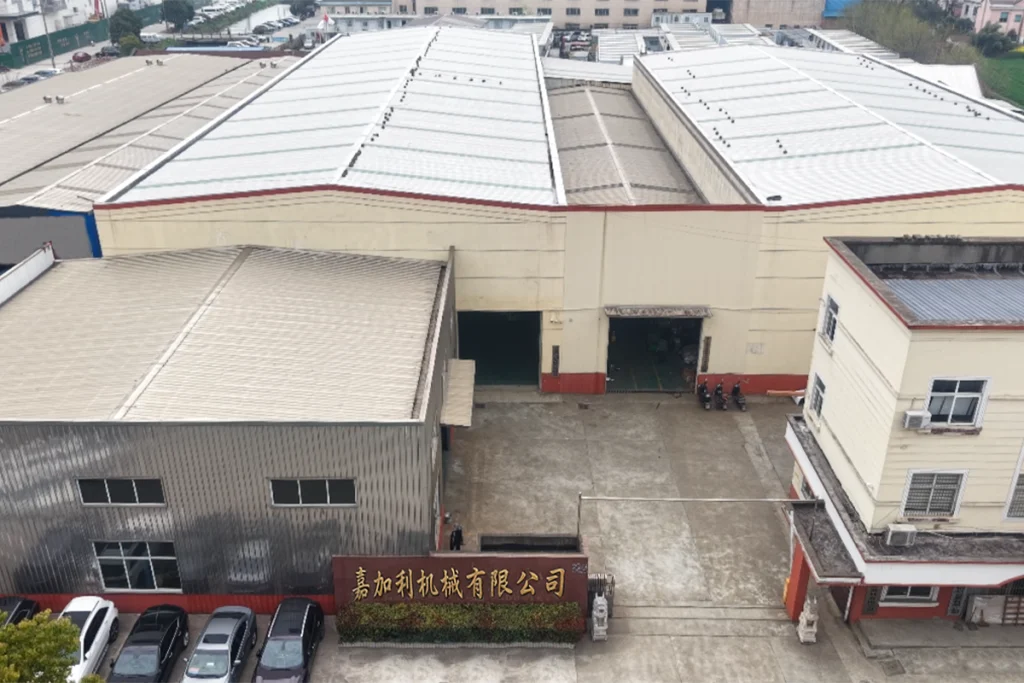
Ask a plastic plant manager what went wrong with their last equipment purchase, and the answer is rarely about the machine itself. It is about the gap around the machine: a hopper that did not match the material, a control system that spoke the wrong protocol, a layout that looked fine on a quote sheet and did not fit the building, or a supplier who disappeared after the commissioning report was signed.
JIAJIALI exists in that gap. We design and build mixing, dosing and conveying systems for plastic processors — not as a catalogue of separate machines, but as one connected process from silo to extruder throat.
This is the short version of who we are, how we got here, and how we work.
What We Actually Build
Our product range covers the material path through a plastic plant:
- Mixing equipment — SHR high-speed mixers, SRL-Z and SRL-W hot/cold mixing units, SH vertical mixers, WSH horizontal ribbon mixers, SHL cooling mixers and LSH drying mixers.
- Centralized feeding and conveying — central feeding systems, vacuum automatic feeders, TCA pipe chain conveyors and ton bag discharging stations.
- Automatic dosing and batching — automatic compounding systems, automatic formula machines, loss-in-weight feeding systems and loss-in-weight metering and mixing systems.
- Extrusion and pelletizing lines — PVC pelletizing lines, profile extrusion production lines and 3D printing filament lines.
- Auxiliary equipment — crushers, milling machines, packaging machines and winding machines.
The range matters less than the way it is combined. A PVC dry-blend plant is a mixing problem, a weighing problem and a conveying problem at the same time; solving them with three suppliers usually means three control philosophies and a fourth company to blame. We build the whole path, test it together, and take one warranty.
The 20+ Years, Explained Honestly
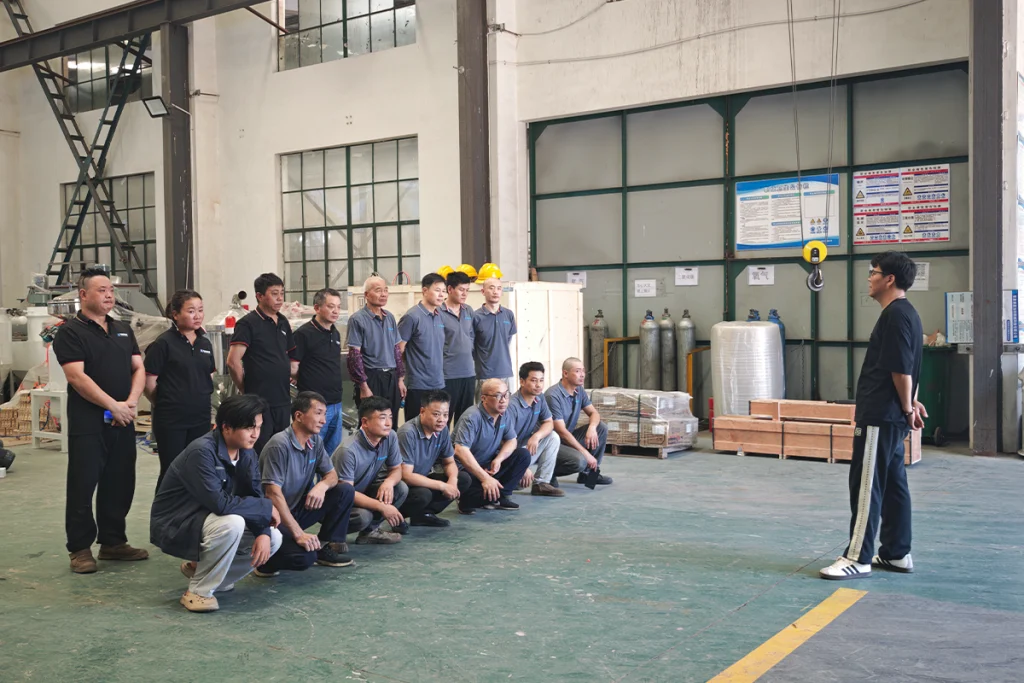
JIAJIALI was established as a company in 2017. The “20+ years” in our profile refers to the industry experience our engineering and production team brings — people who have been designing and building mixing and conveying equipment since long before this company existed.
That distinction is worth stating plainly, because this industry is full of inflated founding dates. What the experience buys you is pattern recognition: knowing that a 200-mesh powder will bridge in a hopper designed for pellets, that a refill valve sized for pellets will choke on regrind, that a mixer specified at maximum batch size will run at poor uniformity at half load. Those lessons are not in a catalogue. They are in the people.
The Timeline
2017 — Founded. The company started with the design and manufacture of plastic mixing and conveying systems, focused on stable, efficient equipment for plastic processors.
2018–2019 — Product range built out. High-speed mixers, dosing systems and vacuum feeding equipment were added, along with the first domestic industrial customers. This is where the technical foundation was laid: material testing, screw and impeller design, and control logic.
2020–2022 — Overseas expansion. Equipment began shipping to Southeast Asia, the Middle East and Europe. Turnkey system packages — mixing plus feeding plus dosing under one control system — became a larger share of the business.
2023–2024 — System integration. Engineering capability was upgraded toward complete line solutions: centralized feeding systems, automatic batching systems and full plant integration projects, rather than single machines.
2025 — 50+ countries. Projects reached more than 50 countries, the R&D team was expanded, and automation and control systems were upgraded for industrial mixing applications.
2026 — Factory relocation. The company moved to a larger, more modern production base, improving manufacturing capacity, quality control and assembly efficiency for turnkey projects.
Inside the Factory
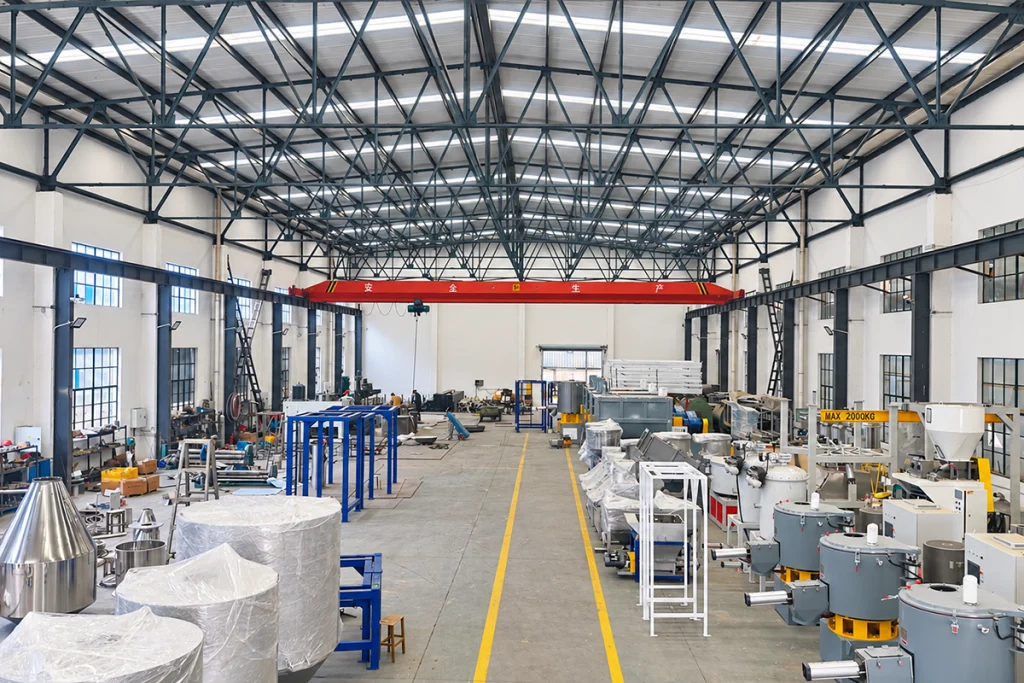
The current facility covers roughly 4,000 m², with CNC machining equipment, fabrication, assembly bays and a test area. More than 100 projects have been completed, and equipment has been exported to 50+ countries.
What a buyer should look for in a factory visit is not floor area but evidence of process:
- Machining in-house. Contact parts, shafts and impellers machined under the same roof as assembly shorten the feedback loop between a tolerance problem and its fix.
- Assembly discipline. Cleanliness at the material-contact stage, proper torque records, guarding installed before test — these are visible in ten minutes of walking the floor.
- Test capability. A machine that is run and instrumented before shipment is a machine whose performance is known. Our factory acceptance tests run at the duty point, on the material, with readings recorded.
- Documentation. Drawings, manuals, calibration records and spare-parts lists prepared in the customer’s language, not assembled after the ship date.
How We Work on a Project
Most projects follow the same sequence:
- Process review. We start from the material and the duty point — component list, percentages, bulk density, throughput, hours of operation — not from a machine model.
- Layout and interface. GA drawing, headroom, access, and the control interface to the existing line. Most integration problems are solved here or not at all.
- Specification. Material contact surfaces, motor and control brands, accuracy targets with a test method, documentation deliverables.
- Manufacture and FAT. Assembly, run-in, and a factory acceptance test with the customer present or on video, with readings visible.
- Shipping, installation, commissioning. Including online support during start-up — a detail that matters more than it sounds for a first-time importer.
- After-sales. Spare parts, calibration guidance and troubleshooting support.
Exhibitions and the Wider Industry
We exhibit at CHINAPLAS (2024, 2025 and 2026 in Shanghai and Shenzhen) and at VietnamPlas 2025 in Ho Chi Minh City. Trade shows are an imperfect way to evaluate a supplier, but they are a useful way to see build quality up close, meet the engineering team, and compare several suppliers in one day.
If you are visiting CHINAPLAS, the practical advice is to book meetings in advance, bring your material data and a layout sketch, and ask each supplier the same five questions so the answers are comparable.
Who We Work With
Our customers are plastic processors, compounders, masterbatch producers, profile and pipe extruders, WPC manufacturers and plant builders — companies that need the material handling and mixing stage to be reliable so the extrusion line downstream can run without interruption.
They are not all large. A single-line PVC compounder with a tight building and a specific formulation is as much a system project as a multi-line plant. What they share is that the equipment has to match the process, not the other way around.
What We Are Not
We are not the cheapest option in the market, and we do not try to be. Low-cost equipment usually removes something: material testing, instrumentation, documentation, or the engineering hours needed to fit a system to a building. Those costs reappear later, on site, at the worst possible time.
We are also not a trading company. Design, machining, assembly and testing happen in our own facility, which is why we can answer a question about a tolerance or a control sequence without forwarding an email.
FAQ
Q: When was JIAJIALI founded?
A: The company was established in 2017. Our team’s industry experience in mixing and conveying equipment extends well beyond that — more than 20 years — which is where the “20+ years” figure comes from.
Q: Where is the factory?
A: In China, at a production base of approximately 4,000 m² that was relocated and upgraded in 2026. Contact us for the address and a visit arrangement.
Q: What is the main product range?
A: Mixing equipment (high-speed, hot/cold, vertical, ribbon, cooling and drying mixers), centralized feeding and conveying systems, automatic dosing and batching systems, extrusion and pelletizing lines, and auxiliary equipment such as crushers, milling machines and packaging machines.
Q: Do you supply complete turnkey plants?
A: Yes. Turnkey system packages — mixing, feeding, dosing and conveying integrated under one control system — are a core part of the business, alongside single machines.
Q: How many countries have you exported to?
A: More than 50, with projects concentrated in Southeast Asia, the Middle East, Europe and other markets.
Q: Can you customize equipment for our material and layout?
A: Yes. Custom and OEM/ODM work is routine: material contact parts, screw and impeller geometry, capacity, voltage, control platform, branding and documentation can all be adapted.
Q: How do I get a quote?
A: Send the material data (component list, bulk density, particle size), the duty point (normal and peak rate, batch or continuous), utilities and a layout sketch. That is enough for a meaningful first proposal rather than a catalogue price.
Q: Do you provide installation and after-sales support?
A: Yes — installation and commissioning support, online troubleshooting during start-up, spare parts and calibration guidance.
Want to see whether your process fits our range? Browse the full product range, watch the equipment running on our video page, or send your material and duty point through contact us. More background is on the about us page.