
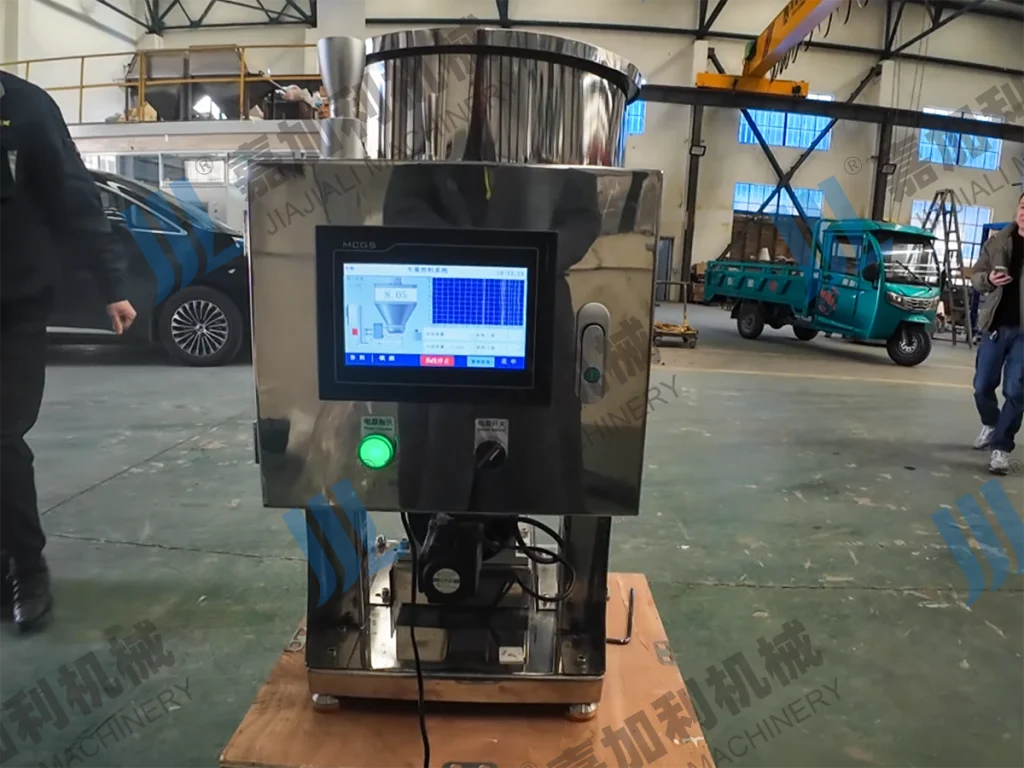
Loss-in-Weight Feeder Calibration is critical to the performance of a loss-in-weight feeder. The whole reason you bought a gravimetric feeder instead of a volumetric screw is that you want to trust the number on the screen — 3.5 kg/h of stabilizer means 3.5 kg/h, not “close enough.”
But that trust depends on the weighing system being true. Get calibration wrong, and the feeder will happily dose the wrong amount with perfect repeatability, which is worse than an obvious fault: nothing alarms, the batch records look fine, and the problem only shows up in product quality weeks later.
This guide covers when to calibrate, how the two-point procedure works, where drift actually comes from, and how to build a schedule you’ll actually follow.
Why Calibration Matters More Than the Brochure Accuracy
A loss-in-weight feeder measures material by weight loss over time. Everything downstream — the feed rate, the recipe ratio, the batch record — is derived from the load cell signal. If that signal is off by 2%, every dose is off by 2%, silently.
Typical gravimetric accuracy is ±0.1% to ±0.5% of setpoint, but that figure is only valid when:
- The load cell is correctly calibrated.
- The mechanical setup is stable (no vibration, no pipe strain).
- The refill cycle isn’t dominating the measurement.
Calibration is how you keep the first condition true over the life of the machine.
When Should You Calibrate?
There’s no single answer, but a practical schedule looks like this:
| Trigger | Action |
|---|---|
| Commissioning | Full two-point calibration before production |
| Every 6–12 months | Routine calibration check (verify, recalibrate if out of tolerance) |
| After disassembly | Full recalibration — hopper cleaned, screw changed, load cell disturbed |
| After a move or re-level | Recalibrate; mounting and strain change the zero point |
| Accuracy complaint / off-spec batch | Verify immediately, then investigate root cause |
| New material with very different bulk density | Verify; often shows as a refill-behaviour change, not a calibration fault |
If you change materials often, don’t recalibrate every time — verify. Calibration is a correction; verification is just a check. Over-calibrating a system that’s already correct introduces error rather than removing it.
The Two-Point Calibration Procedure
Most industrial gravimetric feeders use a two-point calibration, done with certified test weights:
- Zero the system (point 1). Empty the hopper (or leave it at a known tare) and record the raw load cell reading. This defines zero.
- Apply a known weight (point 2). Place a certified test weight — typically 50–100% of the working hopper load — on the load cell or weighing platform. Record the reading.
- Compute span. The controller (or you) calculates the scale factor from the two points: `span = (reading₂ − reading₁) / (weight₂ − weight₁)`. Enter it.
- Verify. Re-check zero, then re-apply the weight and confirm the displayed value matches within tolerance.
- Run a material check. Feed a known quantity over a timed run (a “catch test”) and compare the weighed output to what the feeder reports. This validates the whole chain, not just the load cell.
Steps 1–4 calibrate the sensor. Step 5 proves the feeder. Skipping the catch test is the most common mistake — a perfectly calibrated load cell can still be feeding wrong if the screw or refill valve is the problem.
Where Drift Actually Comes From
When a feeder loses accuracy, calibration is often blamed when the real cause is mechanical. Check these before you touch the span:
Vibration
adjacent equipment, worn mounts, or a loose frame all inject noise into the signal. Load cells should be isolated and the frame rigid.
Pipe and cable strain
a flexible connection that’s too stiff, or a cable that pulls on the hopper, creates a false force reading.
Refill disturbance
during refill the feeder runs in volumetric mode. A slow or violent refill lengthens that window and hurts average accuracy.
Material bridging or rat-holing
the feeder reports the right weight loss but the screw isn’t delivering it evenly.
Temperature drift
load cells are temperature-sensitive; in a hot compounding shop, allow a warm-up period before trusting a reading.
Airflow
a draught or a compressed-air leak onto the hopper creates a measurable force.
If any of these are present, fix them first. Recalibrating a mechanically unstable feeder just hides the symptom.
Calibration vs Verification: Know the Difference
Calibration
adjusts the system to make its reading correct.
Verification
checks whether the reading already *is* correct, without changing anything.
A sound routine verifies on a schedule and only calibrates when verification fails. This keeps a record of the system’s true stability and avoids “chasing” a good calibration with unnecessary adjustments.
Keeping Records (and Why It Pays)
Log every calibration: date, operator, test weights used, zero and span values, catch-test result, and pass/fail. Three reasons:
1. Traceability — when a customer asks why a batch was off, you can show the feeder was verified on the day.
2. Trend detection — a span that keeps drifting the same direction points to a mechanical problem before it becomes a production one.
3. Audit readiness — ISO and food/medical compounding customers increasingly ask for dosing verification records.
Calibration in a Multi-Feeder Batching System
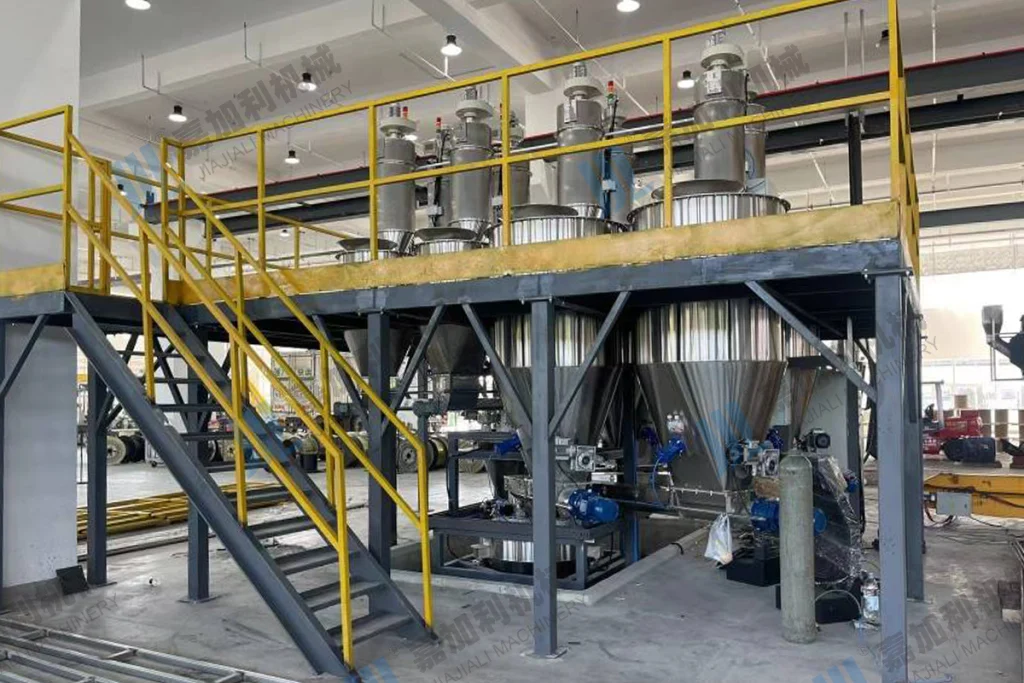
In an automatic dosing and batching system, each ingredient usually has its own loss-in-weight feeder under one controller. Calibrate them individually, then verify the system together:
– Calibrate each feeder with test weights on its own.
– Run a complete recipe and check the batch total against the sum of setpoints.
– Recheck the two feeders with the smallest setpoints first — they carry the highest relative error.
In a central feeding line, remember that the conveying system delivers material to the feeder; a refill problem upstream looks exactly like a calibration problem at the feeder.
FAQ
Q: How often should a loss-in-weight feeder be calibrated?
A: Verify every 6–12 months in routine service, recalibrate after any disassembly, move, or load-cell disturbance, and always after an accuracy complaint. High-accuracy or regulated processes verify more often.
Q: Can I calibrate a loss-in-weight feeder without test weights?
A: You can verify with a catch test (feed a known time and weigh the output), but true calibration needs known weights to establish zero and span. Catch tests alone won’t detect a load cell that’s consistently offset.
Q: Why does accuracy drop right after refill?
A: The feeder switches to volumetric mode while the hopper refills, so it can’t measure weight loss. A fast, low-vibration refill keeps that window short — typically 5–20 seconds — and the gravimetric loop recovers quickly.
Q: My feeder passes calibration but the batch is still off. What now?
A: Look beyond the load cell: screw wear, material bridging, refill valve leakage, or a downstream mixing problem. A catch test isolates feeder error from line error.
Q: Does calibration differ for powder and pellets?
A: The load cell procedure is the same; what differs is the verification. Powders need non-bridging hoppers and may need a longer settling time before readings are trusted. Pellets flow more predictably but can carry static.
Feeder drifting, or batches slowly going out of spec? Send the JIAJIALI team your feeder model, material, and the accuracy you need. We’ll advise on calibration method, test weights, and whether the issue is the weighing system or the mechanical setup — and configure the right loss-in-weight feeding system if it’s time to upgrade.