
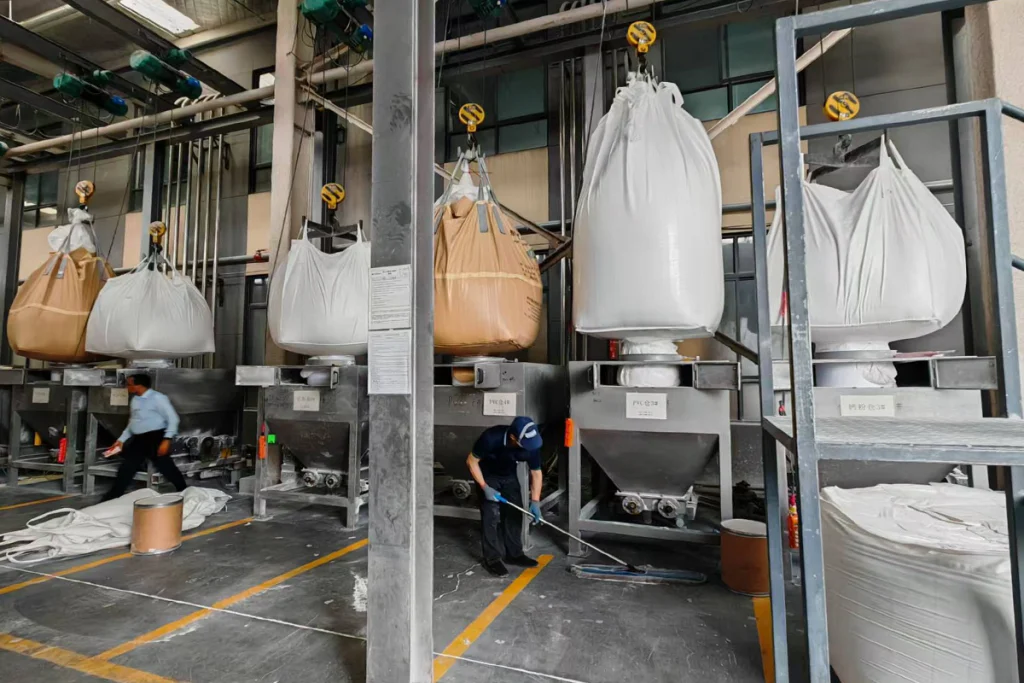
A ton bag arrives at your plant weighing a thousand kilos of powder — calcium carbonate, carbon black, titanium dioxide, PVC resin, or masterbatch. The question is what happens when the bag has to be emptied.
Tipping a bag into an open hopper with a forklift is fast, but it’s also dusty, wasteful, and hard on the person doing it. Every time that powder hits the air, you lose material, contaminate the shop floor, and create a cleaning job that follows you for the rest of the shift.
A ton bag discharging station (also called a bulk bag unloader or FIBC discharge station) solves exactly that problem. This guide covers how these units work, what options matter, and how to pick the right one for a plastics plant.
What Is a Ton Bag Discharging Station?
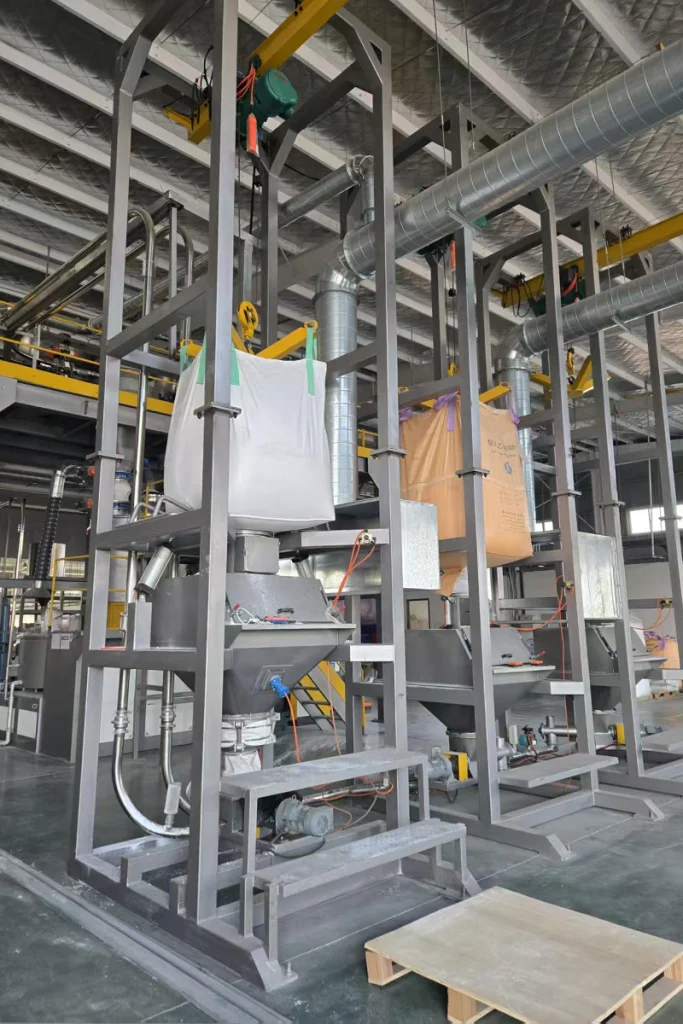
A ton bag discharging station is a structure that holds a bulk bag (FIBC — flexible intermediate bulk container) above a sealed hopper and empties it into your process in a controlled, dust-tight way. It goes by several names — bulk bag unloader, ton bag unpacking machine, FIBC discharge station — but they all describe the same equipment. “Ton bag” is the common name for FIBCs of 500–1,500 kg capacity — the standard bulk packaging for plastic raw materials and additives.
A typical station has four parts:
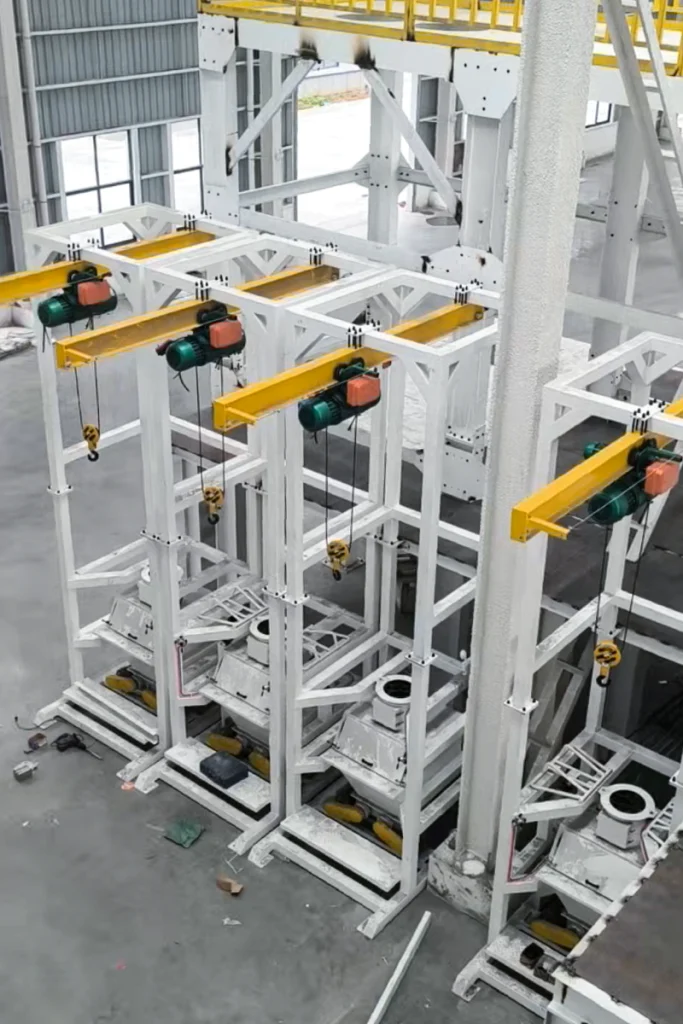
1. Bag support frame — the steel structure that holds the bag, with four load points for the bag loops and room for a forklift or hoist to place the bag on top.
2. Discharge cone and spout clamp — the bag’s outlet spout feeds into the cone, and a clamping mechanism seals it so powder can’t escape.
3. Flow promotion — most powders don’t flow by themselves; stations add vibration, air injection, or agitation to keep material moving.
4. Outlet and downstream connection — the hopper bottom connects to a vacuum automatic feeder, screw conveyor, or loss-in-weight feeding system that carries the material where it’s needed.
Why Plastic Plants Use Bulk Bag Unloaders
The materials handled in a plastics plant are exactly the ones that punish open dumping:
- Fillers— calcium carbonate, talc, glass fiber: fine powders that billow at the slightest draft.
- Pigments and carbon black — so fine they color everything in a 10-meter radius, and their dosing accuracy matters for product shade.
- PVC resin and additives — where dust isn’t just a mess, it’s a safety issue and a formulation problem.
- Masterbatch and pellets — cleaner, but still need dust-free transfer to stay contaminant-free.
An enclosed discharging station contains that dust at the source. In practice that means three immediate results: the operator isn’t breathing powder, the shop floor stays clean, and the material actually ends up in the process instead of on the floor.
How It Works, Step by Step
1. **Loading** — A forklift (or overhead hoist) lifts the bag by its loops and sets it onto the frame. Some frames include an integral hoist so one person can load without a forklift.
2. **Connection** — The operator pulls the bag’s outlet spout through the cone and seals it with the clamp — either a manual toggle clamp or a pneumatic/inflatable seal for the highest dust-tightness.
3. **Flow promotion** — As material discharges, the station’s flow aids keep it moving. Options include:
– **Vibrators** on the cone walls for free-flowing granules.
– **Air injection pads** that fluidize cohesive powders.
– **Internal agitators / massage panels** that flex the bag itself, common for sticky materials like carbon black.
4. **Emptying assist** — A discharge aid (a frame or straps that lift the bag’s bottom into the cone) ensures the last few kilos come out instead of sitting in the bag’s shoulders.
5. **Downstream transfer** — Material falls through the outlet into a conveying or dosing system. The whole discharge path is sealed, with a dust collection connection venting any displaced air.
That sequence matches how JIAJIALI builds its ton bag unpacking machines: the bag is lifted to the inlet by forklift or electric hoist, the discharge spout is opened manually or automatically, and a flow valve plus vibration device keeps powder and granular material moving by gravity into the sealed hopper below — no manual shoveling, no open dust source.
## Dust Control and Safety Considerations
**Dust extraction** is the part buyers underestimate. When a bag discharges, air must enter the system to replace the material that leaves — without a filter or dust collector connection, that air blows dust out of every gap. Look for a station with a dedicated dust port sized to the discharge rate, or an integrated filter with reverse-pulse cleaning.
**Static grounding** is non-negotiable with powders. Fine plastic powders and fillers can carry significant static charge, and bag movement generates more. The frame and bag contact points should be grounded, and the station should be compatible with your plant’s grounding standard.
**Dust explosion awareness**: if you handle combustible powders (many plastics and additives qualify), the station should be part of your ATEX/area classification review. Standard questions: is the filter in the dust path, and is the vacuum source safe for the zone?
Matching the Station to Your Downstream Process
A discharging station is never the whole story — it’s the start of a material handling line. The right downstream depends on what happens next:
Continuous dosing — feed directly into a loss-in-weight feeder for gravimetric accuracy on additives or fillers.
Machine loading — connect to a vacuum conveying line to deliver material to [mixers or machine hoppers](https://jiajialimachinery.com/products/central-feeding-system/) without manual handling.
Batch recipes — integrate with an automatic dosing and batching system where the station is one of several ingredient sources under one controller.
The key spec to define before buying is discharge rate — how many kg/hour must leave the bag — because that drives the outlet size, flow aid selection, and the downstream conveyor size.
Typical Specifications
| Parameter | Typical Value |
|---|---|
| Bag Capacity | 500–1,500 kg (FIBC) |
| Discharge Rate | 1–20 t/h, depending on material and flow characteristics |
| Spout Clamp | Manual toggle clamp or pneumatic inflatable seal |
| Flow Aids | Vibrators, air injection pads, agitators, or massage panels |
| Dust Control | Integrated filter or connection to an external dust collector |
| Construction | Painted carbon steel frame / stainless steel material-contact parts |
Buying Checklist
1. Know your material’s flow behavior.
Free-flowing pellets are easy; cohesive, aerating powders (carbon black, fine fillers) need air injection or agitation. Tell the supplier exactly what you handle — and ask for the flow aid recommendation in writing.
2. Confirm your bag specs.
Bag size, loop style, and spout diameter vary. A station rated for your bag type is the difference between smooth unloading and an operator fighting the spout every shift.
3. Plan the dust path.
Ask where displaced air goes and whether the filter is sized for your discharge rate. Retro-fitting dust control later costs more than speccing it now.
4. Check cleaning access.
If you change colors or materials, can the operator reach the cone and seals to clean them? Quick-release clamps and smooth interior surfaces matter more than they look.
5.Design for the next step.
Whether it’s a vacuum feeder, screw conveyor, or dosing system, the outlet connection and height must match. Decide the downstream before you pour the foundation.
FAQ
Q: What’s the difference between a ton bag and a bulk bag?
A: Nothing — ton bag is the common industry name, FIBC and bulk bag are the technical and international terms. They all refer to the same woven polypropylene container in the 500–1,500 kg range.
Q: Can one station handle different materials?
A: Yes, but plan for it. Switching between free-flowing granules and sticky powders means different flow aids, and color changes mean cleaning between runs. Ask for a station designed for quick changeover if that’s your case.
Q: Do I still need a dust collector if the station is sealed?
A: Yes. The station seals the bag spout, but displaced air still needs to go somewhere. A small filter or dust collector connection is what actually keeps dust inside the system.
Q: Can a ton bag station feed directly into a loss-in-weight feeder?
A: Often yes — the station’s hopper sits above the feeder and refills it in batches, exactly like an upstream storage silo would. Confirm the refill rate and the feeder’s refill valve cycle match so gravimetric accuracy is maintained.
Q: Is a forklift always required?
A: Not necessarily. Stations can be built with an integral hoist (electric or manual) that lifts the bag from floor level, so a single operator can load without a forklift — useful in plants where floor space or lift truck access is limited.
Want the full picture? A discharging station is usually bought as part of a complete automatic dosing and batching system or a centralized material feeding line. Tell the JIAJIALI team your material, bag size, and discharge rate — they’ll confirm the flow aid design, outlet sizing, and downstream connection for your specific plant.