
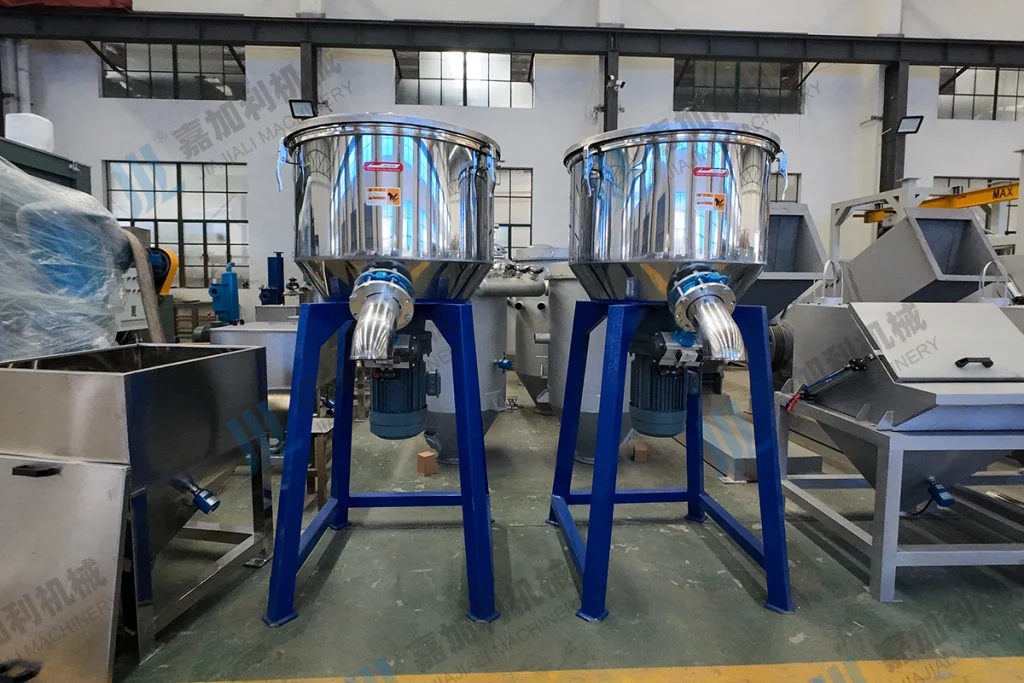
Walk into a plant doing frequent colour changes, small batches and multi-material jobs and you will often see a tall, compact machine standing in the corner — a vertical plastic mixer. It does a different job from the big horizontal blenders and high-speed mixers, and in the right setting it is the most practical mixer in the building.
This guide explains how the SH vertical mixer works, the situations where it beats a horizontal or high-speed mixer, and how to size one.
What a Vertical Mixer Is
A vertical mixer is a cylindrical vessel with a vertical screw (auger) mounted on a rotating arm inside. The screw turns on its own axis while the arm carries it around the vessel wall.
The action is a circulation loop: the screw lifts material from the bottom up the centre, and it falls back down along the outside wall. Up-and-down convection, over and over, until the batch is uniform. Because material is constantly moving from bottom to top, there are no dead corners where unmixed powder can sit.
The SH vertical mixer from JIAJIALI uses exactly this vertical spiral circulation stirring principle, with a design emphasis on compactness and flexibility.
What the SH Does Well
Compact vertical structure, small floor space. The mixer grows upward, not outward. Where floor area is tight, this alone can decide the choice.
Up-and-down circulation, zero mixing dead angle. The convection loop keeps the whole batch moving, so colour and additives blend evenly.
Energy-saving, low noise, low consumption. Vertical mixers run gently compared with high-speed machines — no friction-heating, no big motor fighting shear.
Powder and particles, one machine. It handles plastic powder, pellets and auxiliary materials, supporting intermittent multi-batch and multi-material work.
Easy to install and run. Simple structure, stable operation, straightforward maintenance.
Typical use cases: plastic colour matching, powder batching, chemical raw material mixing, and laboratory trial production of new materials. Anywhere you need quick, flexible, clean blending of modest batches, it fits.
When a Vertical Mixer Makes Sense
Choose vertical when the job looks like this:
You change material often. Colour matching, small runs, multi-product plants — a vertical mixer is quick to load, quick to clean, and happy to run different materials batch after batch.
Floor space is tight. A machine that grows upward leaves the floor free for other equipment.
Batches are modest. From a few tens of kilos up to a few hundred kilos per batch, depending on the model.
The material should not be heated. No friction heat means no risk of degrading a heat-sensitive blend.
You want a versatile all-rounder. One machine blending powders, pellets and additives with minimal fuss.
It is the mixer you reach for when flexibility and space matter more than raw throughput.
When a Vertical Mixer Is the Wrong Choice
Be honest about the limits:
Very large batches. For high-volume dry blending, a WSH horizontal ribbon mixer scales better and blends large volumes more efficiently.
Process heat needed. If your PVC compounding depends on friction heating to coat additives onto resin at 100–120 °C, you need a SHR high speed mixer or an SRL-Z hot/cold mixing unit.
High-shear dispersion. Breaking down agglomerates or dispersing liquids into powder needs shear energy a vertical screw does not deliver.
Continuous, very high output. Vertical mixers are batch machines; a plant running flat out on one product may prefer a different configuration.
Vertical vs Horizontal Ribbon vs High-Speed
| Feature | Vertical Mixer (SH) | Horizontal Ribbon Mixer (WSH) | High-Speed Mixer (SHR) |
|---|---|---|---|
| Footprint | Small, tall | Long, low | Compact |
| Batch Size | Small–medium | Large | Medium |
| Heat Generated | Little | Very little | Significant (100–120 °C) |
| Material Changeover | Very easy | Moderate (cleaning) | Moderate |
| Best For | Colour matching, small batches, lab | Large-volume dry blending | PVC hot mixing, additive coating |
| Particle Damage | Minimal | Minimal | Higher |
Short version: vertical for flexibility and space, ribbon for volume, high-speed for heat and shear.
Sizing the SH Vertical Mixer
Three things drive the specification:
- Batch size. Work from the finished batch weight or volume you need per cycle. Vertical mixers are usually run at a fill level that leaves room for the circulation loop to work — do not size for a full vessel.
- Bulk density. Light PVC powder and dense fillers weigh very different amounts in the same volume. Check both if your materials vary.
- Mixing time and cycle. Dry blends usually reach uniformity in a few minutes. If you need many batches per shift, check that loading and discharging time fits the cycle, not just the mixing time.
Also confirm motor power, discharge arrangement (and how it connects to your conveying or packaging), and whether the vessel material suits your product (for example, for lab or food-adjacent work).
Operating and Maintenance Tips
- Load to the recommended level. Too full and the circulation loop stalls; too empty and you lose capacity per cycle.
- Do not over-mix. Past uniformity, extra time only adds wear. A few minutes is usually enough for a dry blend.
- Clean for colour changes. The vertical design makes cleaning straightforward, which is a big part of why it suits frequent colour switches — keep to a routine so colours never cross-contaminate.
- Check the screw and drive. The screw and its bearings work hardest; periodic inspection keeps mixing uniform and catches wear early.
- Keep it dry and sealed. As with any powder mixer, moisture and dust are the two things that shorten life and spoil blends.
Buying Checklist
- Batch size you need per cycle, in weight, plus bulk density.
- How often you change material — how quick must changeover be?
- Powder, pellets, or both?
- Do you need heat or high shear? (If yes, this is the wrong mixer.)
- Available floor space and ceiling height.
- Discharge method that fits your downstream conveying or packaging.
- Laboratory vs production duty — sizing and finish differ.
- Whether the machine will later be fed automatically from a silo or dosing system.
FAQ
Q: What is a vertical mixer used for?
A: Blending plastic powder, pellets and additives in modest batches — especially plastic colour matching, powder batching, chemical raw material mixing and laboratory trial production. It suits plants that change material frequently and need a compact, easy-to-clean machine.
Q: How does a vertical mixer work?
A: A vertical screw on a rotating arm lifts material up the centre of the vessel while it falls back down the outside wall, creating an up-and-down circulation loop. This convection keeps the whole batch moving with no dead corners.
Q: Vertical or horizontal mixer — which should I choose?
A: Choose vertical for small-to-medium batches, frequent material changes and limited floor space. Choose a horizontal ribbon mixer for large-volume dry blending where throughput matters more than flexibility. For heat and shear, choose a high-speed mixer instead.
Q: Can a vertical mixer handle both powder and pellets?
A: Yes. The SH vertical mixer is a universal machine for plastic powder, pellets and auxiliary materials. That versatility is one of its main selling points for multi-material plants.
Q: Will a vertical mixer heat or damage my material?
A: No. The vertical screw circulates gently, generating very little heat and causing minimal particle damage — unlike a high-speed mixer, which deliberately uses friction to heat the batch. That makes it safe for heat-sensitive blends.
Q: How long does a vertical mixer take to blend a batch?
A: Typically a few minutes for a dry blend, depending on batch size and material. Beyond the point of uniformity, more mixing time only adds wear; check that loading and discharge fit your cycle if you need many batches per shift.
Q: Is a vertical mixer good for colour matching?
A: Yes — this is one of its strongest applications. Fast, even blending plus straightforward cleaning between batches makes it well suited to running many colours through the same machine without cross-contamination.
Choosing a mixer for frequent colour changes and tight floor space? Tell JIAJIALI your batch size, materials and how often you switch products — they will size the SH vertical mixer and match it to your feeding and discharge. See the full range under Mixing Equipment, or contact us with your material and batch size.