
A PVC formula can carry ten or more components, and a stabilizer at 2 phr is not the same product as a stabilizer at 3 phr. When those components are weighed by hand, the batch is only as accurate as the person holding the scoop — and the result shows up later as fisheyes, colour drift, poor gelation, or a whole lot of scrap.
An automatic compounding system takes that judgement call out of the operator’s hands. It weighs, batches, conveys, mixes, and discharges the compound under PLC control, so every batch is built from the same recipe, in the same sequence, with the same tolerances. This guide explains what the system actually does, how the automation levels differ, and how to size one for a PVC line.
What “Automatic Compounding” Really Means
It helps to separate two things people often blur together:
Automatic batching — the weighing and dosing stage. Each component is drawn from its own silo or hopper and weighed to recipe, then the batch is released to the mixer.
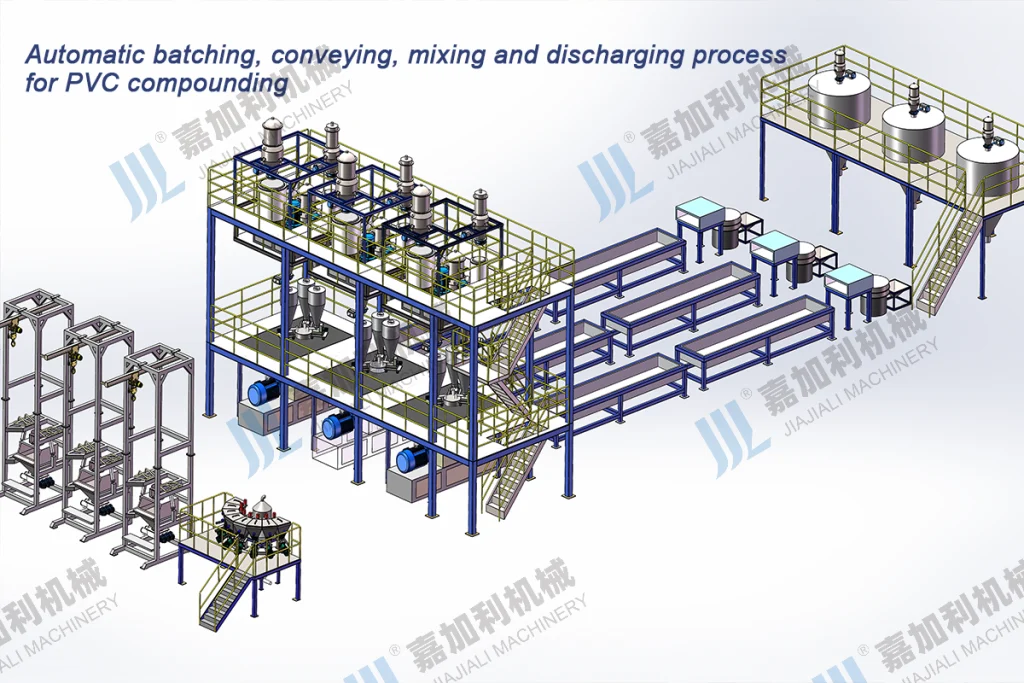
Automatic compounding — the whole chain. Batching is just the first step; the system also handles material feeding, conveying to the mixer, the mix cycle, and discharging the finished dry blend, all linked together.
The full-automatic compounding system sold by JIAJIALI is the second definition: an integrated batching, conveying and mixing all-in-one system with PLC + HMI intelligent linkage. Once the recipe is entered, the line runs from raw material intake to finished compound without an operator carrying a bag anywhere.
The Four Functions Inside the System
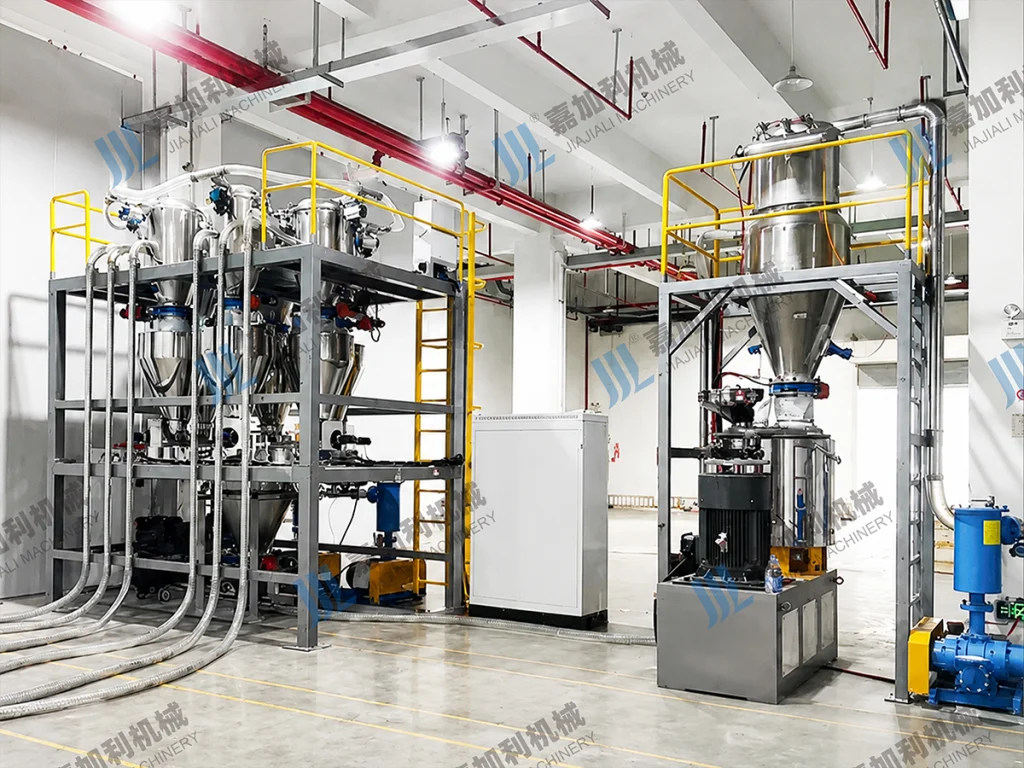
Whatever the vendor calls it, an automatic compounding system does four jobs. If a “system” is missing one of these, it is really just a feeder or just a mixer.
1. Weighing and Dosing
Each raw material — resin, CaCO₃, stabilizer, lubricant, pigment — sits in its own storage bin with a discharge device underneath. The controller calls each one in turn and weighs the target amount.
Loss-in-weight feeding suits the small, high-value, or tight-tolerance components. The feeder measures the *rate of weight loss over time*, which is far more accurate than a volumetric screw at low rates. See loss-in-weight feeding systems.
Gravimetric or volumetric batching suits the bulk components where a slightly wider tolerance is acceptable.
For a classic multi-component PVC recipe, a dedicated automatic formula machine handles the batch weighing and hands the complete batch to the mixer.
2. Conveying and Feeding
The weighed batch has to travel to the mixer, and raw materials have to travel from storage to the bins. Enclosed conveying keeps the dust where it belongs:
- Vacuum or pneumatic lines lift powder from ground level into day bins.
- A central feeding system distributes material to multiple destinations.
- A pipe chain conveyor handles powder gently over longer or more complex routes.
3. Mixing
The batch drops into the mixer. For PVC the workhorse is a high-speed hot mixer — the SHR high speed mixer uses blade friction to throw the powder against the bowl wall and heat it to roughly 100–120 °C, driving off moisture and coating the resin with additives. Combined hot/cold units such as the SRL-Z hot/cold mixing unit discharge straight from the hot pot into a jacketed cooling pot. A WSH horizontal ribbon mixer covers gentler, large-volume dry blending duties.
4. Discharging and Storage
When the batch is done, the system discharges it — to a pelletizing line, to a buffer silo, or straight to extruder hoppers — and logs the batch. Batch logging is the quiet superpower of automation: when a customer complains about one drum of compound, you can trace exactly what went into it.
## What an Automatic System Fixes in a PVC Plant
The pitch is “unmanned production,” but the practical wins are more specific:
| Problem (manual line) | What automation changes |
|---|---|
| Operator weighing error | Fixed recipe tolerances, no human judgement |
| Inconsistent batches | High batch-to-batch consistency, less waste |
| Powder dust everywhere | Closed, dust-free conveying |
| Labour tied to the mixer | Fewer hands per tonne, more output per shift |
| Recipe changes are fiddly | PLC formula switching, saved and repeatable |
| No traceability | Automatic batch records |
For a plant running several grades or colours a week, the recipe switching alone often justifies the upgrade — changing a formula becomes a screen action, not a re-training exercise.
Automation Levels: How Far Do You Go?
Not every plant needs “unmanned.” It pays to pick a level deliberately:
Manual batching + automatic mixing — cheapest. Operators weigh, the mixer handles the cycle. Fine for low output and one or two products.
Semi-automatic — automatic dosing and batching, manual transfer to the mixer. A common middle step for growing plants.
Full-automatic integrated — automatic weighing, batching, conveying, mixing and discharge under one PLC. The choice for standardised, large-scale production.
The honest rule of thumb: manual weighing stops making economic sense somewhere around 500–800 kg/h of finished compound, or as soon as your recipe count and quality demands climb.
Sizing an Automatic Compounding System
Four numbers drive the whole specification. Get these nailed down before you talk price:
Recipe and component count — how many materials, and how tight is the smallest one? More components and tighter ratios push you toward loss-in-weight dosing.
Required output (kg/h or batches/shift) — sizes the storage bins, feeders, mixer and conveying line.
Batch size and cycle time — sets the mixer volume; the cooling or discharge stage must keep up with the hot mixer.
Layout and distances — bin farm to mixer to downstream; this decides vacuum, pneumatic or mechanical conveying.
A multi-material, high-output PVC line with tight tolerances is a very different system from a two-component colour-blending setup, and the price reflects it. Define the four numbers first, then price the line that matches — not the other way around.
When It Pays for Itself
Automatic compounding is capital equipment, so look at payback honestly:
Labour — one operator can oversee a line that used to need several.
Material waste — accurate dosing means you stop giving away over-fills; over a year of CaCO₃ and stabilizer that adds up fast.
Scrap and rework — consistent batches mean fewer rejected products.
Throughput — faster, less interrupted cycles raise output from the same floor space.
Plants that compound a lot of different products, or that have been burned by quality claims, tend to see the fastest return. A single steady product at low volume may not need the full system.
Buying Checklist
- Recipe list and component count — the smallest and tightest component first.
- Target output (kg/h) and shift pattern.
- Required weighing accuracy per component.
- Whether you need pellets out (then include downstream granulation).
- Dust and ATEX / area classification requirements.
- Available floor space and ceiling height (bins and mixers are tall).
- Existing mixers you want the new system to feed.
- Traceability / batch-reporting needs.
- Whether you want the full integrated system or batching only.
FAQ
Q: What is the difference between automatic batching and an automatic compounding system?
A: Automatic batching covers the weighing and dosing of each component only. An automatic compounding system integrates batching with feeding, conveying, mixing and discharging, all linked under one PLC controller, so the whole line runs as a single process.
Q: Is an automatic compounding system suitable for small factories?
A: Often not the full integrated version. A small operation running one or two products at low output is usually better served by an automatic formula machine feeding an existing mixer, and can scale up later. The full system pays off as output, recipe count and quality demands rise.
Q: How accurate are the feeders in an automatic system?
A: It depends on the component. Bulk materials are typically handled gravimetrically to within a fraction of a percent of batch weight, while small additives use loss-in-weight feeders for tighter control at low rates. Confirm the required tolerance per component with the supplier — it drives which feeder type you need.
Q: Can I automate an existing PVC line, or do I need all new equipment?
A: Partly. If your existing mixers are sound, a system can be built to feed them automatically. What usually gets replaced is the manual weighing stage, and bins, feeders and controls are added around the existing mixing equipment.
Q: What controls the whole system — do I need special software?
A: A PLC plus HMI is the industry-standard control package. Recipes, batch targets and sequences are configured on the HMI, and most systems support saving multiple formulas and switching between them without re-programming. Batch data can usually be logged for traceability.
Q: Why is dust-free conveying such a big deal in PVC compounding?
A: PVC powder and fine fillers are a health and housekeeping problem, and they also represent lost material. Enclosed conveying keeps the workshop clean, reduces exposure, and stops the fine material you paid for from settling on the ceiling.
Q: How long does it take to commission an automatic compounding line?
A: It varies with system complexity, but a full integrated line is a project rather than a purchase — expect design, manufacture, shipping, installation, and a tuning phase where recipes are dialled in. Ask the supplier for a realistic schedule and a commissioning plan rather than a single delivery date.
Specifying an automatic compounding system for PVC? Tell JIAJIALI your recipe, component count, target output and layout — they will specify the dosing, conveying and mixing stages as one matched system. See the full range under Mixing Equipment, or contact us with your material path and throughput.