
Buying a plastic mixer looks simple — you need something that blends powder or pellets, so you pick a machine and order it. Then the expensive lessons start: the mixer can’t keep up with the line, the blend isn’t uniform, abrasive filler eats the blades, or cleaning between products takes an hour a batch.
The difference between a mixer that earns its keep and one that becomes a bottleneck comes down to eight questions. Ask them of every supplier before you sign, and you’ll end up with a machine that fits your material, your output, and your maintenance reality.
Question 1: What Material Are You Mixing, and How Does It Behave?
The material decides the machine far more than the price list does. Ask yourself, then ask the supplier:
- Powder, pellets, or paste?
- Bulk density — light, fluffy powders need more volume; dense granules need more torque.
- Flowability — free-flowing pellets blend easily; cohesive powders demand a different action.
- Abrasiveness — calcium carbonate, glass fibre, and mineral fillers wear blades and bowls.
- Fragility — if you’re handling pellets that mustn’t break, aggressive high-shear action is wrong.
- Heat sensitivity — PVC and some compounds must not see excess friction heat.
- Hygiene or contamination concerns — food, medical, or colour-change duty changes the whole design.
A supplier who never asks about your material is a supplier who sells you the machine they stock, not the machine you need.
Question 2: Which Mixing Action Do You Actually Need?
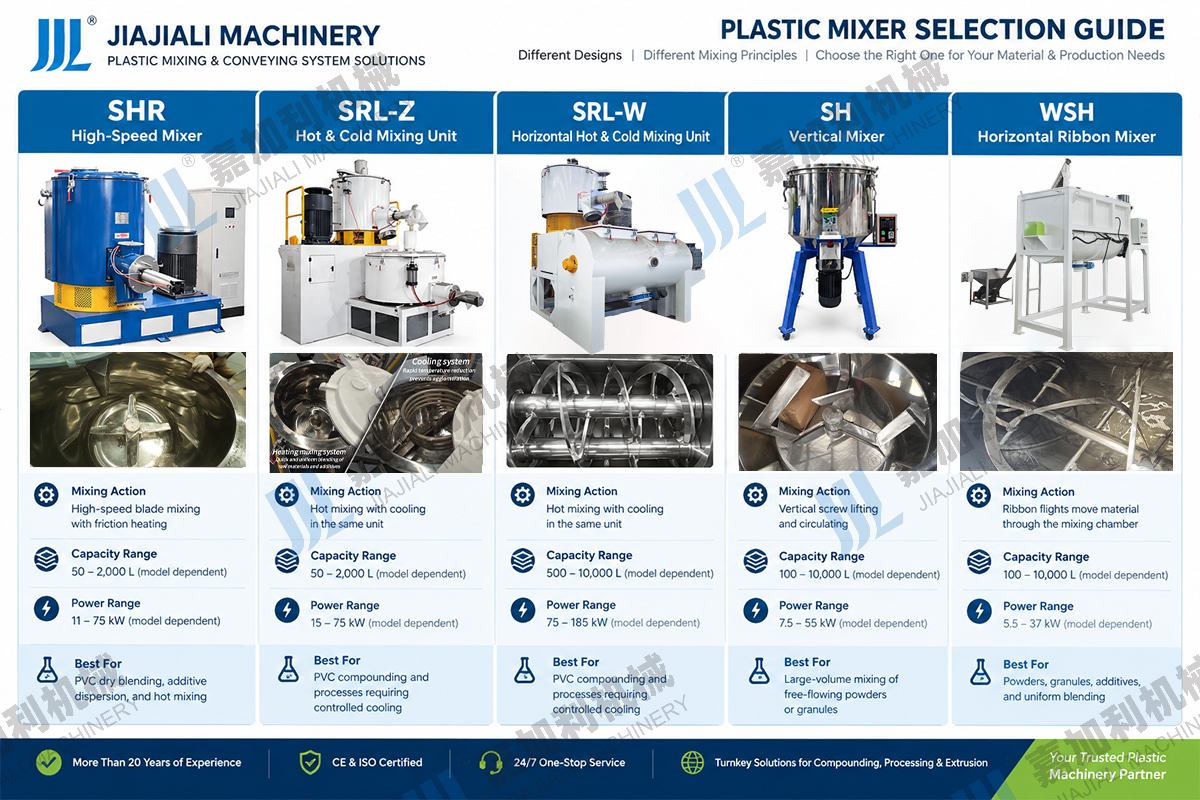
Plastic mixers are not interchangeable. Each design exists because a different duty needs a different mixing principle:
| Type | Action | Best for |
|---|---|---|
| High-speed mixer (SHR) | High-speed blade mixing with friction heating | PVC dry blending, additive dispersion, and hot mixing |
| Vertical mixer (SH) | Vertical screw lifting and circulating | Large-volume mixing of free-flowing powders or granules |
| Horizontal ribbon mixer (WSH) | Ribbon flights move material through the mixing chamber | Powders, granules, additives, and uniform blending |
| Hot/cold mixing unit (SRL-Z) / SRL-W | Hot mixing followed by rapid cooling | PVC compounding and processes requiring controlled cooling |
If a supplier offers you one type for every job, that’s a warning sign. The right recommendation depends on questions 1 and 3.
Question 3: What Batch Size and Throughput Do You Need?
Mixing is usually a batch process, and batch size drives everything: mixer volume, motor power, mixing time, and how the machine connects to the rest of your line.
- Batch weight (kg) × batches per hour = your hourly output. Check that figure against what your extruder or pelletizer actually consumes.
- Fill factor — most mixers run best at roughly 60–80 % of rated volume. A “1000 L” mixer does not give you 1000 L of usable batch.
- Mixing time — short cycle times look good on a brochure but must still deliver a uniform blend. Ask for cycle time *and* uniformity evidence, not just the fast number.
Buying on batch size alone, without checking the downstream line’s appetite, is how mixers end up either starving the extruder or sitting idle half the day.
Question 4: What Are the Wetted Parts Made Of?
For powder and granule handling, the parts that touch your material need to suit the material and the cleaning regime:
- Stainless steel 304 — general purpose, corrosion-resistant, easy to clean.
- Stainless steel 316 — for aggressive or corrosive additives.
- Wear liners or hardened blades — essential with abrasive fillers; without them you’ll be replacing blades annually.
- Surface finish — polished or mirror finishes matter for colour changes and hygiene duty.
Ask specifically: **what grade, what thickness, and what’s the wear part**. Vague answers here get expensive later.
Question 5: How Is It Heated — If It Needs Heat?
Not every mixer heats, but for PVC and some additive blends, heat is the whole point. Options:
- Self-friction heating — the mixer’s own action generates the heat, as in the SHR high-speed mixer. Simple, efficient, no extra energy input.
- Electric heating — jacket or element heating when friction alone can’t reach temperature.
- Oil or water jacket — for heating *and* cooling, with more precise control.
The follow-up question: **how is temperature measured and controlled?** A mixer without reliable temperature feedback is a mixer that burns batches.
Question 6: How Does It Discharge and Clean?
Two costs hide in the discharge design and the cleaning procedure:
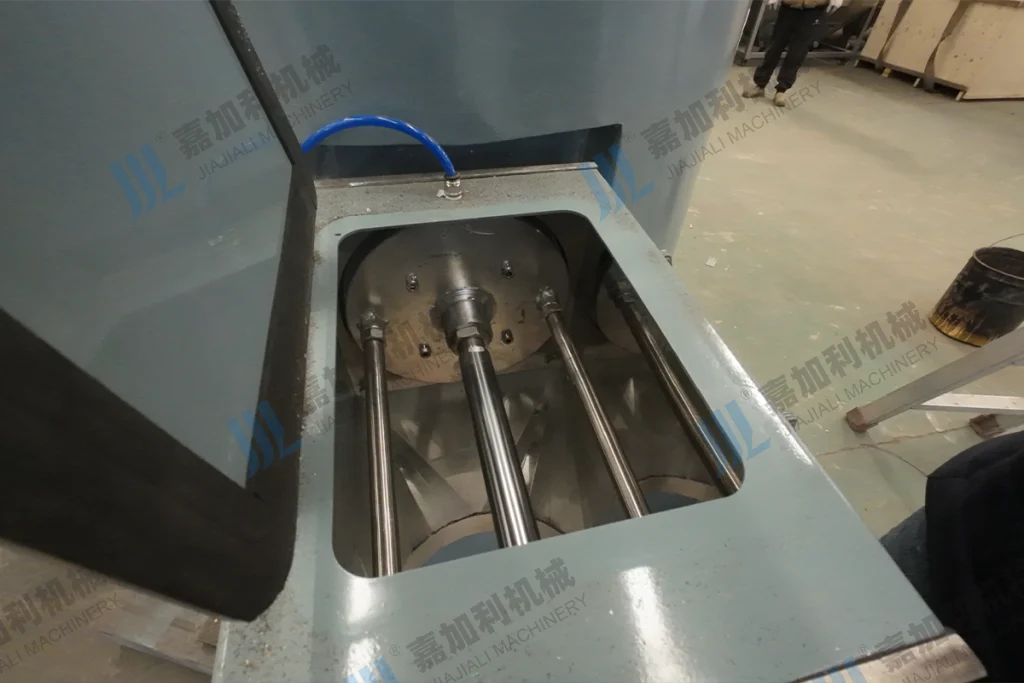
Discharge — pneumatic or manual flap, how fast the batch empties, and whether residue lingers. Fast, complete discharge protects cycle time.
Cleaning — between colour changes or products, how long does it take and what tools are needed? Poor access means either long downtime or cross-contamination.
If you run multiple colours or products, ask for the cleaning time and access design in writing.
Question 7: How Does It Integrate With Your Line?
A mixer does not work alone. It sits in a chain that may include a dosing and batching system, a vacuum or central feeding system, and downstream extrusion or pelletizing. Ask:
- How is the mixer fed? Manual, vacuum, gravity, or automatic dosing?
- How does it discharge to the next stage? Direct, screw, pipe chain, or pneumatic?
- Control and automation — PLC, recipes, alarms, interface to your existing controls?
- Footprint and height — does it fit the space, including the discharge clearance?
A mixer that fits perfectly on its own but doesn’t fit your line is still the wrong mixer.
Question 8: What Support Comes After the Sale?
This is where suppliers separate. Ask directly:
- Commissioning and training — who installs, who trains your operators, and is it included?
- Spare parts — blades, belts, seals, bearings: availability and lead time.
- Warranty — what’s covered, for how long, and what voids it.
- References — can they name customers running a similar material? A supplier who won’t share references is telling you something.
- Response time — when a mixer stops, your line stops. Ask how fast they respond.
For a machine that runs every shift for years, after-sales support is not a soft extra — it’s part of the price.
The Short Version
| Ask about | Why it matters |
|---|---|
| Material behaviour | Determines the mixer type and materials of construction |
| Mixing action | Different applications require different mixing principles |
| Batch size & throughput | Must match the downstream line, not just the mixer capacity |
| Wetted parts & wear | Affects service life, maintenance, and operating cost |
| Heating & temperature control | Important for PVC and other heat-sensitive materials |
| Discharge & cleaning | Affects cycle time, downtime, and cross-contamination |
| Line integration | The mixer must work smoothly with the rest of the production line |
| After-sales support | Spare parts, service, and technical support affect long-term uptime |
FAQ
Q: What’s the best type of plastic mixer?
A: There’s no single best type — it depends on your material and duty. High-speed mixers (SHR) suit PVC dry blend and additive dispersion; vertical mixers (SH) handle large volumes of free-flowing granules gently; horizontal ribbon mixers (WSH) are excellent for powders and uniform granular blends. The right choice comes from your material, batch size, and process.
Q: How do I calculate the mixer size I need?
A: Work from batch weight and batches per hour to get hourly output, then match that to what your downstream equipment consumes. Remember the usable batch is only about 60–80 % of rated volume, so size the machine on usable capacity, not the nameplate litre figure.
Q: Vertical or horizontal mixer — which is better?
A: Vertical mixers are gentler and use less energy for large volumes of free-flowing material, and take less floor space for their capacity. Horizontal ribbon mixers give more thorough blending of powders and additives and often better uniformity. The decision follows from your material and your required blend quality, not from a general rule.
Q: Do I need a hot/cold mixing unit?
A: If you’re compounding PVC or any material that must be heated and then cooled quickly, yes. A combined hot/cold unit mixes at high speed and discharges straight into a cooling vessel, producing a stable dry blend without degradation. If your product is simply blended and doesn’t need heat, a single mixer is enough.
Q: How long should a plastic mixer last?
A: With the right materials of construction and a basic maintenance routine, a good industrial mixer can serve for many years — often well over a decade. Abrasive fillers are the main lifespan limit, which is why wear liners and hardened blades matter. Ask what the wear parts cost and how often they’re expected to be replaced.
Q: Can I mix different materials in the same mixer?
A: Yes, but cleaning between products determines how practical that is. Ask about cleaning time, access, and surface finish before you plan to run multiple colours or recipes through one machine.
Comparing plastic mixer suppliers? Send JIAJIALI your material, batch size, required output, and what the mixer connects to — they’ll recommend the right type from the full range and quote it properly. Browse Mixing Equipment or contact us directly.