
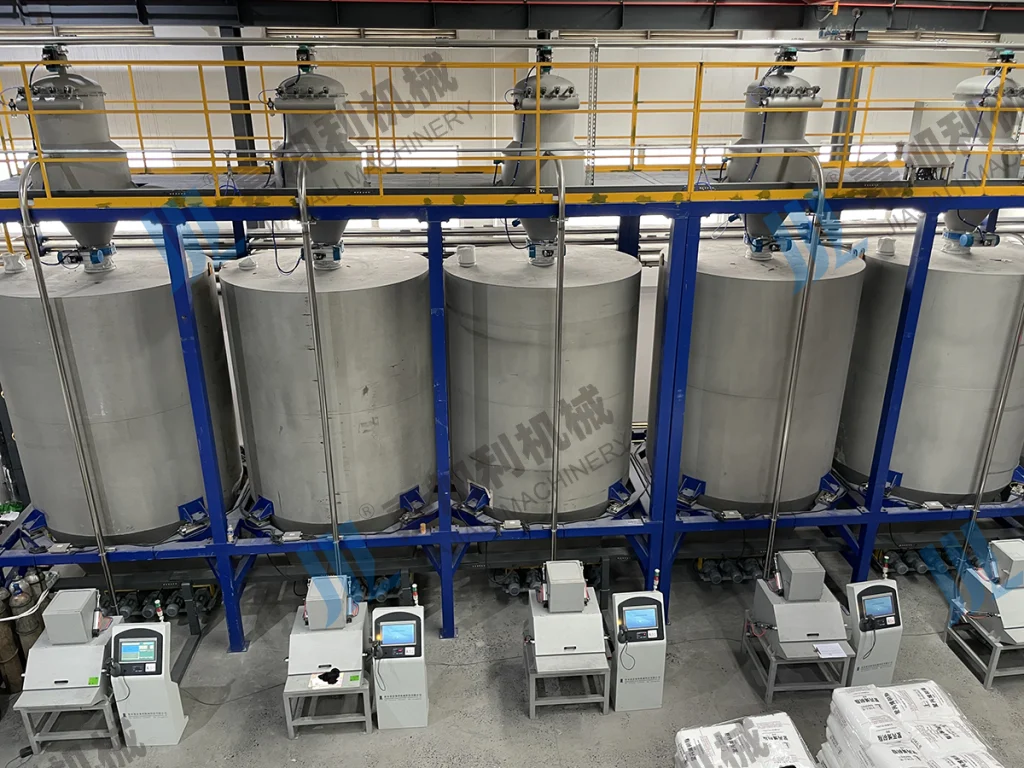
If your injection molding workshop still relies on workers manually carrying bags of resin from storage areas to proIf your injection molding workshop still relies on workers carrying bags of resin from a warehouse to each machine, you already know the pain: dust in the air, material waste, inconsistent supply, and labor costs that keep climbing.In this guide, “central feeding system” and “centralized feeding system” mean the same thing — a plant-wide material conveying setup. We’ll use both terms so it’s clear they’re interchangeable.
A centralized feeding system solves all of this. It moves plastic pellets from a central storage point to every molding machine automatically, through sealed pipelines — with no manual handling in between.
This guide covers how these systems work, what they’re made of, what they actually save you, and how to choose the right one for your plant.
What Is a Centralized Feeding System?
A centralized feeding system (also called a central feeding system or central material feeding system) is an automated material handling solution that stores plastic resin in one place and distributes it to multiple injection molding machines or extrusion lines through a network of sealed pipes.
Instead of each machine having its own loader and its own supply of bags, one system serves the whole workshop: raw material is stored centrally, conveyed on demand, and delivered to each machine automatically.
It’s the standard upgrade that turns a manual workshop into an automated one — and for most injection molding plants, it’s the first step toward a “smart factory.”
Central Feeding System vs Centralized Feeding System: Same Equipment
Buyers search for this equipment under several names, and they all describe the same system:
Central feeding system – the most common short form.
Centralized feeding system / centralized material feeding system – the formal version.
Central material conveying system – emphasises the conveying hardware.
Automatic feeding system – emphasises the automation aspect.
If a supplier treats these as different products, that’s a red flag. The right question isn’t the name – it’s whether the system is designed around your machine count, materials, and plant layout.
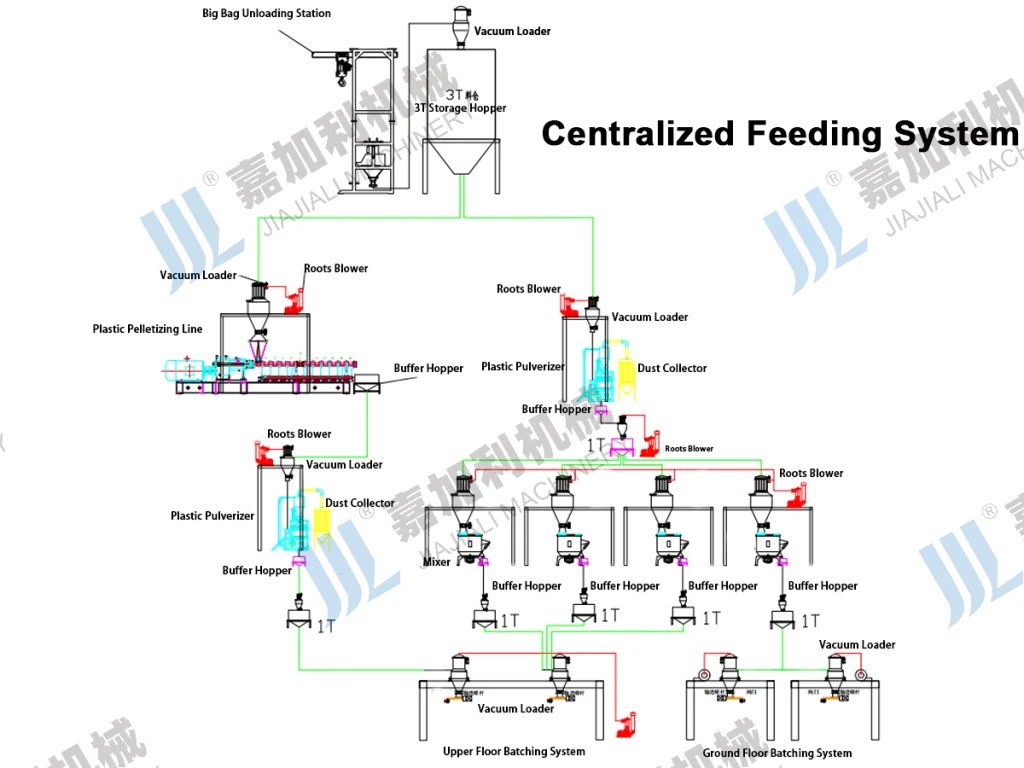
How a Centralized Feeding System Work?
A typical centralized feeding system operates through five main steps:
1. Material Storage
Resin (virgin pellets, regrind, or additives) is stored centrally in hoppers, silos, or at a feeding station, often with a ton bag discharging station for big-bag materials.
2.Conveying
A vacuum blower creates negative pressure in the pipeline, pulling pellets from storage to each machine’s receiver. For longer distances or powder materials, positive-pressure or pipe chain conveying can be used.
3. Distribution
A central control system directs material to the right machine at the right time. Each molding machine has a vacuum receiver with a level sensor.
4. Dosing
When a machine’s hopper drops below the set level, the sensor triggers the system to refill it automatically.
5. Monitoring
The PLC control panel shows material levels and conveying status across the whole plant in real time.
The result: every machine gets a steady, uninterrupted supply of material — no waiting, no shortages, no workers carrying bags.
Key Components You Should Know
If you’re comparing quotes from suppliers, here’s what a complete system should include:
- Central vacuum blower (with redundancy — if one blower fails, production continues)
- Dust collection unit with pulse cleaning
- Material storage & feeding station (hoppers, silos, or bag discharge)
- Distribution station / manifold that routes material to each machine
- Vacuum receivers on each injection molding machine
- PLC control system with touchscreen monitoring
Optional: vacuum automatic feeders for standalone machine loading
Ask the supplier which components are included in the quote — a “cheap” system often turns out to be missing the dust collection or the redundancy blower.
What Does It Actually Save You?
Numbers vary by plant, but based on real installations, a centralized feeding system typically delivers:
- Labor reduction of 60–75% — feeding 20 machines used to need 6–8 workers per shift; with automation, one operator can monitor the whole system.
- Material loss cut from ~8% to under 3% — closed-pipe conveying eliminates spillage, contamination, and bag residue.
- Production efficiency up 50%+ — no downtime waiting for material, consistent supply to every machine.
- Cleaner, safer workshop — dust-free conveying improves air quality and reduces fire and contamination risks.
- Consistent product quality — stable material supply and accurate dosing reduce color variation and defects.
Most systems pay for themselves within 6–12 months, mainly through labor savings and reduced material waste.
Real Project: Injection Molding Factory in Vietnam
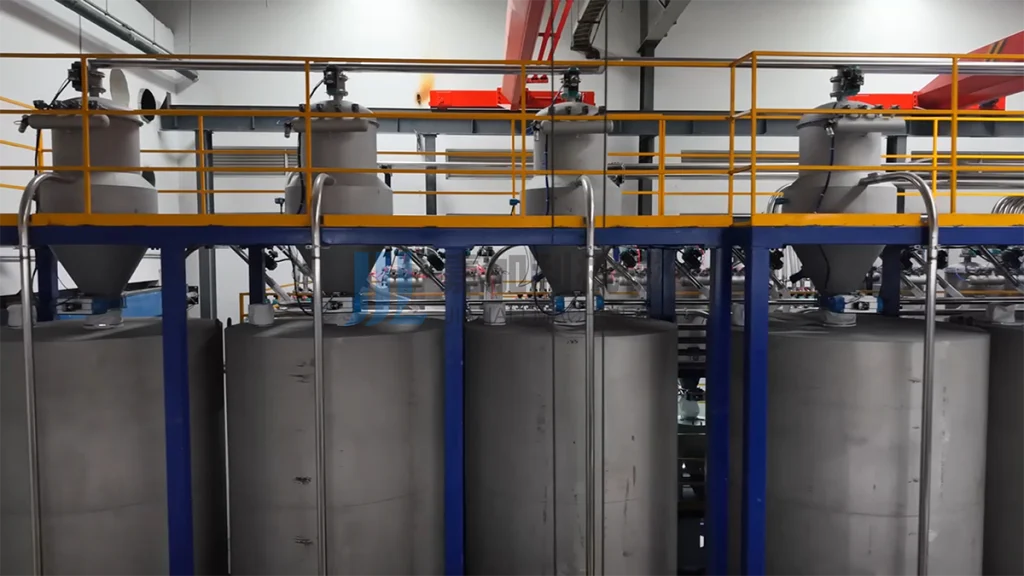
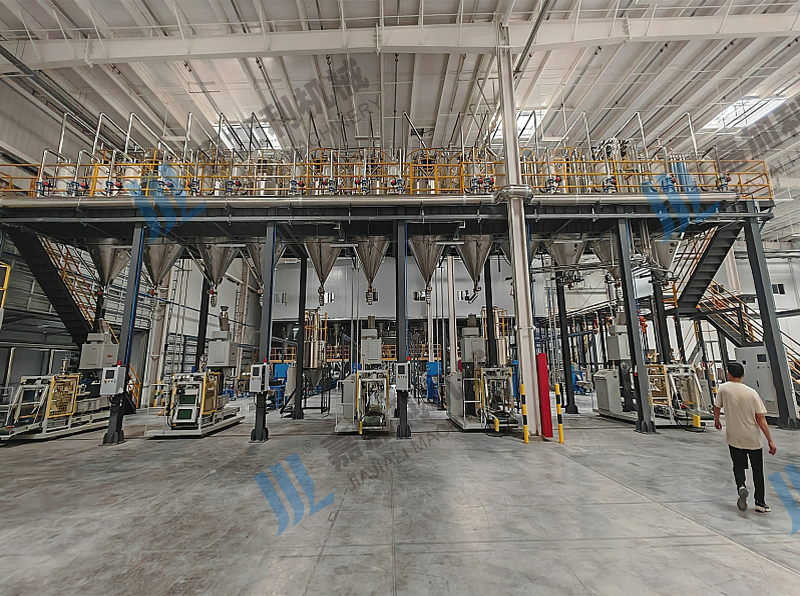
In 2025, JIAJIALI delivered a customized centralized material feeding system for an injection molding factory in Vietnam. The requirement was straightforward but demanding: multiple production machines, automatic raw material conveying, centralized storage, and stable material supply around the clock.
The solution included a central feeding system, vacuum conveying units, storage hoppers, and a material distribution control system. The result: fully automatic conveying and feeding across the workshop, with manual handling errors eliminated and production efficiency up significantly.
It’s a good example of how a system gets designed around a specific plant layout — not sold as a one-size-fits-all package.
Is a Centralized Feeding System Expensive?
Compared to a single vacuum loader (a few hundred dollars), yes — a complete system is a real investment. But compare it to the alternative: 6–8 workers per shift, 8% material loss, and machines that stop when material runs out.
The honest answer is that ROI depends on plant size. As a rough rule:
- 5–10 machines — automation starts to pay off; consider a compact central system or standalone vacuum feeders first.
- 10–30 machines — a full centralized system is usually the right call, with payback typically 6–12 months.
- 30+ machines — the larger the plant, the faster the payback; a ring-type or multi-branch system with redundancy is worth the investment.
Get a layout-based quotation — good suppliers will design the conveying distance, pipe diameters, and blower capacity around your actual workshop, not a catalog.
How to Choose the Right System: 7 Questions to Ask
1. How many machines need feeding, and what are their hourly consumption rates?
This determines conveying capacity and pipe sizing.
2. What materials are you handling?
Pellets, regrind, powder, and fragile materials behave differently; powders need special conveying speeds to avoid segregation.
3. What’s the conveying distance and plant layout?
Longer distances may need positive-pressure or pipe chain conveying instead of vacuum only.
4. Do you need drying integrated?
For hygroscopic materials like PET and PA, the system should include dryers between storage and the machine.
5. Is the blower redundant?
A single point of failure can stop your whole workshop.
6. What control level do you need?
PLC with touchscreen, remote monitoring, or full integration with your MES/ERP?
7. Who handles installation and training?
Insist on on-site commissioning and operator training.
FAQ
Q: Can a centralized feeding system handle different materials on different machines?
A: Yes. The system routes material on demand, so machine A can receive virgin ABS while machine B receives regrind or a blend. Recipes and ratios are managed by the control system.
Q: What’s the maximum conveying distance?
A: For vacuum conveying, practical distances are typically 30–100 meters depending on material and pipe size. Beyond that, positive-pressure or pipe chain conveying is usually a better choice. Tell your supplier the actual layout and they’ll size it correctly.
Q: Does the system work with powder materials, or only pellets?
A: Both, but powder conveying needs different design parameters (lower conveying speed, special receiver design) to avoid segregation and dust explosion risks. Make sure the supplier knows you’re handling powder before they quote.
Q: How long does installation take?
A: For a typical 10–20 machine plant, installation and commissioning usually takes 1–2 weeks, depending on site preparation. Your supplier should provide a detailed installation schedule and on-site training.
Q: Can I add machines to the system later?
A: Yes — this is one of the main advantages. A well-designed system has spare capacity in the blower and distribution station, so you can extend the pipeline when you add machines. Design for future expansion from day one.
Q: How is the system controlled?
A: Most systems use a PLC with a touchscreen control panel. Material levels, conveying cycles, and alarms are all monitored from one place. Advanced systems offer remote monitoring and integration with factory management software.
Q: What is a central feeding system?
A: A central feeding system (also called a centralized feeding system) stores plastic resin in one central location and automatically conveys it to every machine in the plant through sealed pipes. It replaces manual bag handling and individual machine loaders with one controlled, dust-free supply network.
Q: How much does a central feeding system cost?
A: Cost scales with machine count, conveying distance, and control level – a compact system for 5-10 machines costs a fraction of a full plant-wide installation for 30+. Because the savings come from labour, material waste, and uptime, the more machines you have, the faster the payback. Ask for a layout-based quote rather than a catalogue price; see our ROI guide to dosing and batching for the calculation method.
Q: How many machines can one central feeding system handle?
A: A well-designed system feeds anywhere from 5-10 machines up to 30+, using a distribution station and one vacuum receiver per machine. The limit is conveying distance and capacity, not machine count – design spare capacity from day one so you can add machines later.
Ready to Automate Your Material Handling?
Every injection molding workshop is different, which is why JIAJIALI designs centralized feeding systems around your actual plant layout — machine count, materials, distances, and future expansion plans.
With more than 20 years in plastic mixing, dosing, and conveying, we deliver complete turnkey systems, from design and manufacturing to installation and training. OEM/ODM customization is available.
Contact our team with your workshop details — machine count, materials, and layout — and we’ll come back with a system design and quotation within 24 hours.