
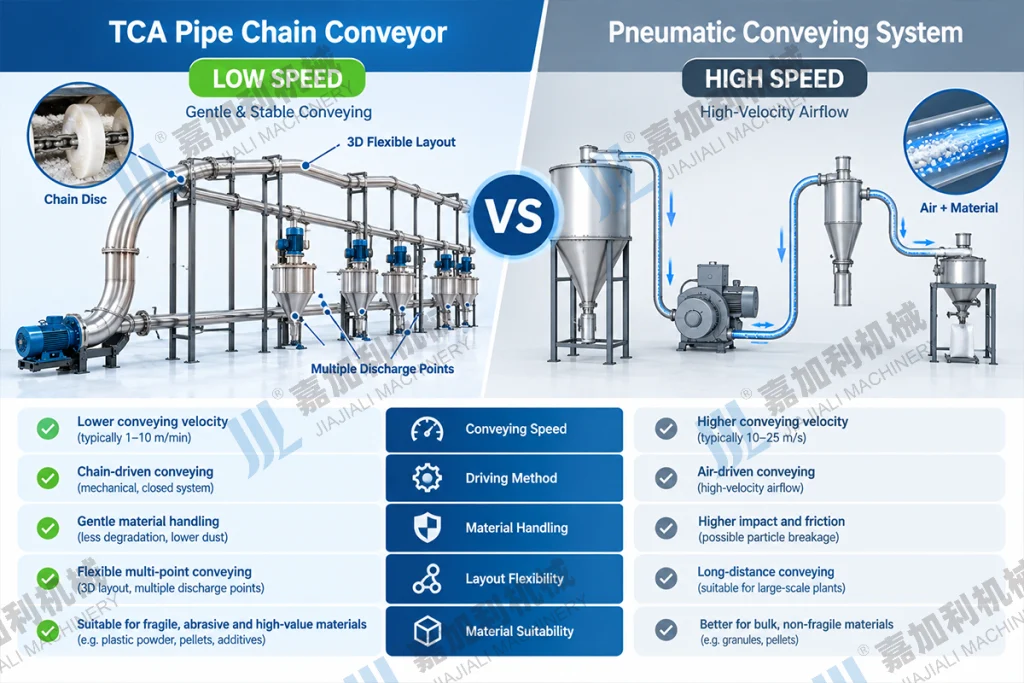
You need to move plastic powder or pellets from a silo or bag station to a mixer, extruder, or machine hopper — through a plant with walls, mezzanines, and existing equipment in the way. Two families of equipment do this job, and they work on completely different principles:
- Pipe chain conveyor drag material through a pipe with a chain and disc assembly, slowly.
- Pneumatic conveying suspends material in a fast-moving air stream.
Both are enclosed, both are dust-free, and both can turn corners. But they behave very differently with your material, your electricity bill, and your floor plan. This guide compares them head-to-head so you can pick the right one.
How a Pipe Chain Conveyor Works
A pipe chain conveyor (often called a tubular drag conveyor) runs a continuous chain inside a sealed pipe. Discs or paddles are spaced along the chain; the chain drags material from the inlet to one or more outlets, then loops back through the return pipe.
The TCA pipe chain conveyor is built exactly this way. Its defining traits:
- Fully enclosed pipe — zero dust pollution, no material leakage.
- 3D flexible layout — horizontal, vertical, and bending sections in one run, so it adapts to tight workshop spaces.
- Low-speed, stable conveying — no material particle damage.
- Low energy consumption, low noise, long service life.
Typical throughput runs from a few hundred litres per hour up to around 27 m³/h depending on pipe size (see the spec table below).
How Pneumatic Conveying Works
Pneumatic conveying uses air as the carrier. A blower or compressor pushes (or pulls) air through a pipe, and the material rides the airflow. It comes in two flavours:
Dilute phase
High air speed, low material-to-air ratio. Material flies through the pipe suspended in air.
Dense phase
Low speed, high material-to-air ratio. Material moves as slow slugs or plugs.
Pneumatic systems are the default answer for vacuum conveying to machine hoppers — that’s what a vacuum automatic feeder does. Their strengths are long runs, easy routing, and simple “point-to-many-points” distribution.
Head-to-Head Comparison
| Factor | Pipe chain conveyor (TCA) | Pneumatic conveying |
|---|---|---|
| Carrier | Chain + discs, mechanical | Air, kinetic |
| Speed | Low (6–30 r/min) | High (dilute phase) or slow (dense phase) |
| Material damage / fines | Minimal — gentle drag | Dilute phase can break pellets and create dust |
| Energy use | Low — only moves the chain | Higher — air must be kept moving continuously |
| Distance | Very long runs, single drive | Good to excellent, especially vacuum lines |
| Layout | Full 3D — multi-plane bends in one run | Flexible, but bends add pressure loss |
| Multi-point discharge | Yes — several outlets on one run | Yes, via diverters |
| Moisture / temperature | No air, so no drying or cooling effect | Air can dry or cool (helpful or harmful) |
| Explosion/ATEX | Lower dust generation | Air + powder needs careful classification |
| Noise | Low | Blower/compressor dependent |
| Best for | Fragile pellets, abrasive powders, long routed runs, multi-point drop | Machine loading, long vacuum lines, many small destinations |
Energy: The Numbers That Surprise People
The most under-appreciated difference is energy. Pneumatic conveying works by keeping air constantly in motion; a dilute-phase line can spend most of its energy on the air rather than the product. Pipe chain conveying moves only the chain and the material, at low speed.
Industry comparisons commonly put dilute-phase pneumatic systems at several times the specific energy consumption of a mechanical chain conveyor for the same duty. That gap matters because conveying runs every shift, every day — it’s a continuous load. If you’re choosing between the two on a high-volume, long-run duty, ask both suppliers for kWh per tonne conveyed, not just motor nameplate power.
Where Each System Wins
Choose a pipe chain conveyor when:
- The material is fragile — pellets where fines and streamers cost you product quality.
- You handle abrasive powders that would wear a high-speed line.
- You need one continuous run with several discharge points along a complex route.
- You want the lowest energy per tonne on a long, continuous duty.
- Dust generation and explosion risk need to stay as low as possible.
Choose pneumatic conveying when:
- You’re loading many machine hoppers from a central source — the classic central feeding system layout.
- The route is long and routing a chain return pipe is awkward.
- You want vacuum pickup from bags or drums with flexible hosing.
- The material tolerates air movement and you value simple, standard components.
TCA Pipe Chain Conveyor Specifications
| Type | Motor power (kW) | Pipe size | Speed (r/min) | Capacity (m³/h) |
|---|---|---|---|---|
| TCA-80 | 0.37 – 3 | DN80 | 6 – 30 | 0.3 – 5 |
| TCA-100 | 0.4 – 4 | DN100 | 6 – 30 | 0.45 – 8 |
| TCA-125 | 0.55 – 5.5 | DN125 | 6 – 25 | 3 – 19 |
| TCA-150 | 2 – 7.5 | DN150 | 8 – 20 | 5 – 27 |
Note how little power even the largest unit needs: 7.5 kW at the top of the range, moving up to 27 m³/h. That’s the mechanical advantage in one line of a table.
Can You Use Both?
Often, yes — and in larger plants it’s the smart layout. A common pattern:
- Pipe chain carries bulk material from silo or ton bag station along a long, complex backbone.
- Vacuum conveying branches off to individual machine hoppers or day bins.
- A loss-in-weight feeder handles the precision dosing at the end.
Matching the carrier to the duty — rather than forcing one technology everywhere — is what keeps both energy and maintenance under control.
How to Decide in Practice
Work through these questions in order:
1.Is the material fragile or abrasive?
If yes, lean mechanical (pipe chain).
2.How many destinations?
Many small hoppers favour vacuum; a few along one route favours pipe chain.
3.How long is the run, and how ugly is the route?
Very long or very awkward routes can favour air.
4.What’s the duty cycle?
Continuous, high-volume runs amplify the energy gap.
5.What’s your kWh per tonne?
Get both suppliers to commit to a number.
FAQ
Q: Will a pipe chain conveyor damage my pellets?
A: Far less than dilute-phase pneumatic conveying. The chain moves slowly and drags material rather than accelerating it against pipe walls, so pellet breakage and fines stay low — one of the main reasons compounders choose it.
Q: Doesn’t pneumatic conveying need less maintenance?
A: It has fewer wear parts in the pipe, but blowers, filters, and rotary valves need attention, and elbows wear fast in abrasive service. Chain conveyors need chain and disc inspection. Which is cheaper depends on your material’s abrasiveness — get wear-part prices for both.
Q: Can a pipe chain conveyor go vertical?
A: Yes. The TCA is designed for 3D routing including vertical lifts, which is why it suits plants where a straight pneumatic run isn’t practical.
Q: Which is better for dusty powders?
A: Both are sealed, so both beat open belts or screw conveyors. Pipe chain generates less dust inside the line because it moves material slowly; pneumatic lines keep powder suspended in air and need proper filtration and, for combustible dusts, area classification.
Q: How do I size the pipe diameter?
A: From your required capacity in m³/h and the material’s bulk density. The TCA table above maps capacity to pipe size — tell the supplier your material and target throughput and they’ll confirm DN80 through DN150 for your case.
—
**Not sure which fits your plant?** Send JIAJIALI a sketch of your material path — source, destination(s), rough distances, and what you’re conveying. They’ll tell you whether a pipe chain conveyor, a pneumatic line, or a combination of the two is the right engineering choice for your floor plan. See the full range under Centralized Feeding & Conveying.