
Vietnam has become one of Southeast Asia’s busiest plastics processing hubs — and the plants that win there are the ones that run continuously, consistently, and with as little manual handling as possible. That was exactly the brief behind our latest project in Vietnam: a PVC processor who needed not one line, but a complete material-to-finished-product chain.
JIAJIALI supplied and integrated two linked systems for this customer:
1. A PVC pelletizing line — turning compounded PVC into uniform pellets.
2. A plastic profile extrusion production line — turning material into finished profiles.
Because both lines share the same philosophy — automatic dosing, tight temperature control, and enclosed conveying — they were designed to work as one plant, not two islands.
The Requirement
The customer’s situation before the upgrade:
The customer needed to improve production coordination between PVC material preparation, pelletizing, and profile extrusion. Integrating these processes helped address common production challenges such as manual material handling and inconsistent material supply.
Their goal was clear:
- Consistent recipe accuracy — every batch within spec, not operator-dependent.
- Higher output with fewer operators — automate weighing, conveying, and feeding.
- Dust-free, enclosed material handling — for a cleaner shop floor and safer working conditions.
- Two end products from one material flow — pellets for sale/feeding, profiles for their own product line.
System 1 — The PVC Pelletizing Line
A PVC pelletizing line is not a single machine; it is a sequence of stages that must be sized to match each other. Here is how the Vietnam line is built.
1.Material Intake
Raw PVC resin and additives arrive in big bags and sacks. A ton bag discharging station unloads bulk resin in a fully enclosed, dust-free process, with an anti-bridging vibration system so material flows evenly into the buffer hopper.
2.Weighing & Dosing
This is the “brain” of the line. An automatic formula machine weighs each component — resin, stabilizer, filler, lubricant — in sequence and discharges the batch to mixing. For tight-tolerance additives, loss-in-weight feeders measure by weight loss over time, giving far better accuracy than volumetric feeding at low rates.
Why it matters: in PVC, 2 phr of stabilizer is not 3 phr. Consistent dosing is what keeps pellets within spec run after run.
3. Hot/Cold Mixing
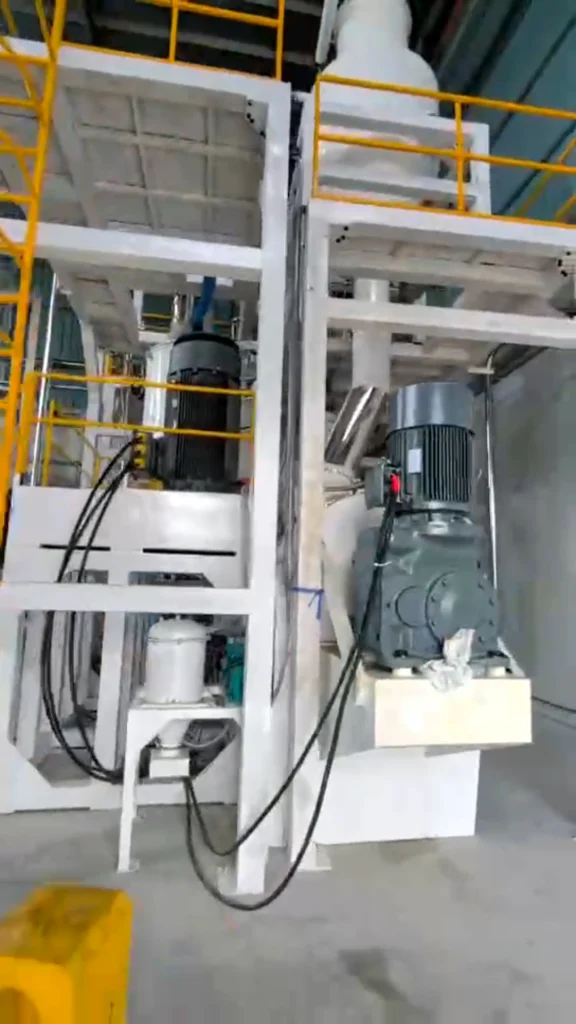
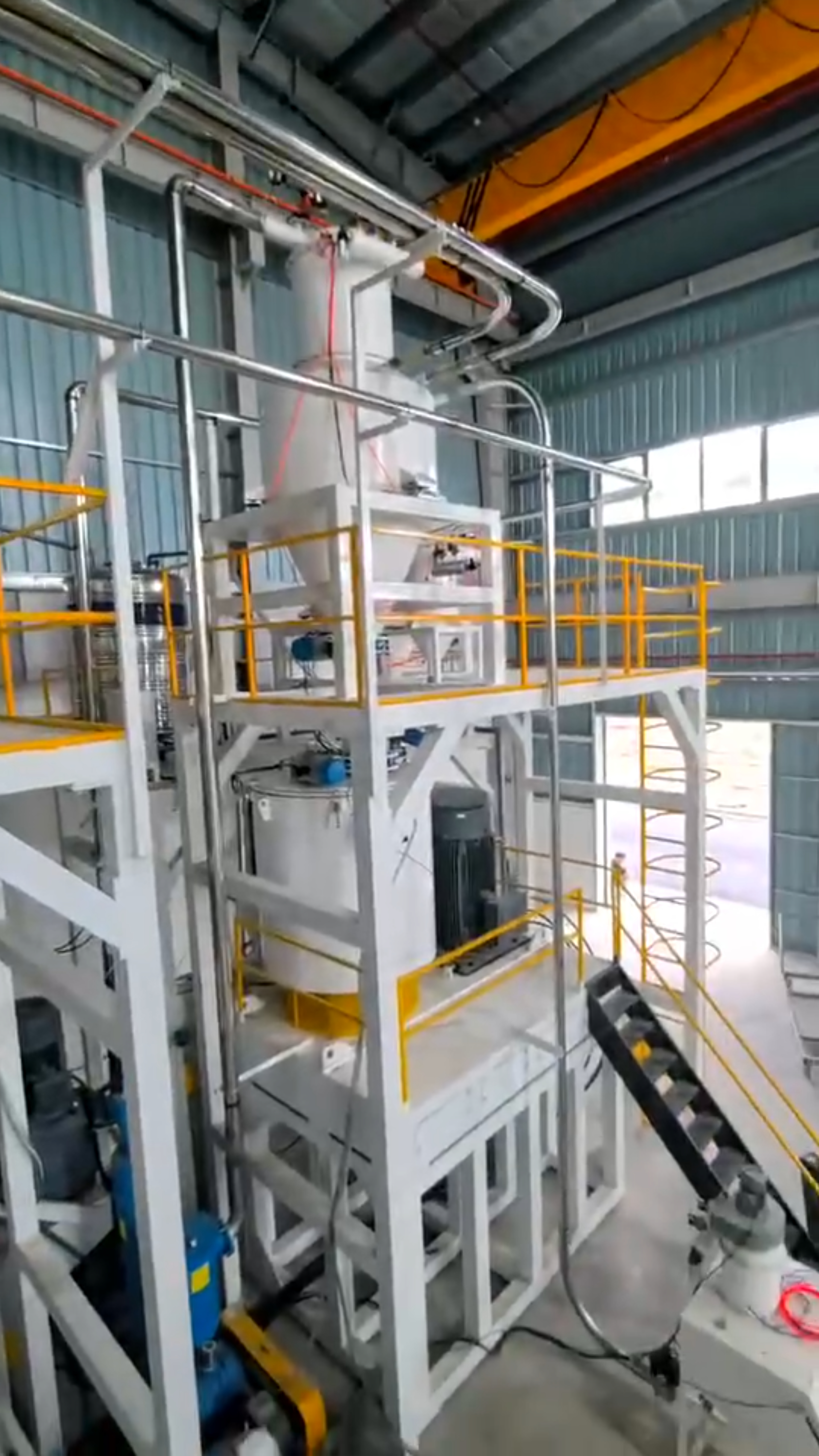
The batch goes into an SRL-W hot/cold mixing unit: high-speed hot mixing (around 100–120 °C) coats the resin with additives and drives out moisture, then the material drops directly into the jacketed cooling mixer to cool below 45 °C into a free-flowing dry blend. Fast, even cooling prevents degradation — the difference between clean pellets and black specks.
4. Conveying
From the cooler, the dry blend travels to the granulation section through an enclosed conveyor — either a TCA pipe chain conveyor for low-energy, multi-point routing, or a central feeding system serving several destinations. Both keep dust in and moisture out.
5. Granulation
The PVC granulation unit converts the compounded dry blend into uniform pellets — engineered specifically for PVC’s heat sensitivity, with a screw and temperature-control system that prevents decomposition. Downstream: cooling, screening, and bagging give the customer finished, sellable compound.
The full sequence — from mixer to pellets — is what the industry calls a PVC pelletizing line.
System 2 — The Profile Extrusion Production Line
Where the pelletizing line makes *material*, the profile extrusion production line makes *product*. It is a fully integrated line for PVC, PE, and PP profiles that runs feeding, extrusion, molding, cooling, haul-off, and cutting as one continuous process.
Key characteristics of the line installed in Vietnam:
- High-speed stable extrusion with a high finished-product rate.
- Intelligent, segmented temperature control for full, uniform plasticization — critical for PVC, which burns if it overheats.
- Multi-mould compatibility — one line can run door/window profiles, decorative profiles, and other plastic profiles by changing the die.
- Energy-efficient, low-consumption design with a long service life.
The line is fed from the same enclosed material-handling side as the pelletizing line, so the plant can swing material between “make pellets” and “make profiles” without a second manual setup.
One Plant, One Control Philosophy
What ties the two lines together is automation. A PLC recipe system manages dosing and batching, stores multiple formulations (PVC / WPC / PE), and logs data for traceability. Operators switch recipes from the panel instead of re-weighing by hand — which is how the customer cut manual handling and improved batch-to-batch consistency at the same time.
Results
Results after commissioning:
After commissioning, the integrated production system helped improve product quality consistency and production stability, reduce dust during material handling, create a cleaner workshop environment, and lower reliance on externally purchased PVC pellets through in-house production.
What This Project Shows
If you are planning a PVC or profile plant, the Vietnam project is a good template because it solves the two most common mistakes at once:
- Buying machines instead of a system. A granulation unit and an extrusion line only perform when dosing, mixing, and conveying are sized and integrated around them.
- Automating one stage and leaving the rest manual. The savings come from automating the *whole path* — intake to finished product.
FAQ
Q: Can a pelletizing line and a profile line share the same mixing and dosing equipment?
A: Yes, and that is usually the smarter layout. One dosing and mixing section can feed both a pelletizing line and a profile extrusion line, so the investment is shared and the footprint is smaller. The material-handling design just needs to allow switching between destinations.
Q: How much automation does a PVC plant actually need?
A: It depends on output and recipe complexity. Manual weighing usually stops making sense somewhere around 500–800 kg/h of finished compound; above that, automatic dosing pays for itself in accuracy and labour. High-component WPC or filled PVC recipes justify automation earlier.
Q: Is this equipment suitable for recycled PVC?
A: Yes. The PVC granulation unit is well suited to waste PVC recycling granulation, improving material utilization — a common requirement in Vietnam’s cost-sensitive market.
Q: What’s the lead time for a complete line?
A: It varies with scope and automation level. Share your throughput, recipe, and finished product, and JIAJIALI will give you a concrete layout, equipment list, and timeline.
Planning a PVC pelletizing line, a profile extrusion line, or both? Send JIAJIALI your target output, recipe, and end product — we’ll specify the dosing, mixing, conveying, and extrusion equipment as one integrated system. Explore Mixing Equipment and our Centralized Feeding & Conveying System, or contact us with your requirements.