
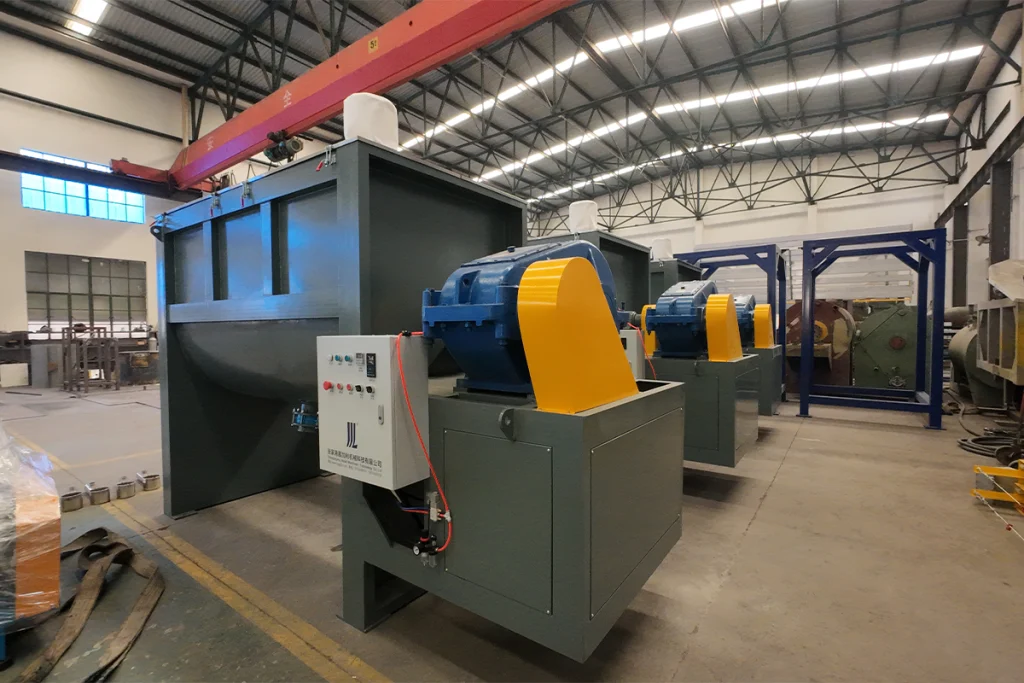
Not every mixing job needs the friction and heat of a high-speed mixer. When you are blending dry powders or pellets — colour masterbatch into resin, fillers into a compound, several dry chemicals into one batch — what you want is uniform blending without damage and without heat build-up. That is exactly the job a horizontal ribbon mixer is built for.
This guide covers how the WSH horizontal ribbon mixer works, what it is good at (and not good at), how it stacks up against high-speed and vertical mixers, and how to size one for your batch.
What a Horizontal Ribbon Mixer Is
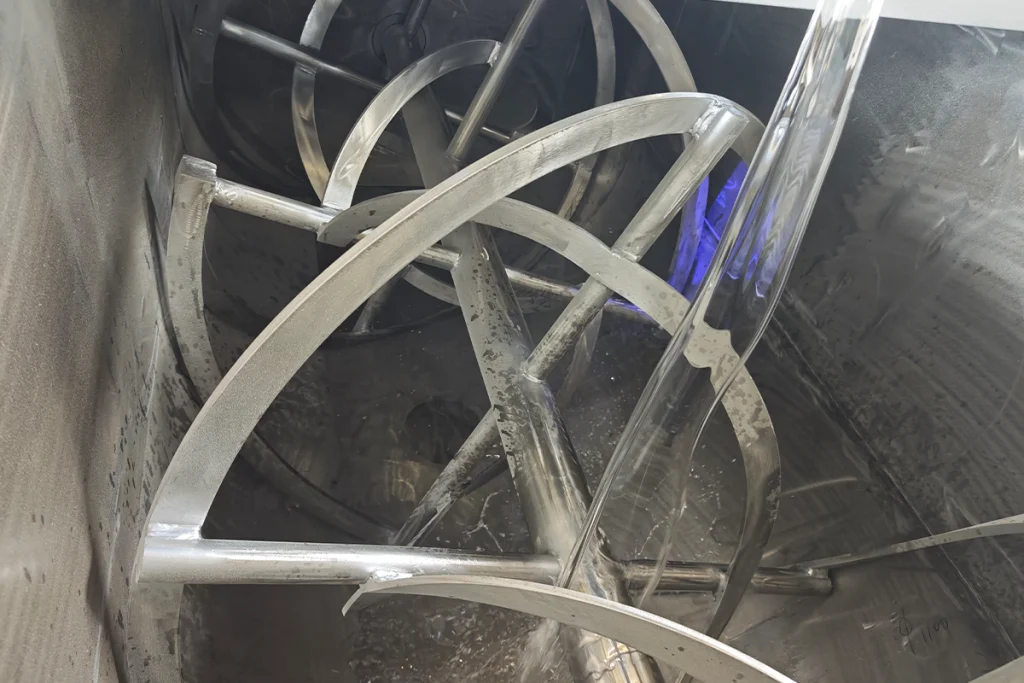
A horizontal ribbon mixer is a stationary trough or cylinder with a horizontal shaft running through it lengthwise. Mounted on that shaft is a spiral ribbon — a continuous helical band — that sweeps the powder along the length of the vessel, inward at the outer edge and back the other way near the shaft.
That counter-flow is the whole trick. Material at the wall is pushed one direction while material near the centre is pushed the other, so the batch keeps folding through itself. The result is a gentle, thorough, even blend rather than the violent shear of a high-speed mixer.
How the WSH Is Built
The WSH horizontal ribbon mixer from JIAJIALI uses a double-layer spiral ribbon stirring structure, designed around three priorities: uniformity, gentleness, and dust control.
Double-helix ribbon blades give a large, uniform mixing range across the vessel, so there is no pocket of unmixed material at the ends.
Soft stirring structure moves the material without hammering it — no damage to plastic particles or the structure of the powder.
Fully enclosed horizontal cylinder keeps the process dust-free and stops material spilling, which means zero product loss and a cleaner workshop.
Large-capacity one-time feeding — the design is happy with a big batch loaded at once, which suits high-throughput dry blending.
The vessel is a horizontal cylinder rather than an open trough, which is what gives it the enclosed, low-dust character that a plain ribbon blender does not always have.
Where the WSH Fits: Applications
The horizontal ribbon mixer is genuinely a multi-industry machine. Typical duties:
- Plastic powder compounding — blending dry blend, fillers and additives before extrusion or pelletizing.
- Colour matching — dispersing pigment or masterbatch through virgin resin for a uniform colour.
- Chemical dry powder mixing — powders and additives that must not be heated or sheared.
- Food-grade raw material — gentle blending where particle integrity matters.
- Feed batching — large-volume dry ingredient blending.
Anywhere the mixture is dry, free-flowing, and needs to be uniform without heat or damage, a ribbon mixer is a natural fit.
When a Ribbon Mixer Is the Wrong Choice
Honesty saves money. A horizontal ribbon mixer is not the answer when:
You need heat. If the process depends on friction heating to coat additives onto resin (classic PVC dry-blend hot mixing), you need a SHR high speed mixer or an SRL-W hot/cold mixing unit, not a ribbon blender.
You need high shear dispersion. Breaking down agglomerates or dispersing liquids into powder needs shear energy a ribbon simply does not produce.
You are blending very small batches. Below a certain volume, a vertical mixer or lab unit is more practical.
You have sticky or pasty material. Ribbon mixers like dry, free-flowing material; wet or adhesive products tend to build up on the ribbons.
Horizontal Ribbon vs High-Speed vs Vertical Mixer
| Horizontal ribbon (WSH) | High-speed mixer (SHR) | Vertical mixer (SH) | |
|---|---|---|---|
| Mixing action | Gentle counter-flow folding | High-speed shear + friction heat | Vertical screw circulation |
| Heat generated | Very little | Significant (up to 100–120 °C) | Little |
| Particle damage | Minimal | Higher | Minimal |
| Best for | Dry blending, colour, fillers | PVC hot mixing, additive coating | Colour matching, small batches, lab |
| Footprint | Long, low | Compact | Small footprint, tall |
| Typical batch | Large | Medium | Small to medium |
Rule of thumb: heat and shear → high-speed; volume and gentleness → ribbon; small footprint and flexibility → vertical.
Sizing the WSH
Three numbers settle the specification:
- Batch volume. Work from the finished batch size, not the vessel’s gross volume. Ribbon mixers are normally run at roughly 40–60% fill so the ribbons can actually fold the material rather than churn a solid mass.
- Bulk density. A 1,000 L vessel holds very different weights of light PVC powder and dense mineral filler. Size by weight where the density is unusual.
- Mixing time. Dry blends typically reach uniformity in a handful of minutes. More time than that adds heat and wear without improving blend quality.
Also confirm motor power, discharge type (centre, end, or full-length flap gate), and whether you want liquid-addition nozzles for small liquid additions.
Operating and Maintenance Notes
Respect the fill level. Over-filling is the most common cause of poor blending and overloaded motors. Keep to the recommended fill range.
Do not over-mix. Beyond the point of uniformity, extra time only adds friction and blade wear — especially with abrasive fillers.
Clean between colours. Ribbon mixers are easy to clean through the vessel openings, but the ribbon edges trap a little material; for frequent colour changes, plan the cleaning routine.
Check ribbon clearance. Abrasive fillers wear the ribbon tips over time. Periodic inspection keeps mixing uniform and avoids metal contamination.
Keep the seal and drive healthy. The shaft seal and gearbox are the parts that fail first if the machine is pushed hard on dusty material.
Buying Checklist
- Finished batch size (kg or L) and bulk density of the material.
- Dry blend only, or do you also need heat / high-shear? (If yes, this is the wrong mixer.)
- Colour changes per shift — how easy must cleaning be?
- Discharge method that fits your downstream conveying.
- Abrasiveness of the fillers (drives ribbon material and wear life).
- Whether small liquid additions are needed (nozzle options).
- Dust and area-classification requirements.
- How the mixer connects to the rest of the line — feeding and conveying.
FAQ
Q: What is a horizontal ribbon mixer used for?
A: Blending dry, free-flowing powders and pellets — plastic powder compounding, colour matching, chemical dry powders, food-grade materials and feed batching. It is chosen wherever a mixture must be uniform without heat or particle damage.
Q: How does the WSH differ from a high-speed mixer?
A: The high-speed mixer uses fast blades to shear the material and generate friction heat, which is what PVC compounding needs to coat additives onto resin. The WSH ribbon mixer works slowly and gently, folding the material through itself for uniform blending with almost no heat and no particle damage.
Q: Is a horizontal or vertical mixer better?
A: It depends on the job. A horizontal ribbon mixer suits larger batches of dry powder where uniformity matters. A vertical mixer has a smaller footprint and is handy for multi-material colour matching, smaller batches and lab work. Horizontal for volume and uniformity, vertical for flexibility and space.
Q: What fill level should I run a ribbon mixer at?
A: Typically around 40–60% of the vessel’s gross volume. Running higher stops the ribbons from folding the material properly and overloads the drive; running much lower wastes capacity per batch.
Q: Can a ribbon mixer damage plastic pellets?
A: The WSH’s soft stirring structure is designed specifically to avoid that. Unlike high-speed blades, the ribbon moves pellets and powder gently, preserving particle structure — one reason it is popular for colour matching and gentle dry blending.
Q: How long should a dry blend take to mix?
A: Usually a few minutes to reach uniformity, depending on the recipe and fill level. More time does not make a better blend — it just adds friction, heat and wear, especially with abrasive fillers.
Q: Can I add liquids in a ribbon mixer?
A: Small liquid additions are possible with nozzle options, sprayed into the moving powder. Heavy liquid loading, or liquids that make the batch sticky, are better handled by a different mixing approach.
Need a gentle, dust-free dry blender for large batches? Tell JIAJIALI your batch size, material and how often you change colour — they will size the WSH and match it to your feeding and discharge. See the full range under Mixing Equipment, or contact us with your material and output.