
Plastic material conveying systems are essential in every plastic plant — pellets move from the silo to the machine, while powder travels from the mixer to the extruder. Getting that movement right is not a detail; it decides your dust level, your material damage, your energy bill and how much of the floor is tied up in machinery.
Pneumatic conveying+ — using air to carry material through a pipe — is the most common answer, and it comes in two quite different flavours: dilute phase and dense phase. They are often mentioned in the same breath, but they behave nothing alike, and picking the wrong one shows up as broken pellets, worn pipes or a compressor running flat out.
This guide explains both, compares them honestly, and helps you decide.
What Pneumatic Conveying Is
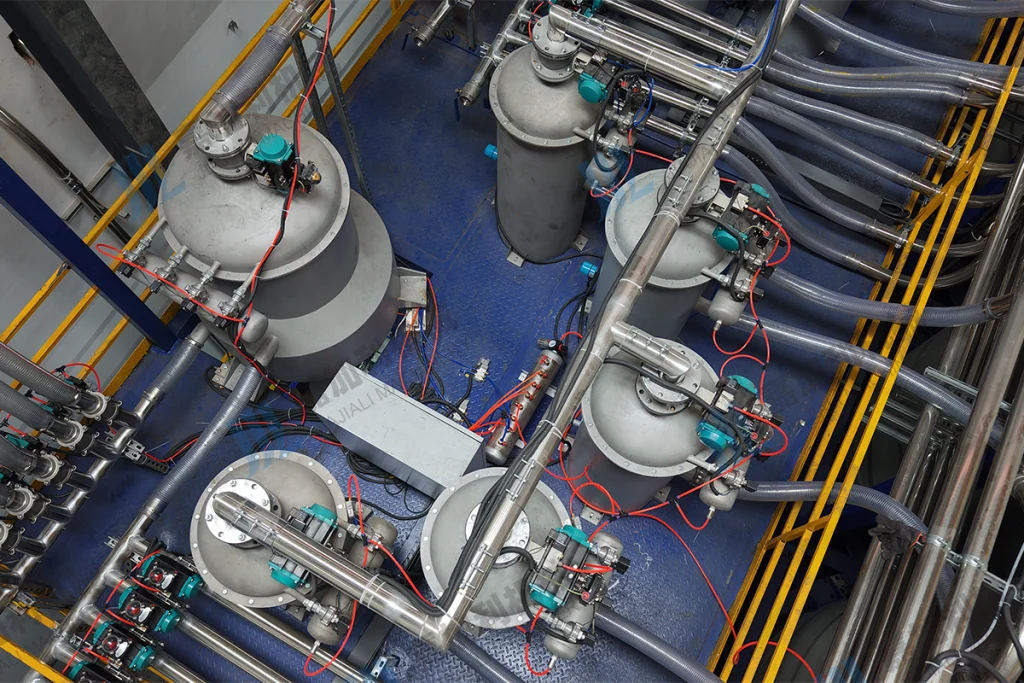
In pneumatic conveying, moving air carries the material through an enclosed pipe. It is fully sealed, which is its biggest advantage in a plastics plant: no dust escaping, no spillage, and flexible routing around existing equipment.
Two families of system do the work:
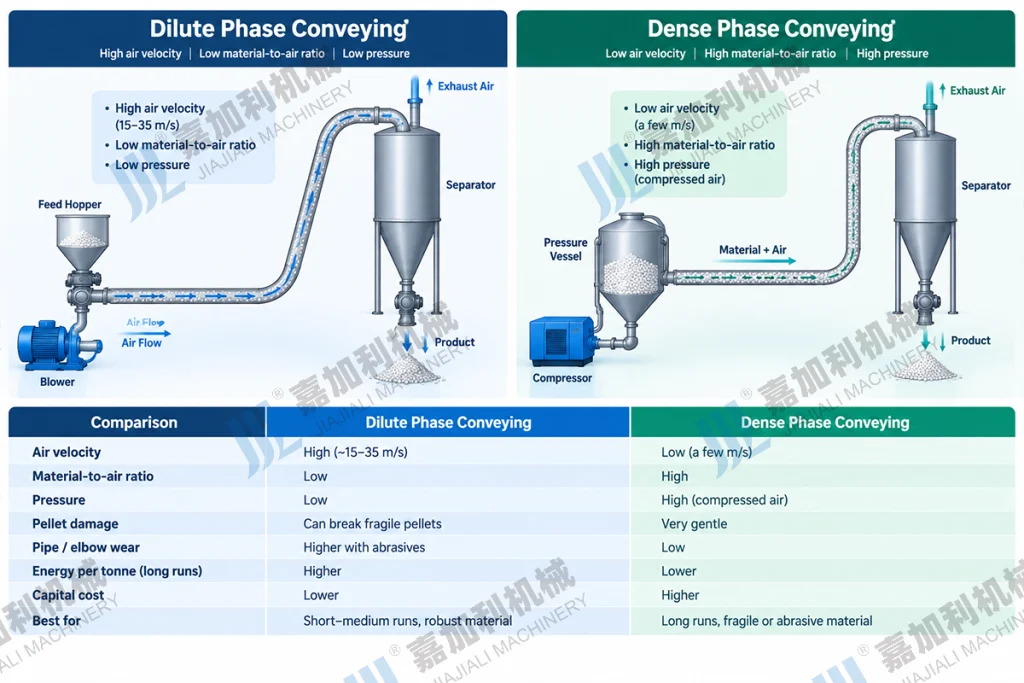
- Dilute phase— the material is suspended in a fast-moving air stream. Low material-to-air ratio, high velocity.
- Dense phase — the material moves as a slow, slug-like plug in a much smaller volume of air. High material-to-air ratio, low velocity.
The names refer to how concentrated the material is in the air, not to how “solid” the material is.
Dilute Phase Conveying
In dilute phase, the air moves fast enough to keep the particles fully suspended — think of leaves blown along by a strong gust. The material-to-air ratio is low; you are moving a little material with a lot of air.
Typical characteristics:
- High air velocity — in the range of roughly 15–35 m/s, depending on the material.
- Low pressure — often a fan or low-pressure blower is enough for shorter runs.
- Simple, proven design — the most common system type because it is straightforward and flexible.
Pros:
- Simple layout, wide range of pipe routing.
- Good for both powder and pellets.
- Lower capital cost for short-to-medium distances.
- Easy to add multiple pick-up and discharge points.
Cons:
- High velocity causes wear on elbows and pipe, and can break or degrade fragile pellets.
- Higher air volume means higher energy use per tonne at long distances.
- Not ideal for abrasive materials or very long runs.
Dilute phase is a solid default for moderate distances and forgiving materials. It becomes a problem when the material is fragile, abrasive, or the run is long.
Dense Phase Conveying
In dense phase, the material travels slowly as a moving plug, pushed by compressed air at higher pressure. There is much more material per unit of air, and much less velocity — think of sliding a dense block through a tube rather than blowing dust.
Typical characteristics:
- Low air velocity — often just a few m/s.
- High pressure — compressed air (typically a pressure vessel or high-pressure blower) drives the plug.
- Higher cost and complexity — pressure vessels, controls and more careful design.
Pros:
- Gentle on material — low velocity means almost no pellet breakage or attrition.
- Less wear — abrasive materials do far less damage to pipes and bends.
- Efficient over long distances — high material-to-air ratio means less air to move per tonne.
- Suits fragile and abrasive materials equally well.
Cons:
- Higher capital cost and more complex control.
- Not the best choice for very short, simple runs where its advantages do not pay.
- Some materials need testing to confirm they will form a stable plug.
Dense phase is the premium option: you pay more up front to protect the material and cut wear and energy over long routes.
Dilute vs Dense: Side by Side
| Dilute phase | Dense phase | |
|---|---|---|
| Air velocity | High (~15–35 m/s) | Low (a few m/s) |
| Material-to-air ratio | Low | High |
| Pressure | Low | High (compressed air) |
| Pellet damage | Can break fragile pellets | Very gentle |
| Pipe / elbow wear | Higher with abrasives | Low |
| Energy per tonne (long runs) | Higher | Lower |
| Capital cost | Lower | Higher |
| Best for | Short–medium runs, robust material | Long runs, fragile or abrasive material |
The single most useful line in that table: if your material is fragile or abrasive and your run is long, dense phase earns its cost. If your run is short and the material is tough, dilute phase is the sensible default.
What This Means for Plastics
Plastics are exactly where the choice bites, because the material is often both fragile and abrasive at once.
Pellets are fragile. A sharp elbow at high velocity scuffs and breaks pellets, creating dust and fines, and hurting the feed consistency at the machine. Gentle dense phase or low-velocity handling protects them.
Powders are abrasive and dusty. Fine fillers wear pipe walls and elbows, and any leak dusts the workshop. Sealed, slower conveying reduces both.
Fines and dust create their own problems — build-up, colour contamination, and reject material.
In practice, many plants use dense phase (or low-velocity vacuum) for pellets and for abrasive fillers, and dilute phase where routes are short and the material is forgiving.
The Alternative: Mechanical Conveying
Air is not the only option — and for some duties it is not the best one. Mechanical conveying moves material with a physical carrier instead of a fast air stream. The TCA pipe chain conveyor drags material slowly through a sealed pipe using a chain with discs, with 3D routing and multiple discharge points.
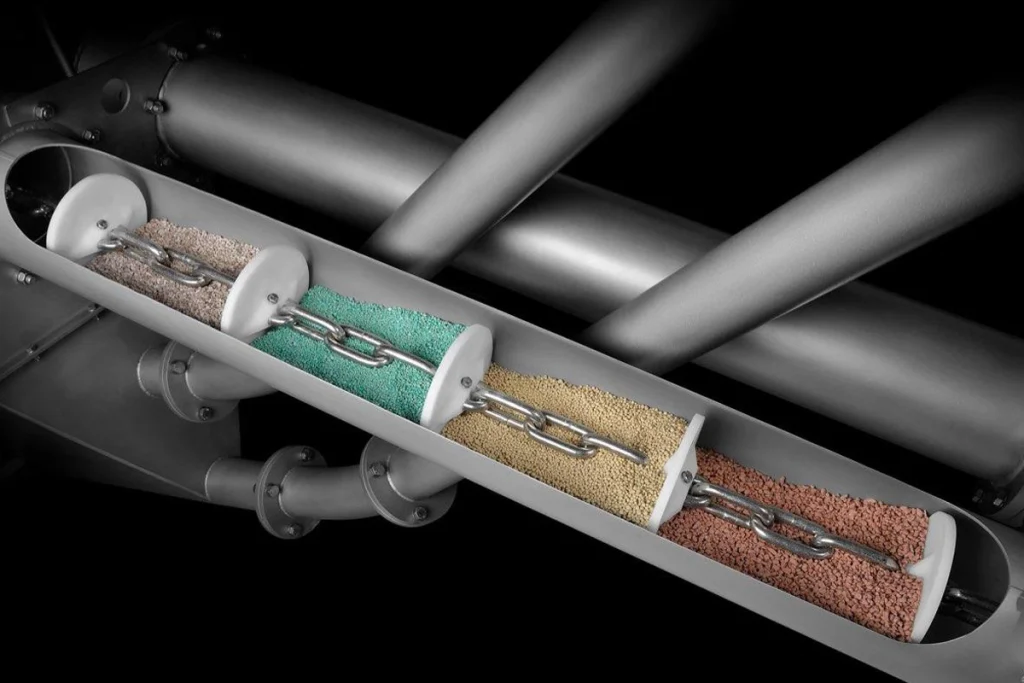
Mechanical conveying advantages:
- Very low velocity — minimal material damage and wear.
- Low energy per tonne compared with long pneumatic runs.
- Multi-point discharge — drop material at several destinations on one route.
- Enclosed — the same dust-free benefit as pneumatic.
For moving powder dry-blend or pellets around a plant with several destinations, a pipe chain conveyor is frequently the better answer than a long pneumatic run. For short, flexible drops to machine hoppers, vacuum conveying — such as a vacuum automatic feeder — is often simplest.
How to Choose Plastic Material Conveying Systems
- Material type — pellets, powder, or a blend? Fragile? Abrasive?
- Distance and route — short and simple, or long with bends and elevation changes?
- Number of destinations — one machine, or many hoppers to feed?
- Non-negotiable constraints — pellet integrity, dust control, or wear life?
- Energy budget — long pneumatic runs can become the biggest motor load in the plant.
- Layout — a central feeding system suits many machines from one source; point-to-point suits simple flows.
- Future expansion — can the system take extra pick-up or discharge points later?
- Material intake — how does material get *into* the conveying system in the first place (ton bags, sacks, silos)? A ton bag discharging station often starts the chain.
FAQ
Q: What is the difference between dense phase and dilute phase conveying?
A: Dilute phase suspends the material in a fast air stream (roughly 15–35 m/s) with a low material-to-air ratio. Dense phase moves the material as a slow, slug-like plug at just a few m/s with a high material-to-air ratio, using compressed air at higher pressure. Dilute is simpler and cheaper; dense is gentler and more efficient over distance.
Q: Which is better for plastic pellets?
A: Dense phase or another low-velocity method is usually better for pellets, because high-velocity dilute phase can break and scuff them, creating dust and fines. If the run is short and the pellets robust, dilute phase can still work — but pellet quality should be the deciding factor.
Q: Is pneumatic conveying or mechanical conveying better for powder?
A: Both are fully enclosed, so both control dust. Mechanical conveying such as a pipe chain conveyor moves material more slowly, with less wear and lower energy per tonne over distance, and can serve multiple discharge points. Pneumatic conveying is more flexible in routing. The right choice depends mostly on distance, route complexity and the number of destinations.
Q: Can one system handle both powder and pellets?
A: It can, but not always at the same settings. Powder and pellets behave very differently in air; a system tuned for pellets may not handle fine powder well and vice versa. If both must be conveyed, the design should account for both, often with separate lines for the two materials.
Q: How do I know which phase my material needs?
A: Two questions settle it most of the time: how fragile or abrasive is the material, and how long is the run? Fragile or abrasive plus long distance points to dense phase or mechanical conveying; robust material over a short route points to dilute phase. Where it is marginal, ask the supplier to test the actual material.
Q: Does pneumatic conveying damage pipes?
A: Yes, at high velocity with abrasive material — elbows take the worst of it. Dilute phase with abrasive fillers wears bends and pipe; dense phase, with its much lower velocity, causes far less wear.
Designing the conveying layout for your plant? Tell JIAJIALI what you are moving, how far, and how many machines it feeds — they will recommend pneumatic, mechanical or a central feeding system to match. See the full range under Plastic Auxiliary Equipment, or contact us with your material path.