
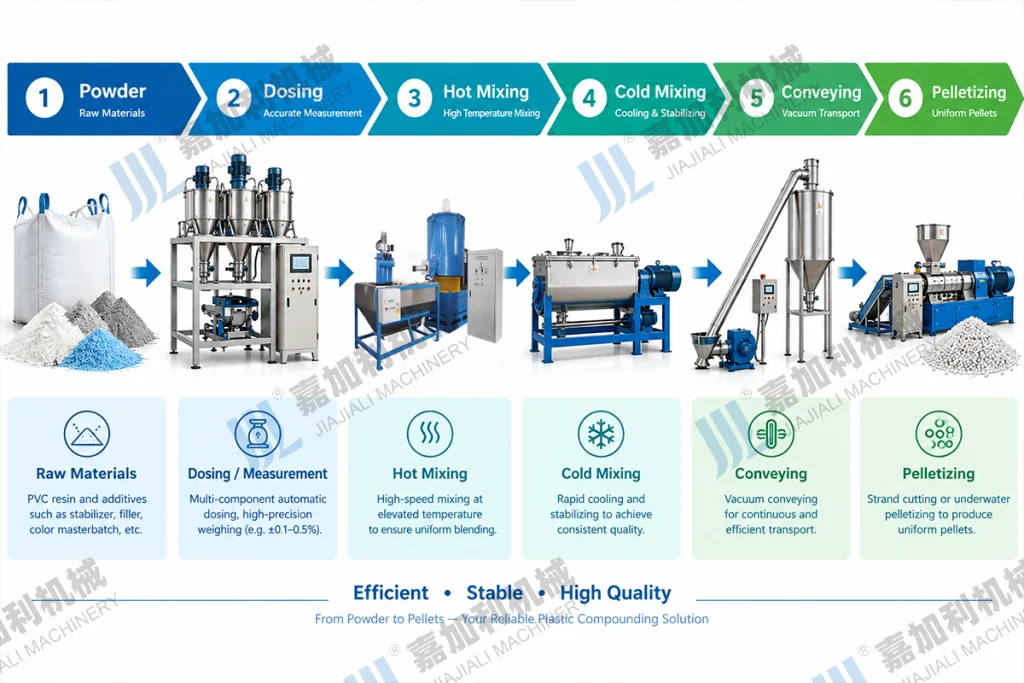
PVC never ships as a finished product straight out of the reactor. Raw PVC resin is a hard, heat-sensitive powder, and it only becomes pipe, profile, cable, flooring, or shoe sole material after it has been compounded — blended with stabilizers, plasticizers, fillers, lubricants, and pigments under controlled heat, then cooled and (usually) pelletized.
That whole chain is a PVC compounding system. Get the layout right and you get consistent product, low scrap, and a mixer that lasts twenty years. Get it wrong and you fight fisheyes, black specks, gelation problems, and burnt batches forever.
This guide walks the process step by step, names the equipment at each stage, and gives you the questions to settle before you buy.
Step 1 — Raw Material Intake and Storage
Compounding starts with feeding the right powders into the line. A PVC recipe typically contains:
- PVC resin — the base polymer, supplied in ton bags or 25 kg sacks.
- Stabilizers — heat stabilizers (lead-based, Ca/Zn, organotin) that stop PVC degrading at temperature.
- Plasticizers— for flexible products such as cable and film.
- Fillers — calcium carbonate most commonly, added for cost and stiffness.
- Lubricants, processing aids, pigments.
At this stage the work is bag intake, dust control, and storing material so it doesn’t absorb moisture. Typical equipment:
- A ton bag discharging station for resin coming in big bags.
- A vacuum automatic feeder or pneumatic line to lift powder from ground level into day bins or the mixer.
Get this part wrong and you either dust-bomb the workshop or spend labour on manual handling you didn’t budget for.
Step 2 — Weighing and Dosing
A PVC formula is not “a bit of this, a bit of that.” Additive ratios are tight — 2 phr of stabilizer is not 3 phr — and consistency between batches is what keeps your finished product within spec.
Two levels of equipment do this:
- Manual batch weighing — fine for low output and simple recipes, but slow and operator-dependent.
- Automatic dosing and batching — an automatic formula machine that weighs each component automatically, in sequence, and discharges the batch to the mixer. This is where accuracy, repeatability, and labour savings come from.
For high-value additives or tight tolerances, loss-in-weight feeders take over — they measure by *weight loss over time*, which is far more accurate than volumetric feeding at low rates.
Rule of thumb:the more components and the higher your output, the faster automatic dosing pays for itself. Manual weighing usually stops making sense somewhere around 500–800 kg/h of finished compound.
Step 3 — Hot Mixing (High-Speed)
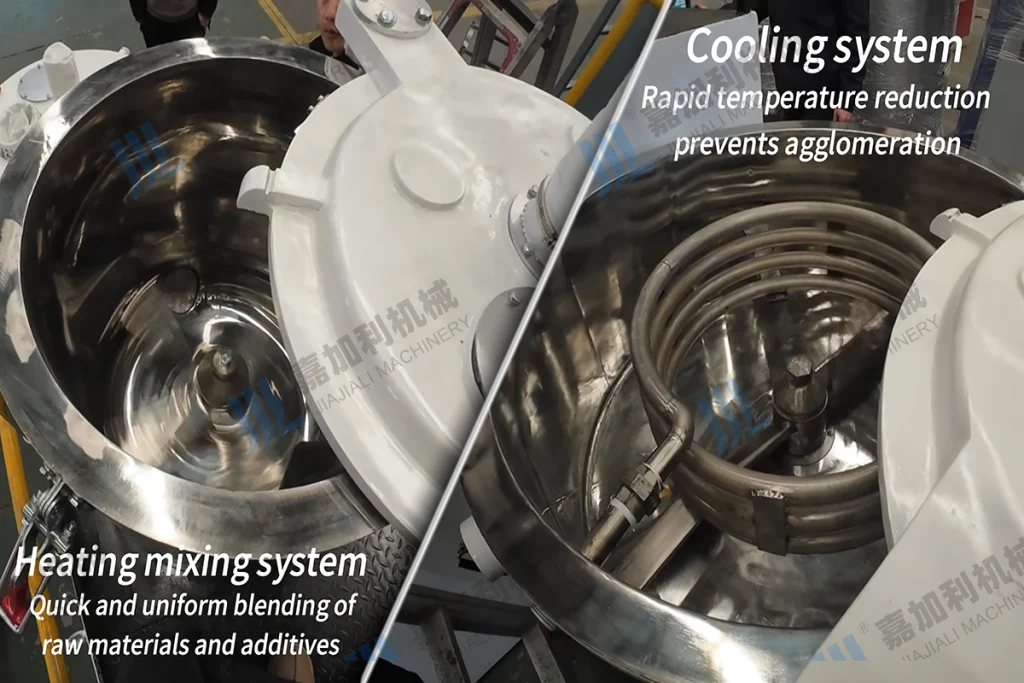
Now the batch goes into a high-speed mixer, where rotating blades throw the powder against the wall and against itself. Friction heats the mix rapidly, and this heat does real work:
- It drives out surface moisture.
- It lets stabilizer and lubricant wet and coat the resin particles evenly.
- It begins gelation — the physical fusion PVC needs before it can be processed.
Typical hot-mix discharge temperatures sit around 100–120 °C, reached in a few minutes. The SHR high speed mixer is built for exactly this: a self-friction heated bowl, fast discharge, and a rugged blade assembly that survives abrasive filler loads.
Temperature control is the whole game. Under-heat it and you get unmelted gel particles in the final product; over-heat it and the batch burns or degrades. Watch batch time, blade speed, and discharge temperature as your three control levers.
Step 4 — Cold Mixing (Cooling)
Hot compound cannot go straight to a pelletizer or extruder — it would still be reacting and would cake solid. It has to be cooled fast and evenly, usually to under 45 °C, back to a free-flowing dry blend.
The standard answer is a combined hot/cold mixing unit: the hot mixer discharges straight into a larger, slower, jacketed cooling mixer. Two common formats:
- The SRL-Z hot/cold mixing unit — vertical layout, hot pot above, cooling pot below, gravity discharge between them. The classic compact PVC compounding workhorse.
- The SRL-W horizontal hot/cold mixing unit — horizontal cooling vessel, better for larger batches and gentler on the compound.
Cooling isn’t just “waiting.” Fast, even cooling prevents degradation and gives you a uniform, reproducible dry blend — the real definition of good compounding.
Step 5 — Conveying the Compound
From the cooling mixer, the dry blend has to reach either a pelletizing line or the extruder hoppers directly. Two families of conveyor do this job, and every plant picks based on layout:
- Mechanical conveying — a TCA pipe chain conveyor drags the powder slowly through a sealed pipe, with 3D routing and several discharge points. Low energy, low dust, minimal material damage.
- Pneumatic conveying — air carries the powder, either as a central feeding system serving many machine hoppers, or as short vacuum drops.
Both are enclosed, so both beat open belts or screw conveyors on dust. For most PVC dry-blend duties, the deciding factors are route complexity, number of destinations, and energy per tonne.
Step 6 — Pelletizing (Optional but Common)
Some plants extrude the dry blend directly — pipe and profile lines often do. Others need pellets, because pellets flow better, feed more consistently, and are easier to ship and sell.
A PVC granulation unit takes the cooled, compounded dry blend and converts it into uniform pellets — typically through a hot-cut or strand-cut route, with cooling and screening downstream. The full line, from mixer through extruder to pellets, is often referred to as a PVC pelletizing line.
A Typical PVC Compounding Layout
Put the steps together and a mid-size plant looks like this:
- Ton bag station → resin in.
- Dosing/batching → resin + additives weighed per recipe.
- SHR high-speed mixer → hot mix to ~110 °C.
- Cooling mixer (SRL-Z / SRL-W) → cool to <45 °C.
- Pipe chain or pneumatic conveying → to pelletizing or storage.
- Granulation unit → dry blend to pellets.
- Screening, weighing, bagging → finished compound out.
Every arrow in that list is an equipment decision, and every one of them affects the next.
Buying Checklist: What to Settle Before You Order
| Question | Why it matters |
|---|---|
| **Recipe and component count?** | Drives whether you need automatic dosing or manual weighing |
| **Required output (kg/h)?** | Sizes the mixer, cooling mixer, and conveying line |
| **Rigid or flexible PVC?** | Plasticizer content changes mixing time and temperatures |
| **Filler loading (%)?** | High CaCO₃ loads need wear-resistant blades and bowls |
| **Hot-mix discharge temperature?** | Sets the heating method and batch time |
| **Powder-to-powder, or pellets out?** | Decides whether you need a granulation line at all |
| **Layout and distances?** | Determines mechanical vs pneumatic conveying |
| **Dust and ATEX requirements?** | Affects enclosure, filtration, and area classification |
FAQ
Q: What’s the difference between hot mixing and cold mixing in PVC compounding?
A: Hot mixing uses high-speed blade friction to heat the powder to 100–120 °C so additives coat the resin and gelation begins. Cold mixing immediately cools that batch back to under 45 °C in a separate, slower, jacketed vessel, producing a stable, free-flowing dry blend that won’t degrade or cake.
Q: Do I need a combined hot/cold mixer, or two separate machines?
A: A combined unit (like the SRL-Z) is the standard choice because hot compound must reach the cooler fast — a combined machine discharges directly and avoids cooling loss or manual transfer. Separate machines only make sense in unusual layouts or very large capacities.
Q: How much does a PVC compounding system cost?
A: It depends almost entirely on output and automation. A basic manual-weighing line with an SHR mixer and cooling mixer is a very different budget from a fully automatic dosing, conveying, and pelletizing line. The honest answer: define kg/h, recipe, and pellet need first, then price the line that matches.
Q: Can I compound PVC without a pelletizer?
A: Yes. Many pipe and profile plants feed the cooled dry blend straight to the extruder. Pelletizing makes sense when you need consistent free-flowing feed, when you sell compound as a product, or when you store and transport it.
Q: Why does my compound have black specks or unmelted particles?
A: Usually one of three things — insufficient hot-mix temperature or time (unmelted gel), burnt material clinging inside the mixer (black specks from cleaning or over-heating), or poor cooling that lets the blend degrade. Check batch time, discharge temperature, and mixer cleaning procedure first.
Q: What’s the right order — mix then pelletize, or something else?
A: Always mix first. Compounding is what gives PVC its properties; pelletizing is just a shaping and handling step. Reversing that order makes no sense because raw PVC powder can’t be pelletized usefully before the additives are dispersed.
Planning a PVC compounding or pelletizing line? Tell JIAJIALI your recipe, target output, and whether you need pellets — they’ll specify the mixer, cooling unit, dosing system, and conveying layout that fit. See the full mixer range under Mixing Equipment, or contact us with your material path.