
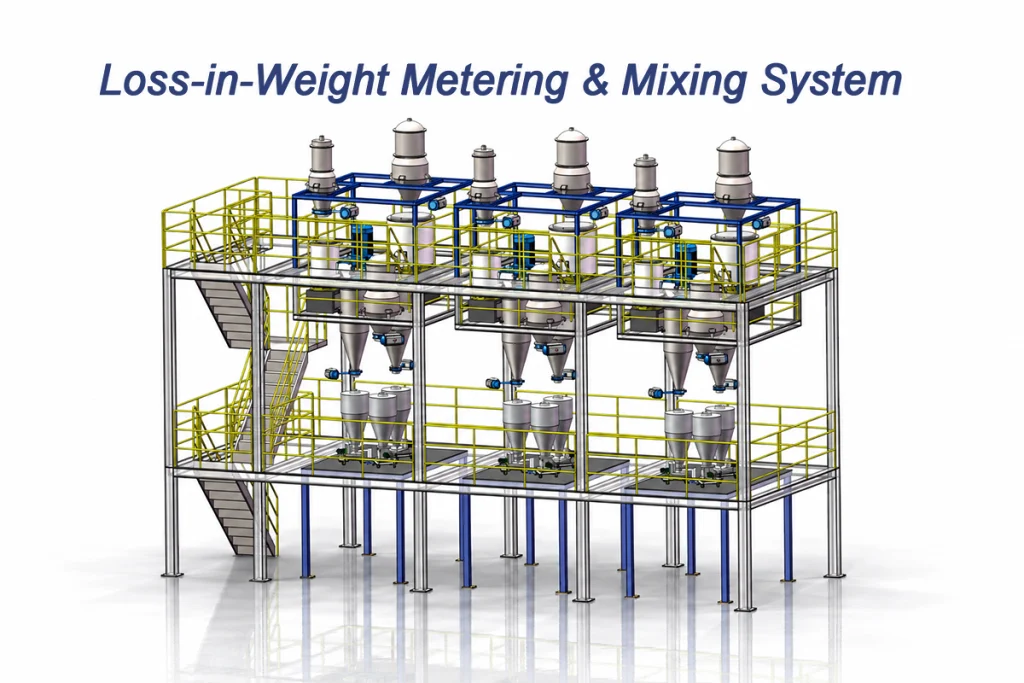
A loss-in-weight metering and mixing system helps plastic manufacturers maintain consistent formulations, improve dosing accuracy, and reduce material waste.
Most plastic plants do not have a weighing problem. They have a consistency problem. A formulation that is correct on paper can drift on the production floor: colour varies between shifts, additives are overdosed “just to be safe”, scrap rates creep up, and nobody can identify which component caused the variation.
In plants running PVC compound, masterbatch, WPC or filled engineering resins, these inconsistencies can cost more than the equipment designed to prevent them.
This guide explains how a loss-in-weight metering and mixing system works, where its accuracy comes from, and what to specify before purchasing one.
What “Loss-in-Weight” Actually Means
A loss-in-weight feeder does not weigh the material going out. It weighs the material going away.
The feeder sits on load cells. The whole feeder — hopper, screw, motor, material — is weighed continuously. As the screw discharges material, the total weight drops. The controller knows the screw’s discharge rate precisely enough (through a calibration factor) that it can convert “kilograms lost per unit time” into “kilograms per hour delivered”.
That is the entire principle, and it explains both the strength and the limits:
- Strength: you are measuring the real mass flow of the real material, not the volume a screw happens to displace. Bulk density changes, pellet shape changes, regrind content changes — the gravimetric loop absorbs them.
- Limit: the measurement is only valid while the hopper is discharging. Every refill interrupts the weight signal, which is why refill logic matters as much as screw design.
Inside the System: Five Blocks
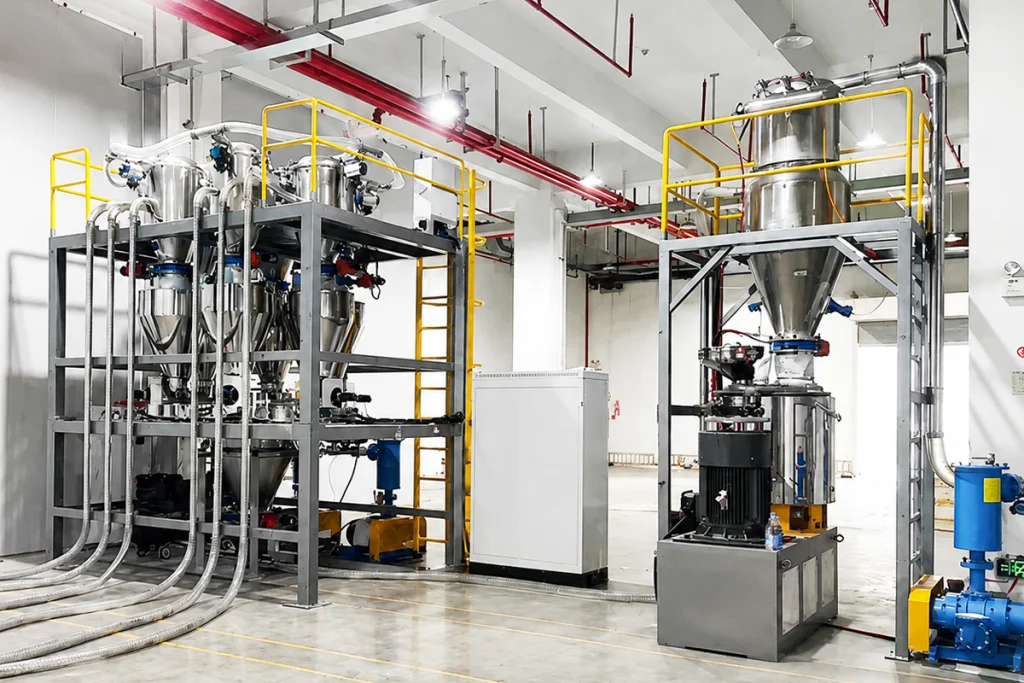
Every LIW metering and mixing system, from a two-component unit to a six-component compounding line, is built from the same five blocks.
1. Weighing hopper and load cells.
The hopper is sized for a few minutes of runtime — long enough to smooth refills, short enough that the weight loss per second is measurable. Load cells are selected for the working range, not for the hopper’s empty weight, because resolution is what sets the floor on accuracy.
2. Discharge screw or vibratory tray.
The metering element. Screw diameter and pitch are chosen per material: fine powder needs a different screw from glass-filled pellets, and fibrous or flaky material may need a vibratory tray or a twin-screw arrangement to avoid bridging.
3. Refill valve and surge hopper.
Refills are fast and, as far as the control loop is concerned, blind. The system therefore refills at high rate, above a low-weight threshold, and holds the last valid feed rate during the refill window rather than trying to control through it.
4. Controller.
This is where the value sits. A good controller runs a gravimetric PID loop per component, applies the calibration factor, logs consumption, handles refill, alarms on deviation, and — critically — keeps each component’s rate stable when the master rate changes.
5. Mixing or receiving stage.
Continuous systems blend the metered streams in a downstream mixer or in the conveying line itself; batch systems accumulate weighed components into a batch and then mix. The choice is driven by recipe complexity and by how much shear and heat your material tolerates.
Gravimetric vs Volumetric: Where the Money Is
Volumetric dosing is cheaper and, on a stable single material, perfectly adequate. It also has a structural weakness: it assumes constant bulk density.
Consider a line running PVC dry blend with varying regrind content. Regrind is bulkier and flows differently from virgin compound. A volumetric additive feeder set on Tuesday delivers a different mass on Friday, because the volumetric screw is now moving a lighter material at the same speed. Nobody notices until a batch fails a test or a customer notices colour variation.
Gravimetric metering closes that loop by measuring mass directly. Typical achievable accuracy for a well-specified LIW feeder is around ±0.3% to ±0.5% of the set rate at steady state — but that figure is only reachable when the feeder is correctly sized, the refill window is short relative to the weighing window, and the material has been tested. A feeder running at 5% of its capacity will not hold ±0.3%, no matter what the brochure says.
This is why “what accuracy do you guarantee?” is the wrong first question. The right first question is “what is the minimum rate this feeder can hold ±1% on my material?”
The Refill Problem, and Why Multi-Component Systems Fail
In a single feeder, refill is a brief interruption. In a six-component system, refills are happening constantly, and each one disturbs one component’s weight signal while the others continue.
Three design details separate a system that holds ratio from one that fights you:
- Staggered refills. The controller should schedule refills so that no more than one or two components are refilling at once.
- Rate hold, not rate guess. During refill, hold the last valid gravimetric rate; do not fall back to volumetric.
- Consumption-based refill triggers. Refill on weight thresholds tied to actual consumption, not on a fixed timer.
The symptom of getting this wrong is easy to recognise: ratio alarms that fire in clusters, and a final product that is correct on average but inconsistent batch to batch — the classic “average is fine, variance is not” failure.
Where LIW Metering and Mixing Pays Back
The economics are clearest in four situations.
1. Additive cost. Masterbatch, stabilisers, flame retardants and impact modifiers are the most expensive kilograms in the plant. A 10% over-dose applied “for safety” on a 2% additive is 0.2% of total mass — trivial on paper, significant on the annual raw material bill once volumes are real.
2. Formulation complexity. Once a recipe has four or more components, manual weighing becomes both slow and error-prone, and changeover between recipes becomes a source of scrap.
3. Quality traceability. Gravimetric systems log actual consumption per component per batch. When a customer asks why lot A and lot B differ, you have data instead of an opinion.
4. Labour. Manual batching ties a person to a scale for the length of the shift. Automated metering moves that person to a task that adds value.
In PVC compounding specifically, LIW metering usually sits upstream of the hot/cold mixing unit: powders and liquids are weighed and dosed into the mixer, then the batch is discharged to a SRL-Z hot/cold mixing unit or an SRL-W horizontal unit for gelation and cooling. Get the metering right and the mixer’s job becomes repeatable; get it wrong and no amount of mixing time will fix the formulation.
For plants building the whole line, the metering system is one module of an automatic compounding system that also covers conveying, mixing and discharge.
What to Send a Supplier Before You Ask for a Quote
A quotation built on incomplete information is a guess with a price on it. Send this instead:
- Component list with target percentages and acceptable tolerance — per component, not per batch.
- Throughput range — minimum, normal and maximum kg/h.
- Bulk density and flow behaviour for each material, plus any bridging or flooding history.
- Material form — powder, pellets, regrind, fibre, flake, liquid.
- Recipe count and changeover frequency — this decides whether you need recipe management in the controller.
- Batch or continuous process, and the cycle time you need.
- Upstream and downstream interfaces — silo, vacuum feeder, central feeding system, mixer model, extruder throat.
- Environment — ambient temperature, washdown, dust classification, available floor space and headroom.
Suppliers who ask for all eight are usually the ones who have installed systems in plants like yours. Suppliers who quote from a single throughput number are selling a machine, not a process.
Five Mistakes That Show Up in Real Installations
- Oversizing the feeder. A feeder sized for peak output runs at 10% of capacity most of the time, where resolution is poor. Size for the normal rate; accept the compromise at peak.
- Ignoring the refill path. A refill that takes 90 seconds on a 5-minute weighing window destroys accuracy. Fix the refill hardware, not the tuning.
- No material test. Free-flowing pellet data does not transfer to a 200-mesh powder. Ask for a material test or a reference installation on the same material.
- Treating mixing as an afterthought. Metering accuracy is wasted if the downstream mixer segregates the blend. Mixer type and residence time must be specified together with the feeder.
- No calibration routine. Load cells drift, screws wear, and material changes seasonally. A system without a scheduled calibration routine will be accurate on the day of commissioning and gradually less so afterwards. (See our guide to loss-in-weight feeder calibration.)
FAQ
Q: What is the difference between a loss-in-weight feeder and a loss-in-weight metering and mixing system?
A: A feeder meters one component. A metering and mixing system combines several feeders under one controller, keeps their ratios locked, and delivers a blended stream or batch to the next process step. The weighing principle is identical; the engineering difficulty is in coordinating refills and ratio control across components.
Q: How accurate is a loss-in-weight metering system?
A: Typically ±0.3% to ±0.5% of the set rate at steady state for a correctly sized feeder on a tested material. Small additives dosed at low percentages often see ±1% or worse, because the absolute feed rate is small. Always ask for accuracy at your actual rate, not at the feeder’s nominal capacity.
Q: Can one system handle powder and pellets at the same time?
A: Yes, but each component needs its own feeder type and screw geometry. Powder, pellets, regrind and liquid all behave differently; a system that uses one screw design for everything will underperform on at least one material.
Q: Do I need a loss-in-weight system if I already have volumetric dosing?
A: If your formulation is single-component, stable and cheap, no. If you run multiple components, expensive additives, regrind with variable bulk density, or need batch traceability, gravimetric metering pays back — often within the first year on additive savings alone.
Q: Batch or continuous mixing — which is better?
A: Batch suits frequent recipe changes and smaller volumes, and is easier to validate. Continuous suits high-volume single-recipe production with tight floor-space constraints. Many plants run batch metering into a continuous mixer, which is a legitimate hybrid.
Q: What maintenance does the system need?
A: Scheduled calibration checks against a reference weight, inspection of screws and seals for wear, cleaning of load cell mounts, and verification that refill valves still close fully. Most accuracy complaints trace back to one of these four items rather than to the controller.
Q: Can the system be added to an existing line?
A: Usually yes. The metering module needs space above the mixer or extruder throat, a compressed air supply for refill valves, and a control interface to the existing line. Retrofits are common and often the fastest route to better consistency.
Need a metering system that holds ratio on your actual recipe? JIAJIALI builds loss-in-weight metering and mixing systems matched to material, throughput and downstream equipment. Send your component list, rates and bulk densities through contact us, or review the loss-in-weight metering and mixing system and the wider automatic dosing and batching range.