
Wood-Plastic Composite — WPC — is one of the fastest-growing materials in outdoor building products. Decking, fences, cladding, garden profiles, and architectural trim all increasingly use WPC because it combines the look and feel of wood with the weather resistance and low maintenance of plastic.
But turning sawdust and PVC into a stable, sellable profile is a *system* problem, not a single-machine problem. This guide explains how a WPC profile production line actually works, stage by stage — and what to settle before you invest.
What Is WPC, and Why Does It Need a Dedicated Line?
WPC is a composite of wood powder (or other natural fibre), thermoplastic resin, and additives. The two most common matrices are PVC (for outdoor profiles and decking) and PE (for decking boards), with PP also used in some automotive and technical parts.
It needs a dedicated line for one reason: wood and plastic are hard to mix well.
– Wood powder is light, dusty, and moisture-hungry.
– It is heat-sensitive — too much heat and it scorches.
– It must be dispersed evenly in the polymer, or the profile has weak spots, blotches, and poor surface finish.
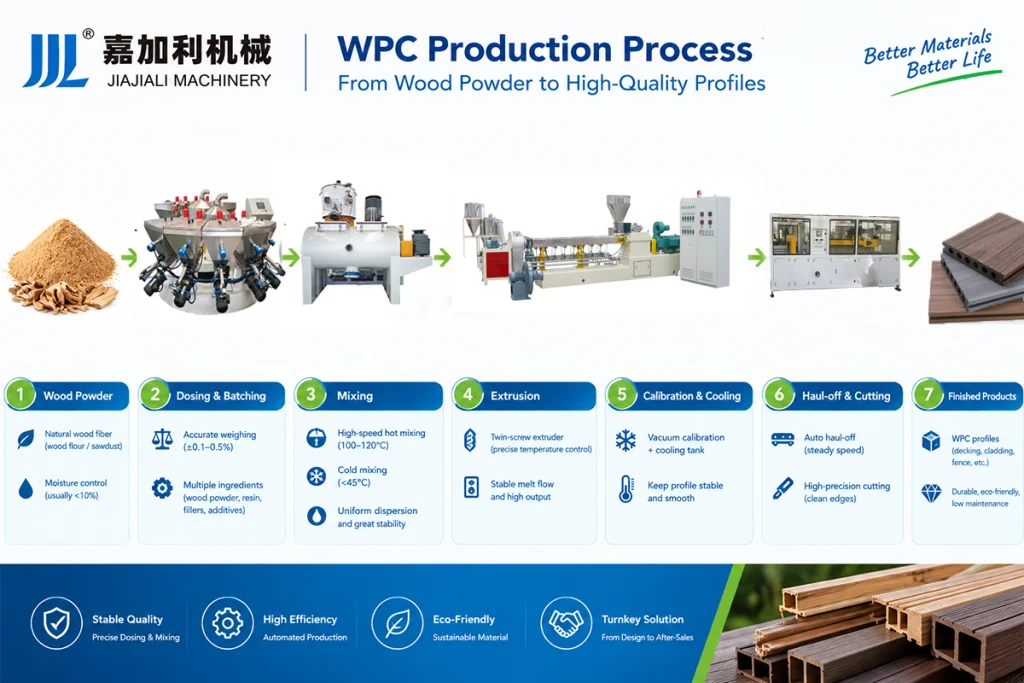
So a WPC line is really three jobs in sequence: dose it accurately → mix it evenly → extrude it precisely.
Stage 1 — Raw Material Intake & Handling
A WPC recipe typically contains:
- Wood powder / wood flour — usually 30–60% by weight.
- PVC (or PE/PP) resin — the matrix.
- Fillers — calcium carbonate, talc.
- Lubricants and processing aids — to control melt flow and prevent scorching.
- Coupling agents / compatibilizers — to bond the polar wood fibre to the non-polar polymer.
- Stabilizers and pigments.
Wood powder arrives in big bags and is extremely dusty. A ton bag discharging station with a sealed discharge and dust collection is the standard starting point — it protects both the product and the operators. From there, enclosed conveying (a vacuum automatic feeder or pneumatic line) lifts material into day bins or the mixer without dust-bombing the workshop.
Drying matters.Wood flour holds moisture, and moisture in WPC causes steam voids, bubbles, and rough surfaces. Depending on your climate and feedstock, a dryer or drying mixer ahead of mixing is often money well spent.
Stage 2 — Precision Dosing & Batching
WPC formulations are unforgiving. Get the wood-to-resin ratio wrong and the profile is either brittle or soft; get the lubricant wrong and it either burns or jams the die.
An automatic formula machine weighs every component in sequence to a stored recipe, then discharges the batch to mixing. For the wood powder and fine additives, loss-in-weight feeders measure by weight loss over time — the most accurate way to feed light, variable powders at low rates. Typical batching accuracy on a well-set-up system is around ±0.3%.
Rule of thumb: the moment your recipe has more than three or four components and your output is above a few hundred kg/h, automatic dosing stops being optional and becomes the cheapest quality control you own.
Stage 3 — Hot/Cold Mixing
This is the heart of WPC preparation. The batch first enters a high-speed hot mixer, where blade friction raises temperature to roughly 100–120 °C. At that temperature:
- Surface moisture is driven off the wood flour.
- Lubricants and stabilizers wet and coat the particles.
- The PVC begins to gel — the physical fusion it needs before extrusion.
The batch is held only long enough to fully coat and gelate, then discharged straight into a cooling mixer, which brings it down below 45 °C into a free-flowing dry blend. Fast, even cooling is what prevents scorching and keeps the blend reproducible.
The industry-standard machine for this is a combined hot/cold unit — either the vertical SRL-Z hot/cold mixing unit (the compact workhorse) or the SRL-W horizontal hot/cold mixing unit for larger batches and gentler handling. High-filler WPC recipes lean toward the horizontal unit for its gentler action on the blend.
Stage 4 — Conveying to the Extruder
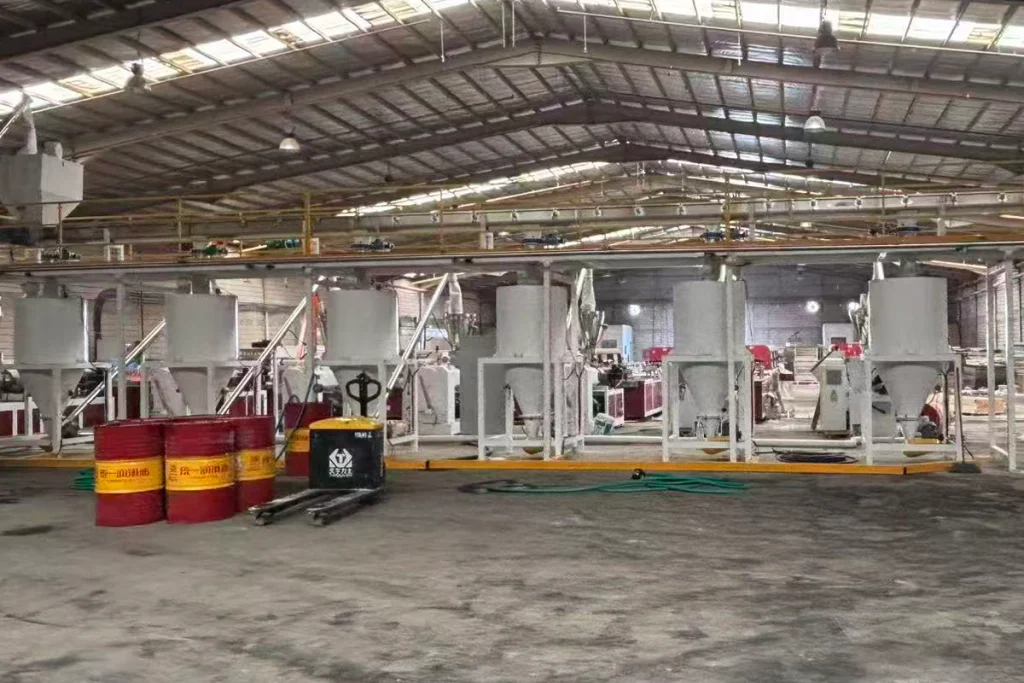
Once cooled, the dry blend travels to the extruder hoppers through an enclosed system — a TCA pipe chain conveyor or a central feeding system serving multiple machines. Enclosed conveying is non-negotiable in WPC: it keeps dust in (good for the environment) and moisture out (good for the product).
Stage 5 — Extrusion & Forming
Now the material becomes a profile. The profile extrusion production line integrates the full forming sequence:
- Extrusion — a twin-screw system (the norm for WPC) plasticises and pumps the compound. Segmented, intelligent temperature control keeps the melt uniform without scorching the wood fraction.
- Die / mould — a profile die shapes the melt. Multi-specification mould compatibility lets one line run decking, cladding, or trim by swapping dies.
- Calibration & cooling — the hot profile is sized and cooled in a calibrating tank, locking in dimensions and surface quality.
- Haul-off (traction) — a caterpillar or roller haul-off pulls the profile at a matched, constant speed.
- Cutting — an automatic cutter cuts to length; downstream, profiles may be embossed, brushed, or surface-treated for a wood grain finish.
A well-built line runs these as one continuous, automatic process — feeding in powder at one end, getting dimensionally stable profiles at the other.
Common WPC Defects — and What Usually Causes Them
| Symptom | Likely Cause |
|---|---|
| Bubbles / voids in profile | Moisture in the wood flour, or insufficient venting/devolatilisation on the extruder |
| Rough or blotchy surface | Poor dispersion — mixing time or temperature too low |
| Brittle profile, low strength | Wrong wood/resin ratio, or missing/insufficient coupling agent |
| Scorch marks / black specks | Overheating in the mixer or extruder; material hanging up inside the barrel |
| Die-line / surging output | Feed inconsistency; volumetric feeding instead of loss-in-weight |
| Warping after cooling | Uneven cooling or wrong haul-off speed |
Notice how many of these trace back to dosing and mixing — not the extruder. That is why the front end of the line deserves as much attention as the die head.
Formulation Pointers (Starting Points, Not Rules)
- Wood content: 30–60% is the common working range. More wood = more wood-like feel but harder to process.
- Coupling agent: essential for strength; without it the fibre and polymer don’t bond.
- Lubricant package: balances internal flow against surface release — the most common cause of processing trouble.
- Moisture control: dry the wood flour; WPC is unforgiving of wet feedstock.
Always confirm the final recipe against your own material tests and the equipment supplier’s recommendation.
Buying Checklist: What to Settle Before You Order
| Question | Why It Matters |
|---|---|
| Which matrix — PVC, PE or PP? | Changes screw design, temperatures, and additive package |
| Target wood content (%)? | Drives mixing time, lubrication, and tooling wear |
| Required output (kg/h)? | Sizes mixer, cooling mixer, conveyor, and extruder |
| Profile type & dimensions? | Sets die, calibration tank, and haul-off capacity |
| Feedstock form & moisture? | Determines whether you need drying |
| Level of automation? | Manual vs fully automatic dosing and conveying — the biggest cost lever |
| Layout & footprint? | Decides mechanical vs pneumatic conveying and machine arrangement |
| Dust & safety requirements? | Affects enclosure, filtration, and area classification |
FAQ
Q: What is the difference between a WPC profile line and a normal plastic profile line?
A: The extrusion hardware is similar, but a WPC line adds heavy emphasis on dosing accuracy, wood-flour drying, and thorough hot/cold mixing — because the wood fraction is dusty, moisture-sensitive, and hard to disperse. Feed the extruder an uneven WPC blend and no die will save the profile.
Q: Can I run WPC and regular PVC on the same line?
A: Often yes, with the right screw configuration and recipes. A PLC recipe system stores different formulations so you can switch products without rebuilding the line — one of the main reasons to automate dosing and mixing.
Q: Do I really need both a hot and a cold mixer?
A: For WPC, yes in practice. Hot mixing coats and gelates; immediate cold mixing stops the reaction and produces a stable dry blend. A combined hot/cold unit discharges directly between the two, avoiding cooling loss and manual transfer.
Q: Why does my WPC profile have bubbles?
A: Almost always moisture. Wood flour absorbs water, and any moisture flashes to steam in the barrel. Dry the feedstock, check your venting, and don’t skip the hot-mixing stage that drives off surface moisture.
Q: How many people does a WPC line need to run?
A: With automatic dosing, mixing, and conveying, a modern line runs continuous shifts with a small crew — often one operator per line — versus several people tied up in manual weighing and handling on a non-automated setup.
Q: What’s the typical layout of a WPC production line?
A: Big bag station → dosing/batching → SRL-Z hot/cold mixing unit → enclosed conveying → twin-screw profile extrusion line (extrusion, calibration, cooling, haul-off, cutting) → surface treatment and packing. Every stage is sized to match the one before it.
See It Applied
JIAJIALI has delivered an integrated WPC production line for the Middle East market, covering big bag unloading, dosing and batching, hot/cold mixing, conveying, and the WPC extrusion section as one system — see the 2026 Saudi Arabia WPC Production Line Project.
Planning a WPC profile production line? Tell JIAJIALI your matrix, wood content, target output, and profile type — we’ll specify the dosing, mixing, conveying, and extrusion equipment as a single integrated line. Explore Mixing Equipment and our Centralized Feeding & Conveying System, or contact us with your requirements.