
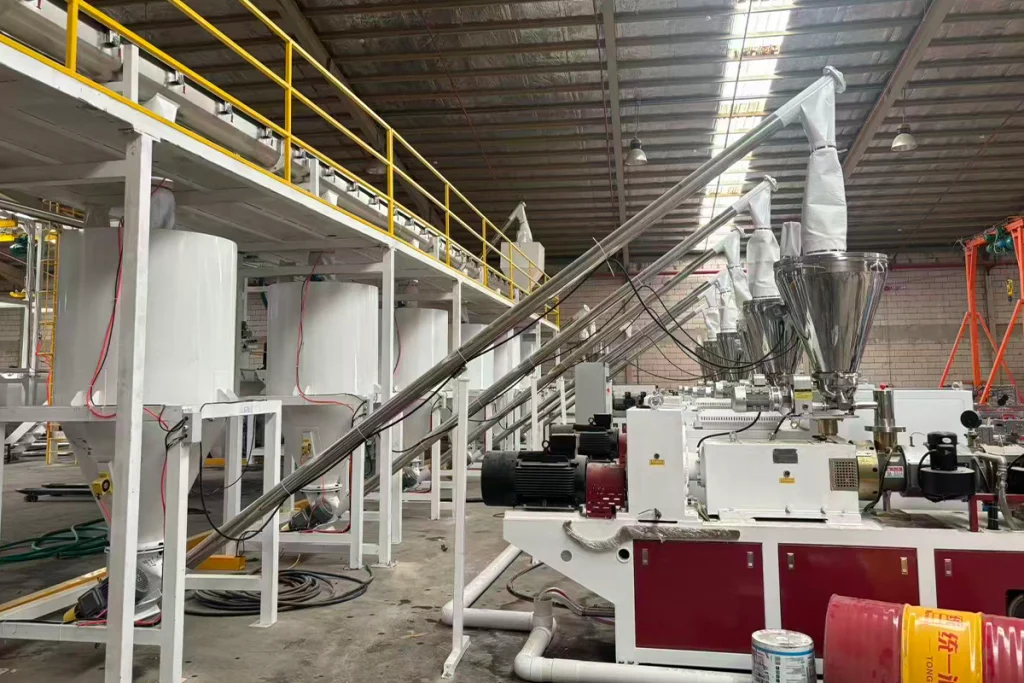
Plastic Extrusion Auxiliary Equipment is often overlooked because buyers spend most of their attention on the extruder. It is the biggest line item, it carries the screw design, and it is what the plant’s output is named after.
Then the line starts up, and the problems turn out to be everywhere else: material bridges in the hopper, the dryer cannot keep up in monsoon season, gauge drifts because the dosing is volumetric, the haul-off pulls the profile out of tolerance, and the granulator jams on start-up scrap.
That “everywhere else” is the auxiliary equipment — and in practice it decides whether a line runs at its rated output or at 70% of it. This is the complete list, grouped by what each machine actually does, so you can map it against your own process.
1. Material Handling: Getting Resin to the Throat
Hopper loader / vacuum automatic feeder. Draws pellets or powder from a container or silo into the machine hopper on demand. The basic single-machine unit is the vacuum automatic feeder; it removes the most common cause of short-shifts, which is somebody walking to the machine with a bag.
Central feeding system. One vacuum source and a manifold serving many machines from silos or day bins, with centralized conveying replacing bags on the floor. Worth it once you have more than roughly four to six machines in one hall, or when material must be kept clean and dry.
Pipe chain conveyor. A closed-loop mechanical conveyor for pellets, gentle on material and low on energy per tonne over longer horizontal runs. Compare it against pneumatic conveying before committing — the pipe chain vs pneumatic comparison covers where each wins.
Ton bag discharging station. Unloads FIBCs into the system without manual shovelling, usually with a dust extraction connection. Essential if you buy resin in 500–1000 kg bags rather than silos.
Silo and day bin. Storage, not transport — but it belongs on the list because the size of your day bin determines how often somebody has to intervene.
2. Drying and Conditioning
Hopper dryer. Heated, dehumidified air through a hopper mounted on the machine. Mandatory for hygroscopic resins — PA, PC, PET, ABS, PMMA — and commonly ignored for materials that only need it seasonally.
Dehumidifying dryer (desiccant). For engineering resins where surface drying is not enough; the dew point of the supply air matters more than the temperature.
LSH drying mixer. Combines drying and mixing in one vessel for powder and colour batches, useful where a separate dryer and mixer would not fit or would add a transfer step too many.
The sizing rule: dryers are specified on residence time at temperature, not on throughput alone. A dryer that matches the extruder’s kg/h but gives 40 minutes of residence where the material needs 2 hours is undersized.
3. Dosing, Metering and Blending
Volumetric doser. Cheap, simple, adequate for a single stable additive on a stable material.
Gravimetric / loss-in-weight feeder. Measures mass loss from a weighed hopper, so bulk density variation and regrind content stop changing the recipe. This is the standard upgrade when colour or additive consistency becomes a customer complaint; see the loss-in-weight feeding system and the metering and mixing system for multi-component work.
Automatic formula / batching machine. Weighs several components to a recipe and discharges a batch — the core of most compounding rooms. See the automatic formula machine.
Mixers. High-speed hot mixers for gelation and colour dispersion, horizontal ribbon mixers for large-volume dry blending, vertical mixers for smaller batches and frequent colour changes. Which one you need depends on whether the job is *dispersing* or merely *blending* — our guide to choosing a plastic mixer covers the decision.
4. Melt Filtration and Pressure Control
Screen changer. Manual or hydraulic, continuous or discontinuous. It catches contamination and gels, and it is the difference between selling pellets and selling scrap when you run regrind.
Melt pump. Delivers constant pressure and constant output independent of screw flutter. On profile, sheet and pelletizing lines it is often the single biggest gauge-consistency improvement available.
Static mixer. Low-cost thermal homogenisation between extruder and die.
None of these are optional extras on a line making a specification product; they are what makes the specification holdable hour after hour.
5. Downstream: Shaping, Cooling and Take-off
Vacuum sizing tank / calibrator. Sets the final dimensions of pipe and profile and holds them while the polymer cools.
Cooling tank or spray bath. Removes heat at a controlled rate so the part does not warp or sink.
Haul-off (caterpillar, belt or roller). Pulls at constant speed and, on profile lines, sets wall thickness along with screw speed. Haul-off stability is a common hidden cause of gauge variation.
Cutter / saw. Planetary or knife cutting for pipe and profile, with the cut quality matched to the downstream handling.
Winder or coiler. For filament, strap, tube and cable — the double-disc winding machine is a typical unit for filament lines.
6. Reclaim and Finishing
Granulator / crusher. Returns start-up scrap, edge trim and rejects to production. The plastic crusher is the entry-level unit; screen size and rotor design determine whether the regrind is reusable in-line or only sellable.
Pulverizer / milling machine. Grinds pellets or regrind to powder for rotomoulding, powder coating or PVC dry blend. See the plastic milling machine.
Automatic packaging machine. Weighs and bags the finished pellets or parts; often the difference between a plant that ships on time and one that does not.
Metal detector and dust extraction. Small, cheap, and the two items most often left out of a quotation until a customer audit puts them back in.
How to Choose Plastic Extrusion Auxiliary Equipment
The mistake is buying auxiliaries one at a time, as problems appear. A better sequence:
- Start from the material. Hygroscopic? Abrasive? Regrind-heavy? Powder or pellet? Each answer eliminates options before price enters the conversation.
- Size from the extruder’s real output, not its nameplate. Auxiliaries are typically specified at 110–120% of normal output, not of peak.
- Design the material path as one system. Silo → conveyor → dryer → doser → machine throat should have no manual step, no open bag, and no place where material can sit and absorb moisture.
- Match downstream speed control to the extruder. Independent uncontrolled haul-off is a gauge problem waiting to happen.
- Leave room for reclaim. Regrind handling is cheapest when designed in, most expensive when retrofitted.
- Check the utilities. Compressed air quality, chilled water capacity, and floor space for maintenance access are routine omissions that delay commissioning.
Common Buying Mistakes
- Buying the dryer after the defects appear. Drying is a process requirement, not a troubleshooting accessory.
- Volumetric dosing on a multi-component recipe. The cheapest component to buy is the most expensive to live with.
- Undersized conveying. A loader that just barely keeps up becomes the line’s pacemaker on every shift.
- No spare screen or rotor set. A crusher down for a wear part stops the reclaim loop and, often, the line.
- Mixing brands without checking interfaces. Controls, signal types and mechanical connections are where retrofits go wrong.
FAQ
Q: What counts as plastic extrusion auxiliary equipment?
A: Everything on the line except the extruder itself: feeding and conveying, drying, dosing and mixing, filtration and melt pressure control, downstream cooling/sizing/haul-off/cutting, and reclaim and packaging equipment.
Q: Which auxiliaries are essential and which are optional?
A: Essential for almost every line: feeding, drying (for hygroscopic material), dosing, cooling and haul-off. Optional but usually justified: central conveying, gravimetric dosing, melt pump, screen changer, automatic packaging. The split depends on product tolerance and volume, not on preference.
Q: How much of a line’s cost is auxiliary equipment?
A: Commonly 30–50% of the total line investment, and higher on profile, sheet and pelletizing lines where downstream equipment is substantial. It is also where most output losses originate, which is why it deserves proportional attention during specification.
Q: Can I add auxiliaries to an existing line later?
A: Yes, and most plants do. Feeding, drying and dosing retrofits are straightforward. Central conveying and melt filtration retrofits need more planning because they change the layout and the utilities.
Q: Does auxiliary equipment affect energy consumption much?
A: Dryers, chillers and vacuum conveying are the significant consumers. Gravimetric dosing and melt pumps usually save more energy than they consume by stabilizing output and reducing scrap.
Q: How do I choose between a vacuum feeder and a central feeding system?
A: One machine, one hopper: vacuum feeder. Multiple machines in one hall, shared material grades, or a cleanliness requirement: central system. The break-even is usually around four to six machines.
Building a new line or fixing an existing one? JIAJIALI supplies feeding, conveying, drying, dosing, mixing and reclaim equipment that is specified against your material and output rather than sold off a shelf. Start from the plastic auxiliary equipment range, or send your line layout and material list through contact us and we will map the auxiliaries to it.